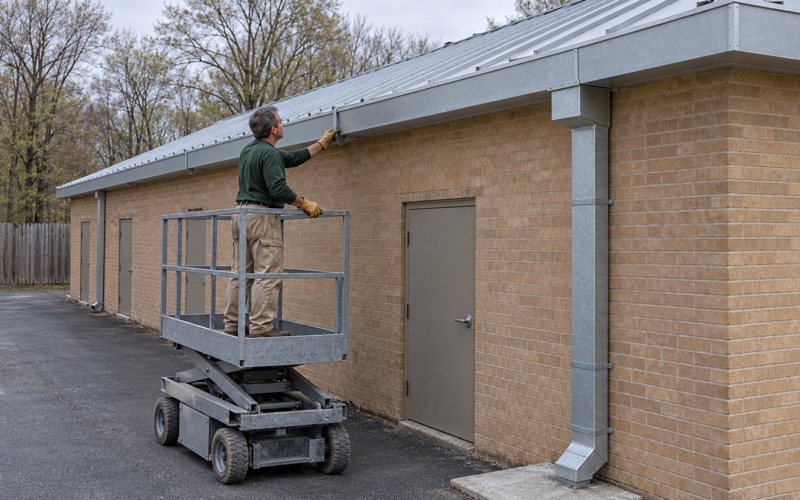
Middletown Quality Gutters installs, repairs and cleans gutters in Bound Brook with more than two decades of experience behind every estimate. We start each job with a question many crews skip: once water leaves the roof edge, where does it actually go? A gutter is only the first few feet of that path, and the rest of the route decides whether it protects the house or soaks the wall below.
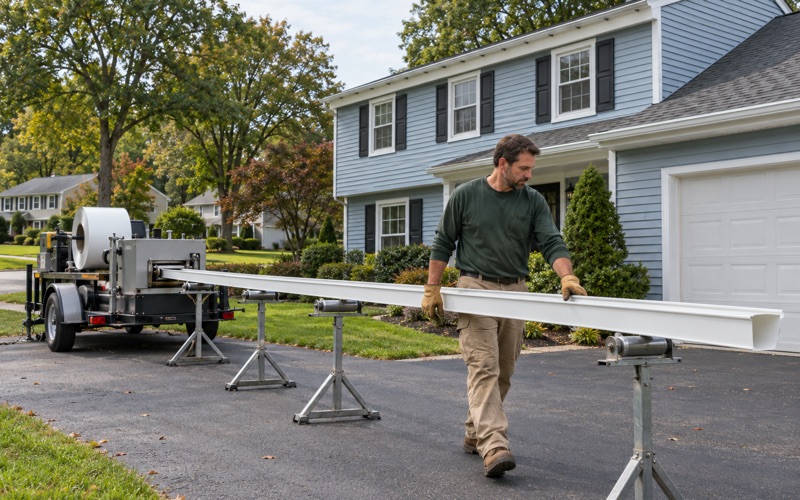
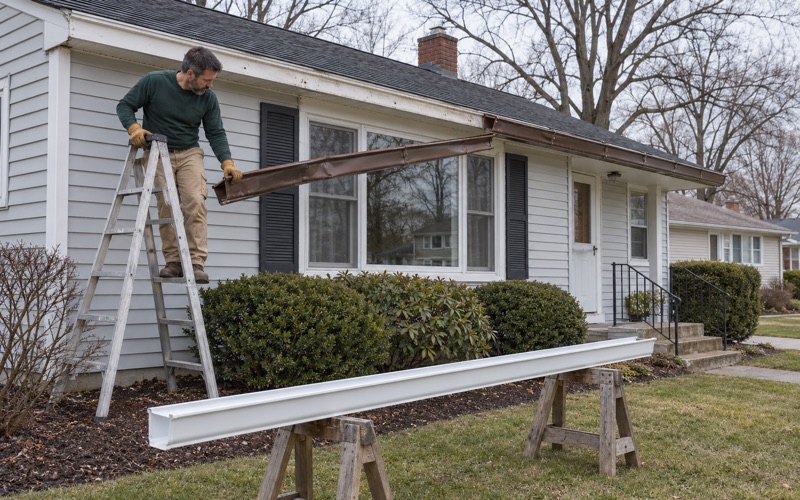
Our sizing starts from the roof, not from habit. We measure the area that drains to each run and pick the gutter and downspout to match, so a broad main roof is not handed the same trough as a small porch. The gutters themselves are formed on site from coil, one seamless piece for each run of the house, with no joints left to open later.
That approach matters more in this borough than in most towns we serve. Bound Brook drains in two directions at once: toward a river that is held back by engineered protection, and toward an interior system that has to carry rain the river cannot take. The sections below explain how that works and what it changes about your gutters, leaders and basement.
Gutters Behind the Levee in Bound Brook
A Borough Built Behind Levees and Floodwalls
Bound Brook sits along the Raritan River, which forms its southern edge, and since August 2016 its downtown has stood behind the Army Corps of Engineers Green Brook Flood Risk Management Project. WHYY reported the Bound Brook works as 8,500 feet of levees, two floodwalls and two pumping stations. The R2 levee on the southwest keeps the Raritan out of downtown, and closure gates span the NJ Transit tracks and the South Main Street underpass.
The Army Corps says the project is designed to provide flood protection up to a 150-year storm event. That changes the river’s role in a storm, but it does not change the rain’s. Water falling on roofs inside the line of protection still has to go somewhere, and the gutters and leaders on each house are the first piece of the system that decides where it goes.
Reading the Raritan Gauge
The National Weather Service tracks the Raritan River at Bound Brook on gauge BDKN4, which shares its site with USGS gauge 01403060. Action stage is 26 feet, minor flooding begins at 28 feet, moderate at 30 and major at 33. At 28 feet the weather service notes that backyards and low areas are protected by the levees and the flood wall, rather than flooding as they once would have.
Forecasts for the borough come from the NWS Mount Holly office, which places Bound Brook in forecast zone NJZ010, Somerset. On a day when a slow storm sits over the basin, those gauge readings show which stage of protection is in play. If your house sits low on the protected side, the gauge is worth watching alongside the condition of your gutters and leaders.
The 30-Foot Trigger for the Gates
At 30 feet the NWS impact statement reads that Main Street is protected by flap valves and sluice gates, and that this level triggers the gate closures. Flap valves let protected-side water drain out while the river is lower and swing shut as it rises. Once the gates close, the river and the town are separated, and the town has to manage its own water.
At 33 feet the weather service says a large portion of Bound Brook is protected by the flood reduction project, and that pump station operations become critical for the continued protection of the borough. That is the stage at which rain falling inside the levee can no longer simply run downhill to the river. From there it depends on the interior drainage system and the pumps.
Looking for gutters closer to New Providence? See Gutters Services in New Providence.
Where Roof Water Goes When the Gates Close
Interior Drainage on the Protected Side
The Army Corps describes an interior drainage system that includes pump stations, with interior drainage pipes that convey the water on the protected side to the pump stations. Rain that falls on yards, streets and roofs behind the levee is that protected-side water. While the gates are shut it cannot run out to the Raritan, so it collects and waits its turn at the pumps.
No source traces an individual leader into that system, and we will not pretend one does. The mechanism is plain enough without it. Water off a downtown roof lands on the protected side, and from there it soaks into the yard, runs across the lot toward a neighbor, or heads for the street drains. Where it lands first is the part an owner controls.
Leaders, Splash Blocks and Basements
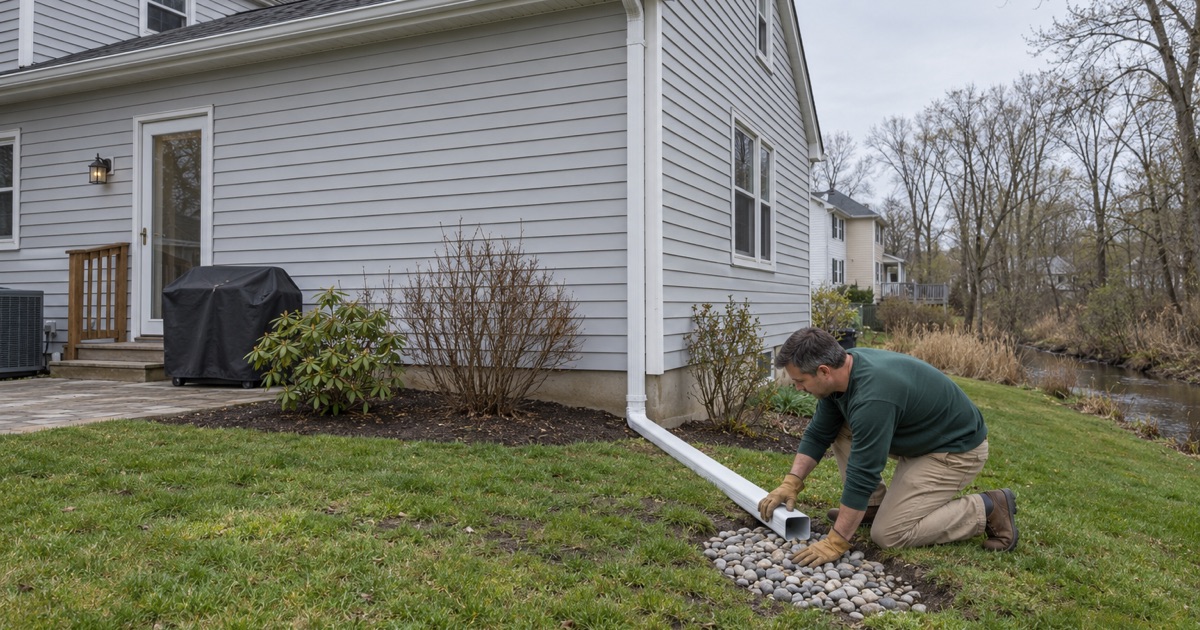
That is why we follow every downspout to the spot where its water ends up. A leader that empties onto a tipped splash block beside the foundation puts the whole roof’s runoff at the basement wall, and it does so during the same heavy rain that can have the river high. When a discharge sits against the house, we propose an extension, a pop-up drainage emitter or a drywell.
The New Jersey edition of the 2021 residential code, section R401.3, calls for the grade to fall 6 inches within the first 10 feet from the foundation. On a settled older lot, that slope is worth checking before any new leader goes in. Where the ground is flat, an underground downspout line carried out to a pop-up emitter moves the water away from the wall without dumping it beside the next house.
Drywells, Ground Water and the Sewer Line
Leader outlets are never tied into the sanitary sewer on our jobs, and every estimate states where each one will discharge. We found no Bound Brook rule on leader discharge, so this is our own practice rather than a borough requirement. A sewer line built for household flow is the wrong place for a roof’s worth of storm water, and the problem it creates rarely stays on one lot.
Where a drywell is the right answer, the state stormwater rule at New Jersey Administrative Code 7:8 keeps dry wells 2 feet above the seasonal high water table. In a borough along a river, that clearance cannot be assumed. We check the site before proposing one, and when the ground water sits too close we fall back to an emitter or a surface extension instead.
Ida, the Floodgate and the Buildings Behind It
When a Gate Could Not Close
Ida showed what happens when part of the system fails to close on time. The Raritan at Bound Brook stood at 35.8 feet at 3:15 a.m. on September 2, 2021, against a 28.0-foot flood stage. Three 23rd District legislators then sought an independent investigation after a stuck New Jersey Transit train blocked floodgates from closing, citing damage to homes and businesses without giving a count.
The river’s record is older still: Hurricane Floyd took the Raritan to 42.13 feet at Bound Brook on September 17, 1999. In July 2016 the Army Corps reported a change in flood insurance requirements, quoting Mayor Robert Fazen that approximately 500 properties would no longer be required to pay flood insurance. We cannot say which properties those are, and a lighter premium does not change where your roof water goes.
Older Two- to Four-Unit Buildings
Bound Brook is a town of small rental buildings. Census survey figures for 2024 show 55.2 percent of occupied units as renter-occupied and 1,275 units in two- to four-unit buildings, and 458 of 468 occupied units in three- and four-unit buildings are rented. The stock is old as well: 27.6 percent of the borough’s housing was built 1939 or earlier, and 39.5 percent before 1950.
Older two- and three-family houses can carry several roof levels and porch roofs that empty into one another, and each run needs its own sizing rather than a single size for the whole building. Where a prewar house calls for it, we match copper or half-round work to its age and style, down to the double-bead profile and the 16-ounce copper that weathers to a patina.
Who Is Responsible for the Gutters
A building with three or more units is a multiple dwelling, registered with the NJ DCA Bureau of Housing Inspection and inspected on a five-year cycle under New Jersey Administrative Code 5:10. The maintenance standard there expects leaders and drainpipes to be securely fastened, free of leaks and obstructions, and to direct storm water away from the foundation walls.
Owners are the ones responsible for registering those buildings, so when a tenant calls us we point them toward the owner. When a unit sits in a condominium or association, we check the master deed or the management office first so everyone knows who is responsible for the gutters. Before-and-after photos give the owner a record of the work to keep with the building’s file.
Gutter Service Across Bound Brook
Fascia, Hangers and Flashing
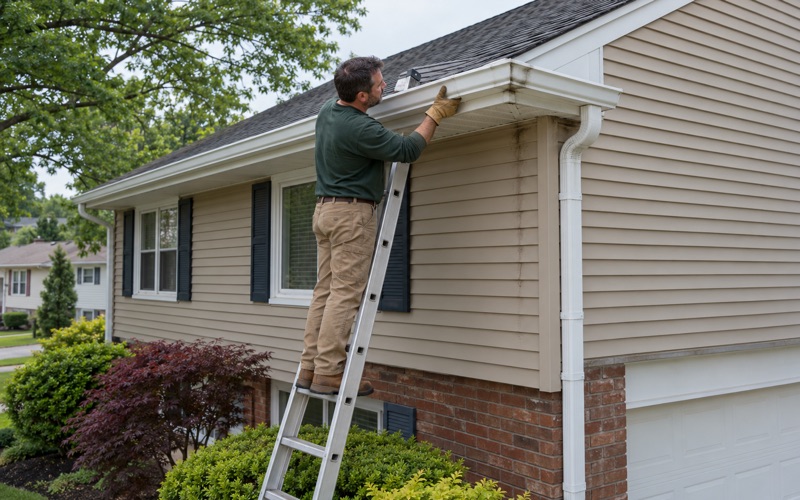
Before new gutters go up, we check the fascia board behind them for rot, and any soft wood is shown to the owner before it is replaced. On a house that has overflowed for years, that board is often where the damage shows first. We hang the new runs on hidden hangers rather than spike and ferrule fastening, which loosens as the wood around each spike gives way.
Gutter apron or drip edge carries roof water into the trough instead of letting it run behind, and kickout flashing goes wherever a roof edge meets a sidewall. On a broad main roof that often means 6-inch K-style gutters with 3x4 downspouts, formed from .032 aluminum coil. Corners get box or strip miters and bay miters where the wall angles, with A and B elbows set to the wall.
Trees, Storms and Guards
Wind-damage reports logged at Bound Brook by the Mount Holly office include October 16, 2021 and July 31, 2025, while hail recorded there since 2010 has been half an inch or smaller. For gutters, that points toward limbs, leaves and twigs in the troughs more than dents from hail. A clogged outlet during a long storm sends water over the front edge and straight down to the foundation.
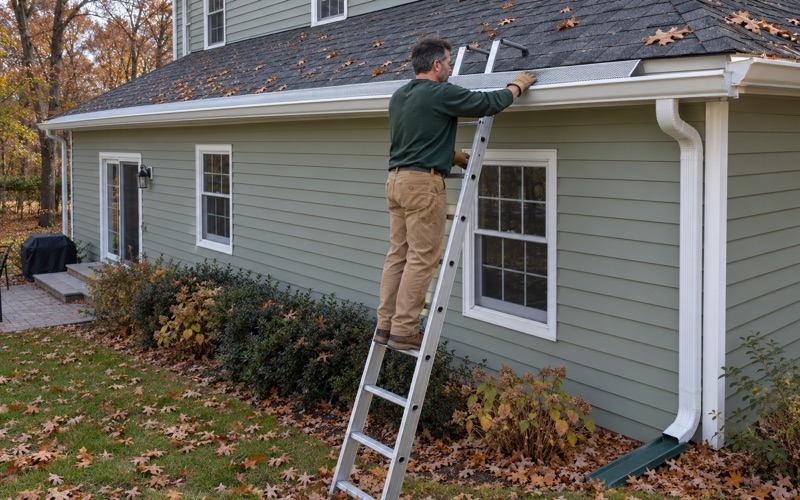
Guards are matched to the trees over each lot. Pine needles slip through a coarse screen that handles oak leaves well, so we look up before recommending stainless steel micro-mesh or a heavier screen. A guard that suits the canopy keeps the wide-flange outlets open during the heavy rains that matter most on the protected side of the levee.
Cleaning and Repair Visits
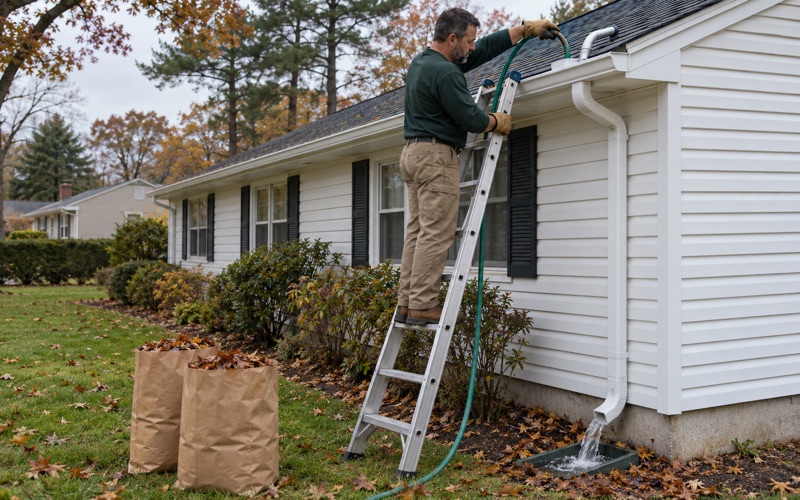
Our cleaning visits flush every downspout and bag the debris, so nothing is left on the lawn or at the curb. Repairs cover leaking seams resealed with tripolymer gutter sealant, loose or missing hangers, sagging runs and outlets that no longer line up with their leaders. Larger projects can raise their own questions for the Bound Brook Building Department at Borough Hall, 230 Hamilton Street.
Every cleaning and repair comes with before-and-after photos, so you can see the work without climbing a ladder. In Bound Brook the river is held back by levees, gates and pumps that the borough and the Army Corps maintain. The water that stays inside is the part each owner can manage, and it starts at the gutter and ends wherever the leader sends it.
- 20+ Years on Gutters
- Seamless, Formed On Site
- Before-and-After Photos