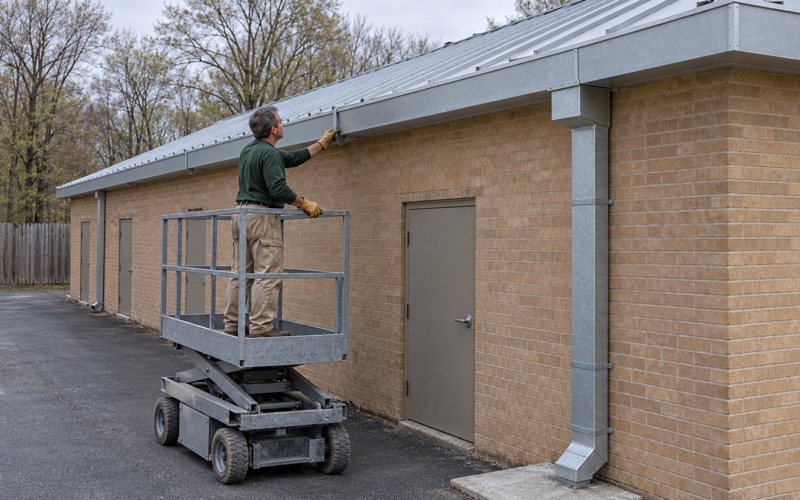
Middletown Quality Gutters has spent more than 20 years on gutters, and in Chatham Township the question we hear most is not about color or profile. It is about where the water goes once it leaves the downspout. On many lots the honest answer runs underground, into a drywell that someone has to keep working long after the installer has gone home.
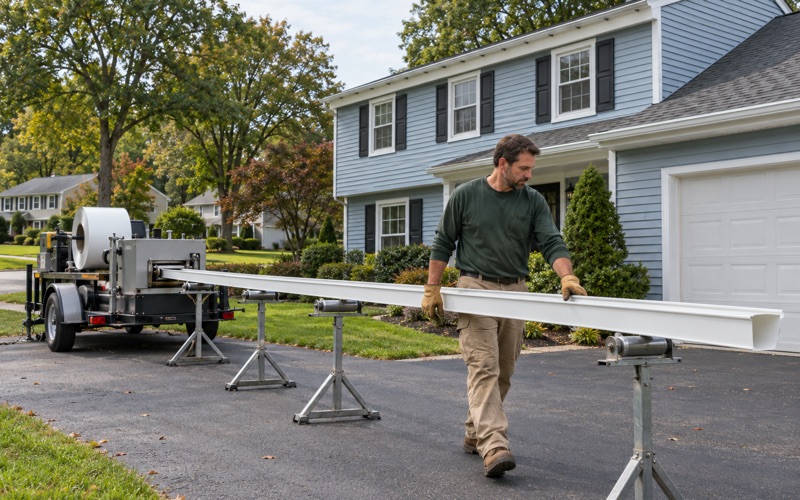
That changes how we plan and price a job. We size every gutter and leader for the roof area that actually drains into it, form seamless runs on site from coil, and follow each downspout to its outlet before we write the estimate. If an outlet dumps water against the foundation, we propose an extension, a pop-up emitter or a drywell connection.
This page covers the local side of that work: the stormwater overlay that shapes how newer lots handle roof water, the groundwater that limits it, the drywell upkeep that falls to owners, and the townhome communities where an association may own the gutters. None of it replaces a visit to your house, but it explains the questions we ask on the first one.
Where Chatham Township Roof Water Is Supposed to Go
The Great Swamp Watershed Overlay District
Part of Chatham Township lies inside the Great Swamp Watershed Overlay District, set out in Township Code Section 30-83.2. As the Township Engineer quoted it in a July 2024 review, development and redevelopment in that portion of the township must infiltrate the design storm on site rather than send it downstream. The quoted text says the requirement applies equally to every such application.
We want to be precise about what that means for a homeowner. The overlay governs applications for development and redevelopment, such as a new house or a subdivision. As we read the quoted text, swapping old gutters for new ones on an existing house is not that kind of application, and we will not tell you a replacement pulls you into stormwater review. Where the overlay matters to us is on lots built or rebuilt under it.
Why Roof Leaders End Up in a Drywell
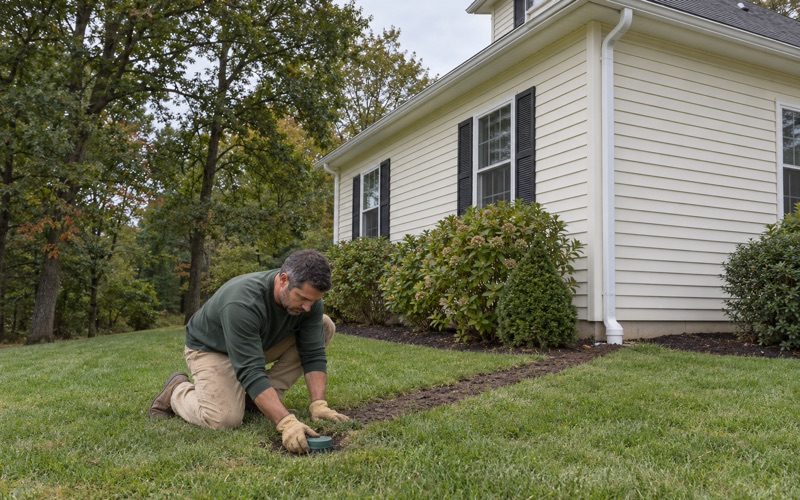
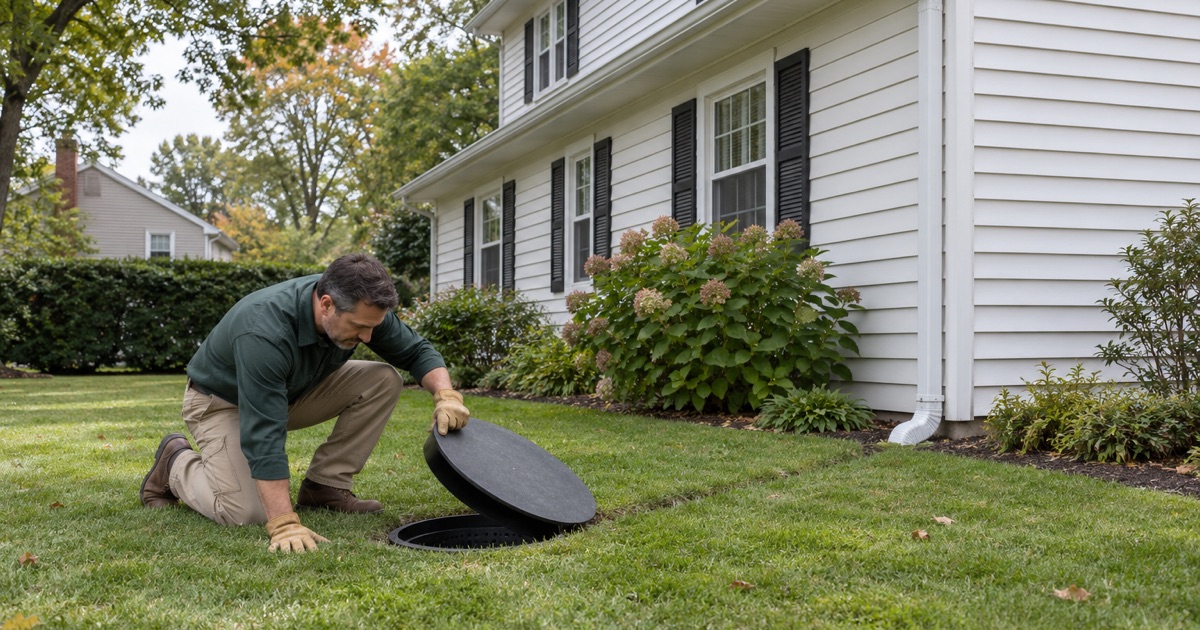
On a house lot, the practical way to infiltrate roof water is to pipe the leaders into a drywell, a buried chamber that holds runoff and lets it soak back into the soil. On those lots the gutters and downspouts are the front end of the stormwater system the board approved, not just trim along the eaves.
That is why we treat a downspout on a drywell lot differently from one that spills onto a splash block. The outlet location, the size of the leader and the tightness of the underground connection all decide whether the drywell receives the water it was designed for, or whether part of that water spills across the yard first.
Leader Sizing Under Township Engineer Review
How roof water is handled on a new lot here is reviewed in public. At a May 2025 Planning Board hearing on a two-lot subdivision at 23 Cedar Lane, the applicant’s engineer testified that the drywells would hold 661 and 464 cubic feet and that the roof leaders would be sized for the projected flow. Those calculations were subject to review and approval by the Township Engineer.
A neighbor at that hearing asked specifically about the gutters, and the answer was that roof pitch does not affect the drywells, because only the footprint counts toward roof area. We apply the same logic when we replace gutters on a house like that. We measure the footprint each run drains, pick the gutter and downspout size to match, and keep the outlets where the approved plan put them.
Looking for gutters closer to South River? See South River Gutters.
Gutters, Leaders and the Ground Underneath
When High Groundwater Rules Out Infiltration
A drywell only works when the soil below it can take water. The Township Engineer’s July 2024 review of a lot on Southern Boulevard, which has freshwater wetlands at the rear, records a design waiver from Section 30-83.2 because of the observed presence of high groundwater on site. The engineer took no exception to waiving the soil and drainage calculations given those conditions, and the code points such lots toward off-site mitigation instead.
New Jersey’s stormwater rule sets a 2-foot minimum separation between the bottom of a drywell and the seasonal high water table. Where the water table sits close to the surface, a drywell fills from below and has no room left for the roof. On those lots we talk through surface options, such as extensions and discharge points away from the house, rather than burying a chamber that will not drain.
Matching the Outlet to the Lot
Because conditions underground vary from one lot to the next, we do not carry a single answer from house to house. On a lot with an existing drywell, we confirm it is draining before we tie new leaders into it. On a lot without one, we look at where the water lands now and propose the simplest outlet that keeps it off the foundation.
Every estimate names where each leader will discharge, and none of them will be tied into the sanitary sewer. That line matters here more than most places, because a misplaced outlet on a drywell lot can undo a system that someone paid to design and the board reviewed before the house was built.
Seamless Runs That Feed the System Cleanly
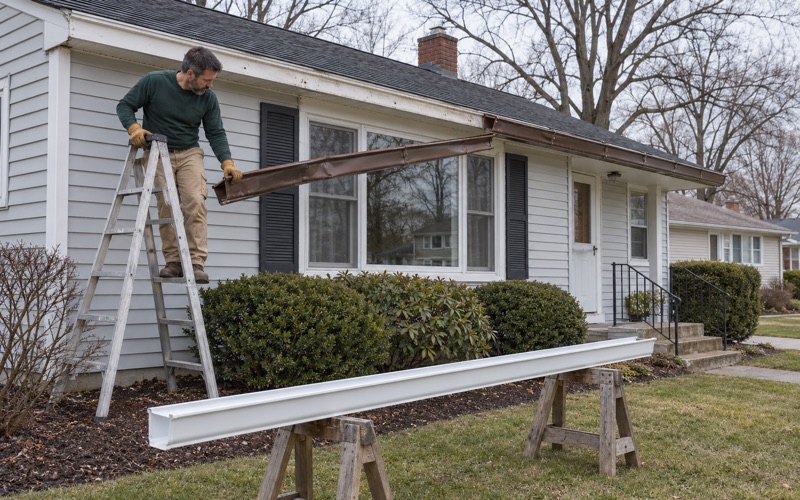
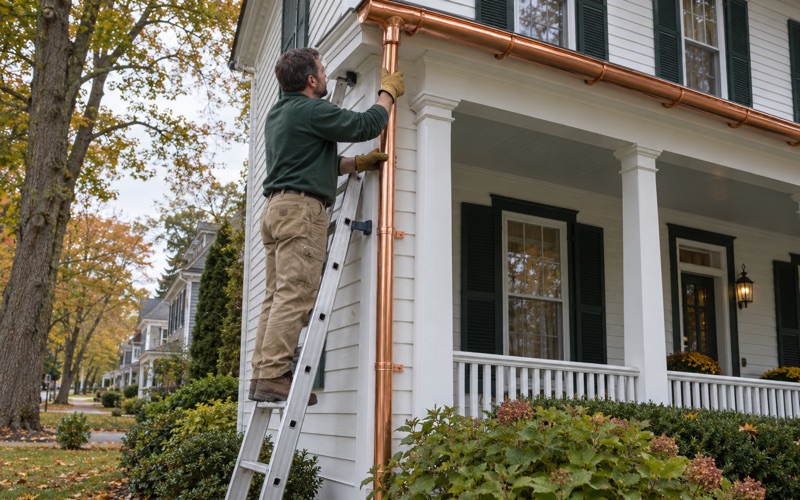
Seams are where gutters leak, and a leak at a seam drops water at the eave instead of sending it to the outlet. We form seamless runs on site from .032 aluminum coil, one piece per run, and hang them on hidden hangers pitched toward the outlets. On older houses, copper or half-round profiles can be matched to the age and style of the home.
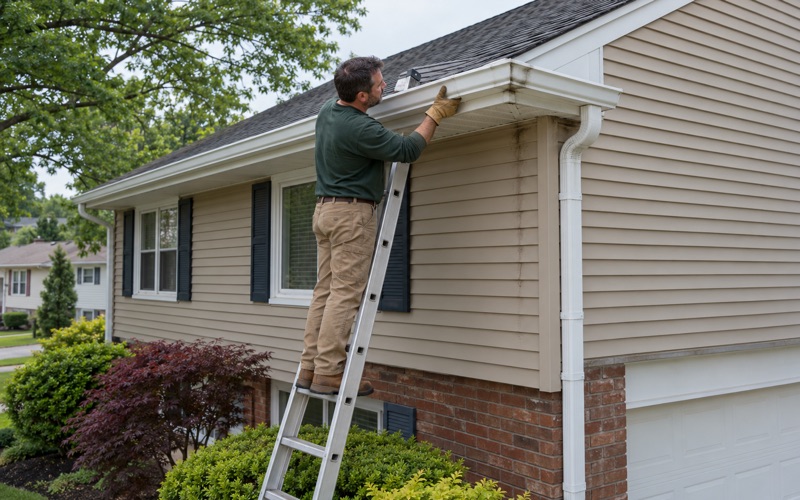
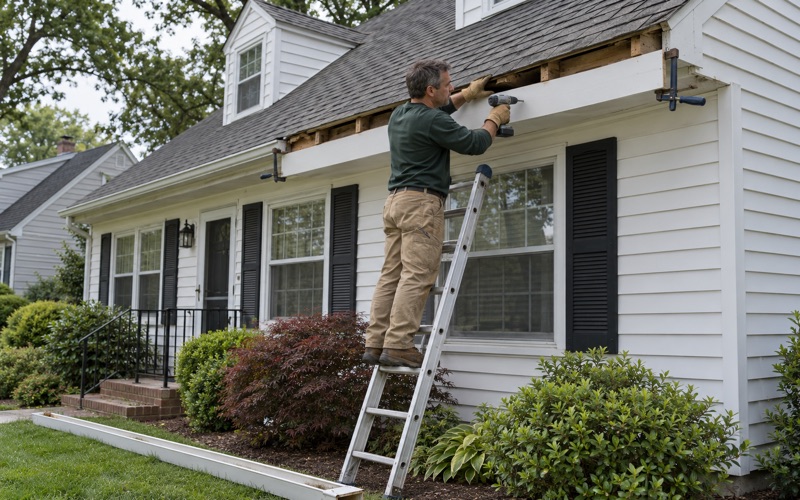
Before a new gutter goes up, we check the fascia board behind it for rot, and any soft wood is shown to the owner before we replace it. Hanging a new run on a failing board only moves the leak a few feet. With 291 homes here dating to 1939 or earlier and many more from the postwar decades, we see fascia in every condition.
Keeping a Drywell Working
Leaves, Grit and the Downspout
A drywell is only as good as what goes into it. Leaves, roof grit and needles that wash down a downspout do not leave on their own; they settle in the chamber and slowly take away the volume it was built to hold. The Cedar Lane testimony described roof runoff as clean by the DEP’s standard, and clear gutters are part of what keeps it that way.
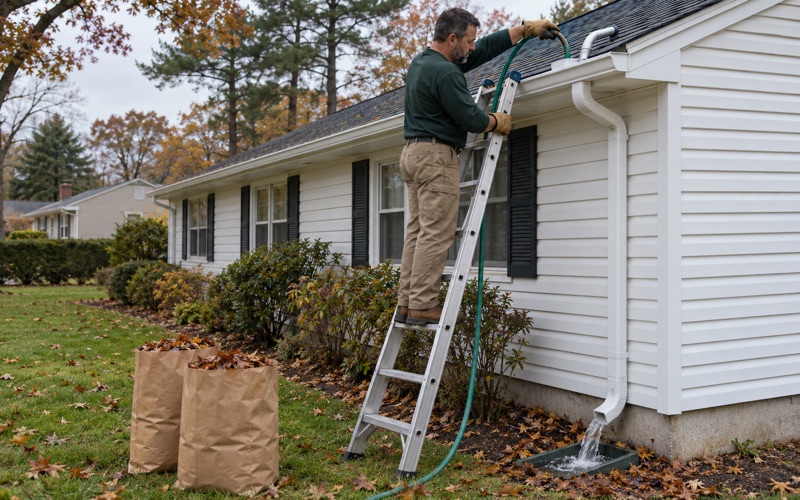
Our cleaning visits flush every downspout after the troughs are cleared, so nothing loose sits in the leader waiting for the next storm. Debris is bagged and taken away rather than left on the lawn or at the curb, and every visit ends with before-and-after photos you can keep alongside your drywell paperwork.
Guards Chosen for the Trees on the Lot
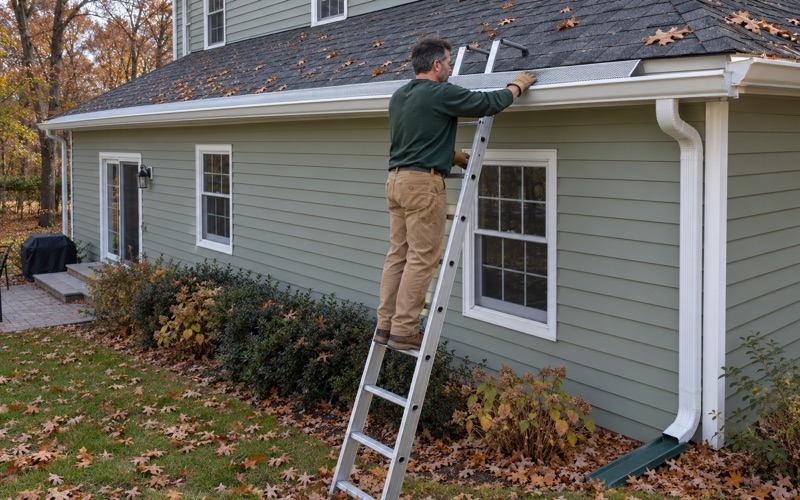
Chatham Township borders the Great Swamp National Wildlife Refuge at Green Village. On a drywell lot a gutter guard does double duty, keeping the trough flowing and keeping debris out of the chamber below. We match the guard to the trees over your roof, because pine needles slip through screens that stop oak leaves, and stainless steel micro-mesh handles needles that a coarser screen lets pass.
If a tree over the gutters needs to come down instead, check with the township first. Its land development permit request says removing a tree with a diameter of 12 inches or more, measured at four and a half feet, requires a tree removal permit. We clean and guard around trees; we do not take them down.
Who Inspects the Drywell
Drywell upkeep sits with the owner, not the township. At the May 2025 hearing, the Township Engineer said the township has no program to inspect every drywell, that inspections usually happen on request, and that warnings and summonses can be issued when drywells are not maintained. The board attorney added that an operations manual is usually recorded in the County Clerk’s office.
On that application, the applicant’s engineer said the homeowner would submit evidence each year that the maintenance schedule was being followed. That was one engineer’s testimony about one subdivision, not a township-wide ordinance, but it shows what the board expects to see. Dated photos from regular cleanings are an easy way to keep that kind of record.
Overflow, Swales and Chatham Glen Townhomes
Pop-Up Emitters for the Storm Beyond the Design
No drywell holds every storm. The Cedar Lane testimony said that in a storm beyond the design, the water would overflow through pop-up emitters into the street. That makes the emitter a working part of the system, so we check that its lid lifts freely and that grass or mulch has not sealed it shut.
Where a downspout drains to the surface instead, we aim to send it toward ground that slopes away from the house and away from a neighbor’s yard. An extension, or a pop-up emitter at the end of an underground line, is often enough to stop water from pooling against the foundation.
The Four Backyard Swales on Record
The township’s own hazard planning names drainage problems behind homes. Its annex to the Morris County Hazard Mitigation Plan lists backyard swales on Candace Lane, Runnymede Road, Susan Drive and Sunset Drive as not at sufficient capacity, and the 2025 annex lists drainage studies for all four as not started. The annex does not give a cause.
The same annex cites flooding from Loantaka Brook in the Green Village and Britten Road area, and Black Brook flooding regularly near several houses where it crosses Green Village Road. On lots along those streets and stretches, we pay close attention to where each outlet sends its water and talk it through with the owner before we move one.
Gutter Work in Chatham Glen
About a quarter of the township’s homes are attached or in small multi-unit buildings, most of them in Chatham Glen. Its four sections, Briarwood, Heritage Green, Coachlight and Sutton Woods, were built from 1984 to 1994, and each is managed by its own condominium association.
Who owns the gutters on a Chatham Glen unit depends on that association’s documents, and we do not assume an answer for any of them. Before we quote, we check the master deed or ask the management office, so you know whether the work is yours to order or the association’s to schedule. Estimates list new gutters and repairs on separate lines, since New Jersey taxes them differently.
- 20+ Years on Gutters
- Seamless, Formed On Site
- Before-and-After Photos