
Middletown Quality Gutters handles downspout installation in Middletown Township, NJ, serving surrounding cities including Red Bank, Holmdel, Eatontown, Aberdeen and Tinton Falls. For more than 20 years we have treated the downspout as the half of the gutter system that decides where roof water ends up. A gutter can be perfect and still flood a basement if its downspout empties in the wrong place.
That is why we follow every downspout to the spot where its water lands. Where it lands against the foundation, onto a walkway or toward a neighbor, we propose an extension, an underground line to a pop-up emitter, or a drywell. The estimate names the discharge point for every leader on the house.
We install downspouts with new gutters, add them to existing systems that need more outlets, and replace crushed or undersized ones. Each run is sized for the roof area above it and tested with running water before we leave.
Downspout Sizes, Shapes and Placement
Sizing Downspouts to the Roof
A downspout has to carry everything the gutter collects, and on a large roof that can be more water than a standard downspout handles in a hard storm. We measure the roof area draining to each outlet and choose standard or oversized 3x4 downspouts to match. Oversized downspouts also clog less, since leaves pass through more easily.
On a long run, adding a second downspout often works better than enlarging one. Splitting the run shortens the distance water travels in the gutter and halves the load on each outlet. We weigh both options when we lay out the system.
Placing Outlets Where They Work
Where a downspout goes matters as much as its size. An outlet behind a large shrub is hard to maintain, one by a door sends water across the step, and one at a low corner of the yard may put water where it already collects. We place outlets where the water can be led away from the house.
Wide-flange outlets cut into the gutter bottom let water drop into the downspout quickly, reducing backup at the outlet during heavy rain. We seal each outlet to the gutter so it does not become a leak point.
Round Downspouts for Half-Round and Copper Gutters
Half-round gutters are usually paired with round downspouts, which suit older and period houses better than rectangular ones. On copper systems, the downspouts are copper too, fastened with matching brackets. We match the downspout style to the gutter and the house.
In Middletown’s historic districts, where exterior work goes to the Landmarks Commission, these details carry weight. Round copper downspouts on a period house look the way the house was meant to.
Where the Water Goes
Extensions and Splash Blocks
The simplest way to move water off the foundation is an extension pipe or splash block at the bottom of the downspout. The New Jersey edition of the 2021 International Residential Code, section R401.3, calls for the ground to fall 6 inches within the first 10 feet from the foundation. An extension that carries water past that slope lets the grade do the rest.
Extensions are inexpensive and easy to fix, but they get knocked loose by mowers and kicked aside. Hinged and flip-up extensions solve some of that. Where an extension would cross a walkway or drive, we look at an underground line instead.
Underground Lines and Pop-Up Emitters
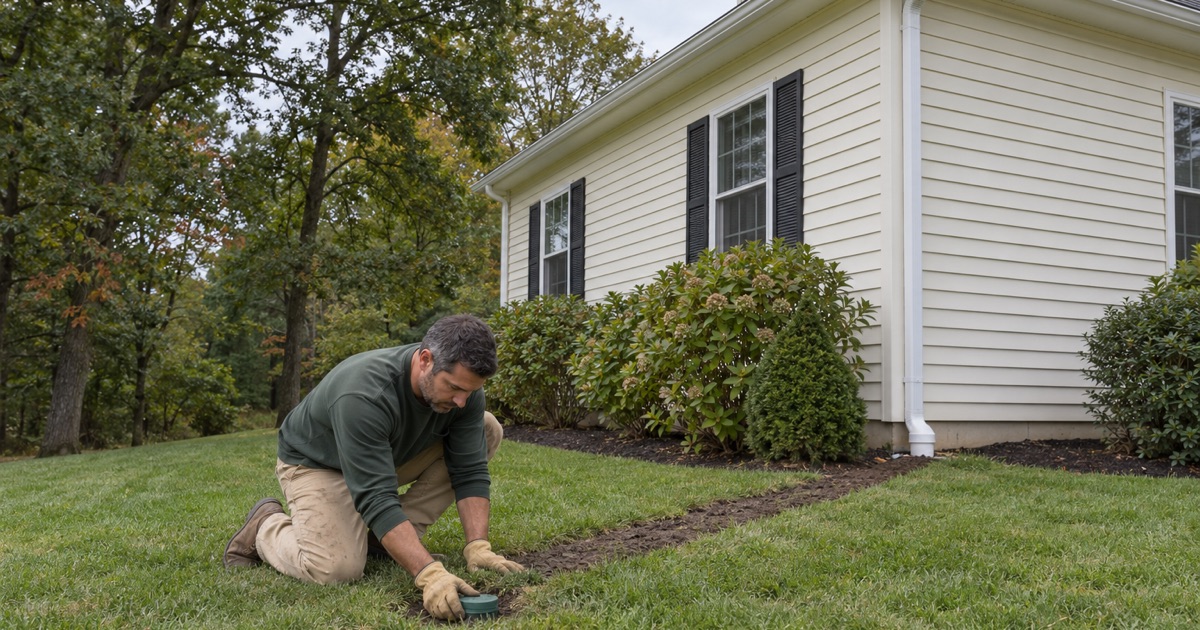
An underground line carries downspout water through buried pipe to a discharge point well away from the house. We use smooth-wall pipe, which clogs less than corrugated pipe and is easier to flush, laid with steady fall so water does not sit in it. The line ends at a pop-up emitter at the lawn, a curb outlet or a drywell.
A pop-up emitter lifts open when water flows and closes when it stops, keeping the yard clear of pipes. We place emitters where the water can spread and soak in without running back toward the house or onto a neighbor’s lot. Each line is tested before backfilling.
Drywells
A drywell is a buried chamber that holds roof water and lets it seep into the surrounding soil. New Jersey’s stormwater rule requires a dry well to sit 2 feet above the seasonal high water table, so they do not work on every lot, especially low ground near the bay. We check the soil and site before recommending one.
Where a Middletown project requires a grading plan, the township requires roof leaders piped to a drywell sized at 1.25 inches times the net increased impervious area. The finished work appears on an as-built survey with a drywell certification. We build drywells to those numbers so the system passes review and holds the water it was designed for.
Rules and Neighbors
Never Into the Sanitary Sewer
Roof water does not belong in the sanitary sewer, and we never connect a leader to one. Middletown’s own sump pump permit forbids sump connections to the sanitary sewer, and that permit covers only sump discharge pipes, not downspouts tied into street inlets. Roof water stays on your property and soaks in.
On older houses we sometimes find downspouts that disappear into the ground with no clear outlet. We trace where they go before deciding what to do. If a line cannot be traced or ends somewhere it should not, we reroute it.
Keeping Water Off Neighbors and Walkways
Moving water away from your foundation should not mean sending it into a neighbor’s yard or across a public sidewalk where it can freeze. We look at the slope of the whole lot before choosing where a downspout discharges. On tight lots, an underground line to a drywell is often the answer.
Walkways, driveways and steps get the same attention. A downspout that empties onto pavement creates puddles in summer and ice in winter. We redirect those outlets to lawn or planting areas that can absorb the water.
Fittings That Keep Downspouts Working
Elbows, Straps and Clean-Outs
Downspouts change direction at the eave and at the ground, using A and B elbows that turn front-to-back or side-to-side. Each bend is a place where leaves and grit can lodge. We use as few bends as the route allows and fasten each section with straps so the run stays tight to the wall.
Where a downspout feeds an underground line, a clean-out or leaf trap at the connection makes it easy to clear debris before it reaches the buried pipe. That small fitting saves digging up a clogged line later. Every downspout we install is flushed and tested before we finish.
- 20+ Years on Gutters
- Seamless, Formed On Site
- Before-and-After Photos