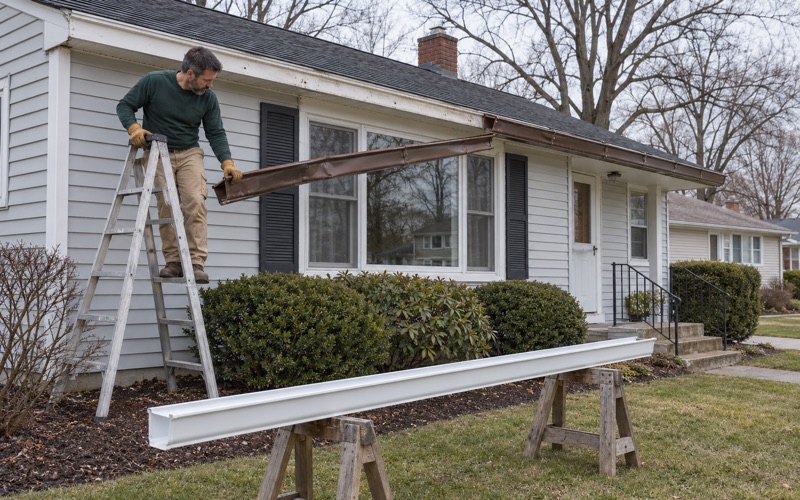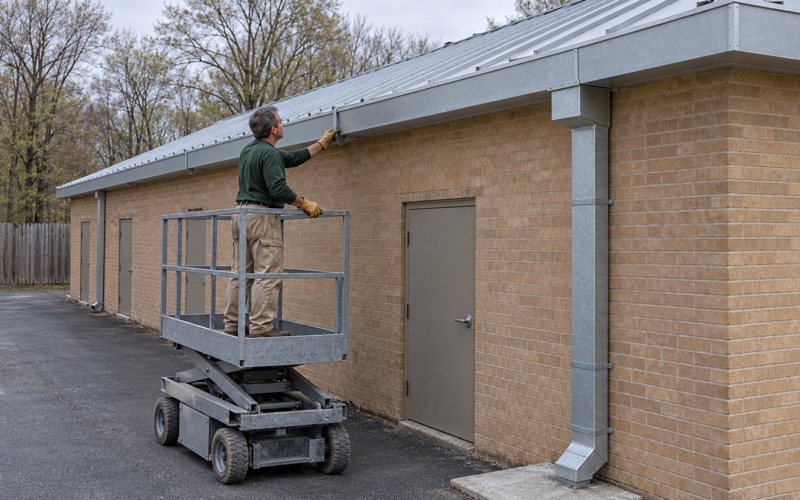
Middletown Quality Gutters brings more than 20 years of work to gutters in East Rutherford, and the job here starts with a question many towns never have to ask: where does the roof water go after it leaves the leader? We answer that before we talk about color or profile, and we size each gutter and downspout to the roof area that actually drains into that run, not to a habit carried over from the last house.
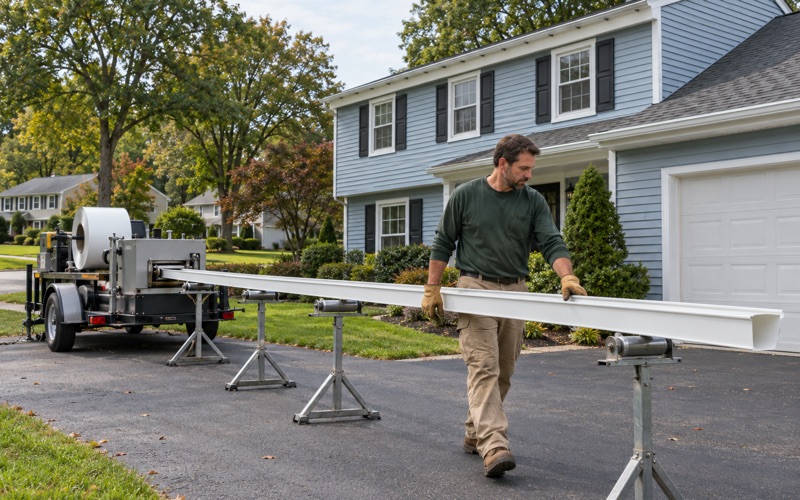
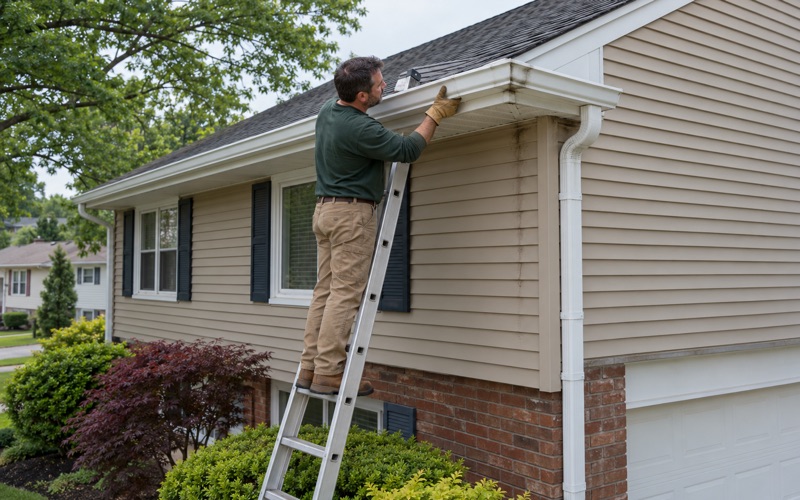
Our seamless gutters are formed from coil on site, one continuous piece for each run of the building, so the only joints left are the corners and the outlets. Before anything new is hung, we check the fascia board behind the old gutter for rot. If we find soft wood, we show it to the owner first and replace it only after they have seen it for themselves.
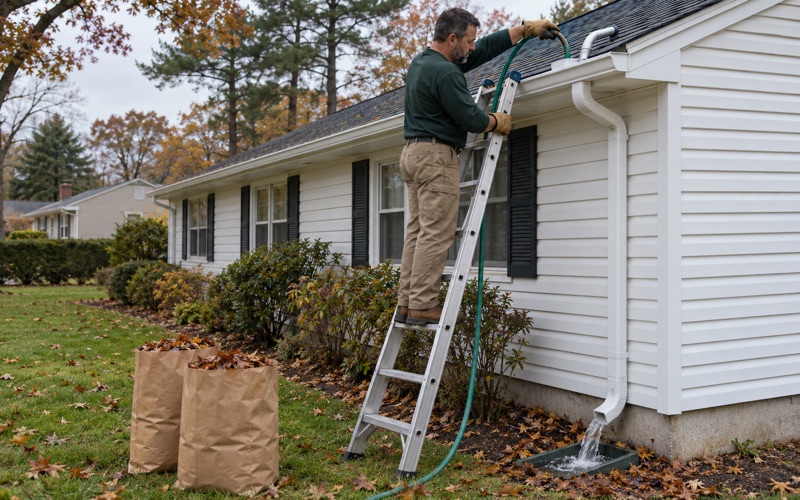
Cleaning visits end with every downspout flushed and the debris bagged and hauled away, so nothing is left on the lawn or piled at the curb beside a storm drain. Each cleaning and each repair comes with before-and-after photos, which matters when the person paying for the work lives upstairs, downstairs or across town from the building we were on.
Why East Rutherford’s Storm Drains Answer to the Tide
Berry’s Creek and the tide gates
Much of East Rutherford’s low ground drains toward tidal water. Berry’s Creek, largely a tidal estuary that forms the western boundary of the Meadowlands Sports Complex, and the Hackensack River on the borough’s eastern edge both rise and fall with the tide. The drainage behind them leaves through tide gates, which close against a rising tide and open again as the water drops.
The NJSEA Meadowlands Research and Restoration Institute lists ‘East Rutherford - Berrys Creek’ first among the eight tide gates in its sensor network. Those sensors read water levels on the landside and riverside of each gate every 15 minutes, a network built to predict storm-surge flooding across the 14 Hackensack Meadowlands District towns. East Rutherford is one of those towns, which is why its drainage is watched this closely.
What a closed gate means for a leader at the curb
When a high tide holds a gate shut, the storm drains on the land side have nowhere to empty. A leader piped to the curb, or dumped onto a driveway that slopes to the street, sends roof water into a system that is already waiting on the tide. That water then sits in the street instead of moving away, and a heavy rain can stack more on top of it.
The institute’s East Rutherford flood map, built from 2022 LiDAR with heights banded from 0 to above 8.0 feet, carries a layer labeled ‘Potential Predicted Flooding in Absence of Tide Gate.’ We have not read which streets fall inside each band. We treat the map as a reason to ask careful questions about a property, not as an answer about any one address.
Route 17 and the Meadowlands edge
On the zoning map, Route 17 is where the borough’s neighborhoods meet the Meadowlands District. The NJSEA’s July 2015 map draws the District boundary along the highway, with every residential zone west of it and Environmental Conservation land along Berry’s Creek and the Hackensack River to the east. Most of the gutters we work on sit on the residential side, yet storm water from those streets still has to reach tidal water.
A gate that fails shows up as road flooding. In 2006 The Record reported that six of the District’s 34 tide gates did not work, including the Rutherford gates, where only one of five could open and close. Those gates were blamed almost every time the southern stretch of Route 17 flooded. The Meadowlands Commission planned to rebuild them, and we have not read their current condition.
Looking for gutters closer to Rutherford? See Gutters Services in Rutherford.
Where Your Leaders Should Discharge on Low Ground
Away from the foundation first
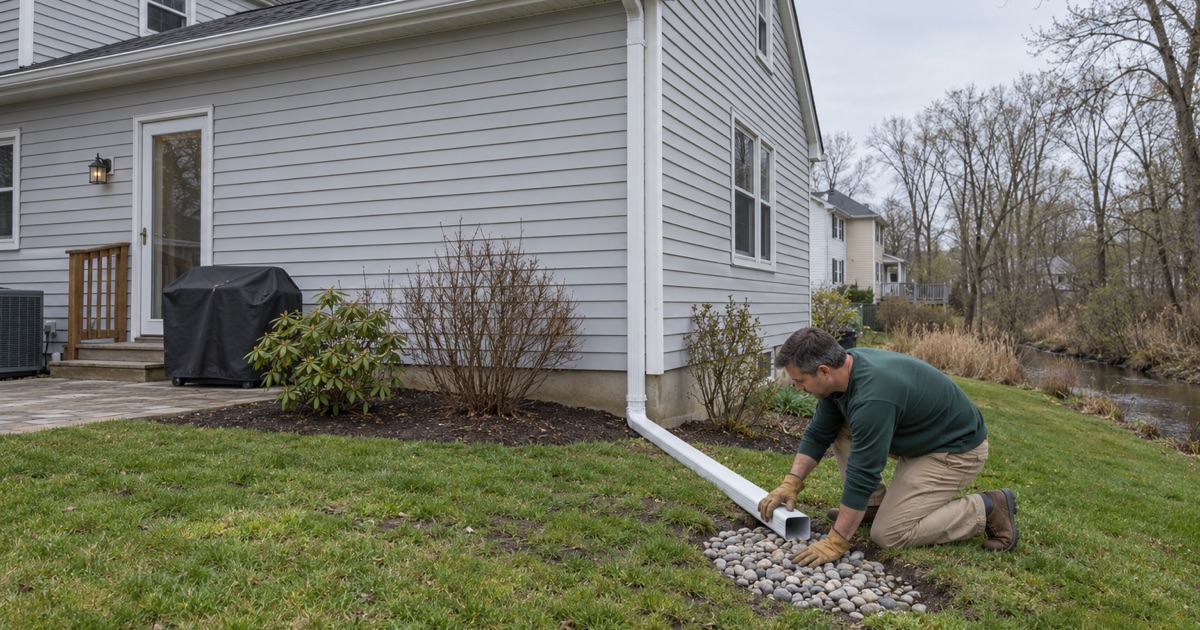
We follow every downspout to the spot where its water lands. When it lands against the foundation, we propose an extension, a pop-up emitter or a drywell, and the estimate states where each leader will discharge. The building code sets the baseline: under IRC 2021 New Jersey edition R401.3, grade should fall 6 inches within the first 10 feet from the foundation.
Where a lot is flat, a long extension can simply move the puddle a few feet. Where the yard pitches toward the street, sending water there works on a dry afternoon and helps much less when the tide is holding the storm drains. We walk through both cases with the owner on site rather than picking one discharge point by default and leaving them to discover the difference later.
Drywells and the water table
A drywell can take roof water off the surface, but the New Jersey stormwater rule, N.J.A.C. 7:8, calls for dry wells to sit 2 feet above the seasonal high water table. On ground this close to a tidal creek, that separation may not exist, and we say so plainly instead of digging a pit that could fill from below.
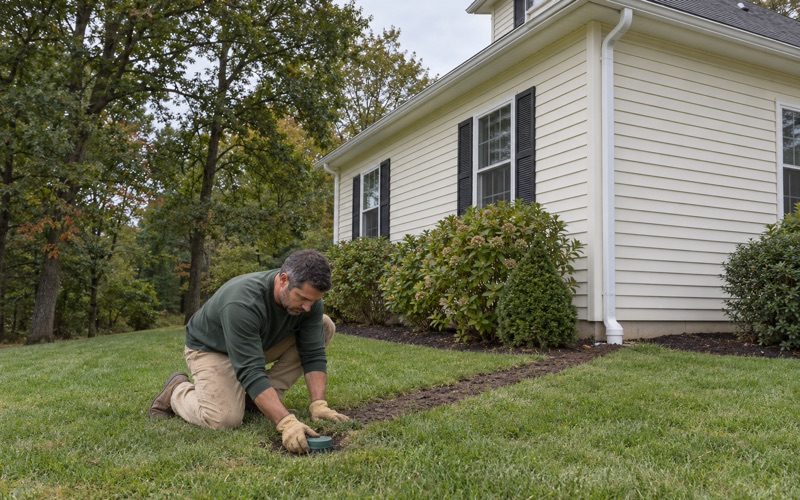
When a drywell is ruled out, an underground downspout line run to a pop-up emitter that spreads water over lawn can be a better fit. We lay the line with steady fall, cap it with an emitter that opens under pressure and closes when the flow stops, and mark its route in the photos so a future owner knows where it runs.
Never into the sanitary line
Our crews never tie a leader outlet into a sanitary sewer connection, on any building we touch. Roof water belongs in the storm system or on the ground, and the estimate names the discharge point for each outlet. New Jersey home inspectors must inspect and report roof drainage system deficiencies under N.J.A.C. 13:40-15.16, so a clear written record helps when the building changes hands.
Gutters on Two-Family Houses and Apartment Buildings
Who owns the gutter
Most gutters in East Rutherford sit on buildings that hold more than one household. Census figures for the borough show 33.3 percent of housing units in two-unit buildings and 26.7 percent in buildings of 20 or more units, against 16.6 percent detached houses, and 64.6 percent of households rent. That mix changes who calls us, who lets us onto the property and who signs the estimate.
In a condominium or association building, we check the master deed or ask the management office first, so the owner knows whether the gutters belong to them or to the association. On a two-family house with an owner upstairs and a tenant below, we schedule around both households and send the photos and the estimate to whoever is paying for the work.
Sizing for a bigger roof
A two-family roof often drains more area into each run than a small detached house does. We size gutters and downspouts to the square footage that feeds each run, which may mean 6-inch K-style seamless gutters with 3x4 downspouts, an extra outlet, or wide-flange outlets where one long run collects water from a broad slope.
We hang new runs from .032 aluminum coil on hidden hangers rather than spike and ferrule, and we add gutter apron or drip edge wherever the roof edge leaves a gap behind the back of the gutter. Kickout flashing goes in wherever a roof edge ends against a wall, so water is turned into the gutter instead of running down the siding behind it.
Older houses and painted trim
About 22.4 percent of the borough’s housing was built 1939 or earlier, and another 13.9 percent and 14.9 percent date from the 1950s and 1960s. On pre-1978 houses, painted fascia and trim fall under the EPA Renovation, Repair and Painting rule, 40 CFR 745, and we set up for it before disturbing any paint around a failing gutter.
Where an older house calls for it, we match copper or half-round work to its age and style, from half-round gutters with a double-bead profile to 16-ounce copper that weathers to a patina. The Richard Outwater House at 231 Hackensack Street, listed on the National Register of Historic Places in 1983, is a reminder that the borough has buildings old enough to deserve that care.
After Hurricane Ida: Checking Gutters, Leaders and Paperwork
What the storm showed
Hurricane Ida, on September 1, 2021, flooded East Rutherford. News 12 reported flooding at businesses and train stations in East Rutherford and Rutherford, with abandoned cars on the road, and East Rutherford Fire Chief Alan DeRosa described crews having to rescue people from flooded areas. The reports did not name streets or causes, and we do not guess at them.
A storm like that overwhelms any gutter, so the useful work afterward is checking what the water found. We look for runs pulled away from the fascia, leaders crushed or disconnected at the elbow, and outlets packed with debris. Then we follow each run down to see whether its water has been feeding a damp basement wall.
A post-storm inspection
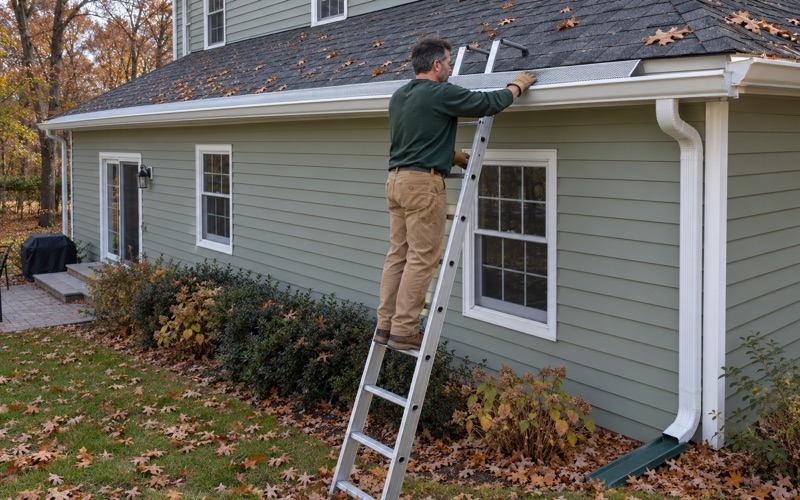
Our post-storm visit starts at the roof edge: open seams and box, strip and bay miters resealed with tripolymer gutter sealant, loose hangers tightened, and the fascia probed for soft spots. Below, we check A and B elbows, clear underground downspout lines, and dig out any pop-up emitter that has been buried or crushed. Every finding is photographed for the owner.
Leaves already sitting in a gutter before a storm are what turn heavy rain into an overflow. We match guards to the trees on each lot, because pine needles and oak leaves call for different screens, and stainless steel micro-mesh suits many of the lots we see. A guard that fits the trees means fewer clogged outlets the next time the rain and the tide arrive together.
Permits, flood maps and the estimate
Repairing, replacing or installing exterior gutters and leaders is ordinary maintenance in New Jersey under N.J.A.C. 5:23-2.7(c)1.xvi, whatever the building type, so most of our work needs no construction permit from the Borough of East Rutherford Building Department. No permit does not mean no plan: the estimate still names the size of each run and the discharge point of every leader.
The borough’s own flood insurance community, CID 340028B, has a current FEMA map dated August 28, 2019, and no Community Rating System class, while the New Jersey Meadowlands Commission is a separate NFIP community holding CRS class 7. Owners asking about flood coverage should confirm with FEMA NFIP which community rates their parcel, because new gutters do not settle that question.
Our estimates also list new gutters and repair work on separate lines. New Jersey Division of Taxation guidance in S&U-2 treats new gutters as an exempt capital improvement on Form ST-8 and gutter repair as a taxable repair, so an owner who splits the job across two units or two visits can see exactly what was charged tax and why.
- 20+ Years on Gutters
- Seamless, Formed On Site
- Before-and-After Photos