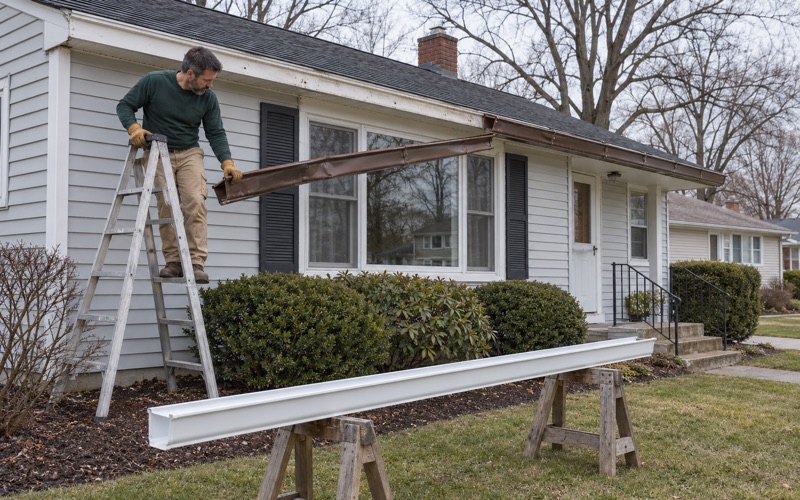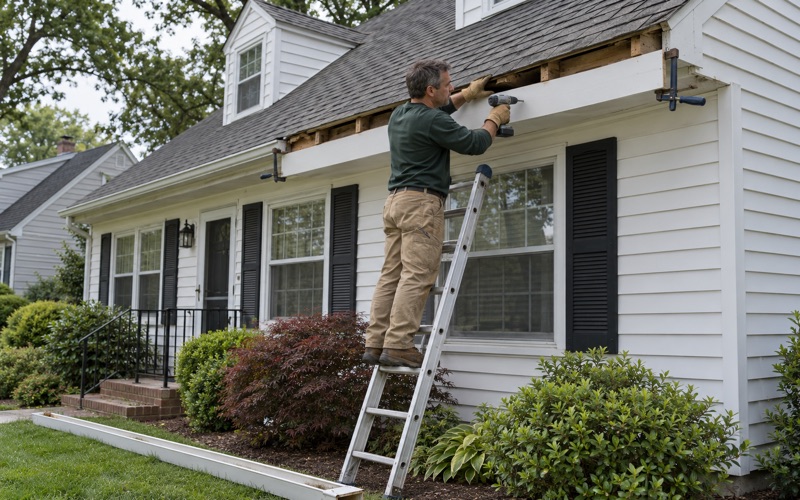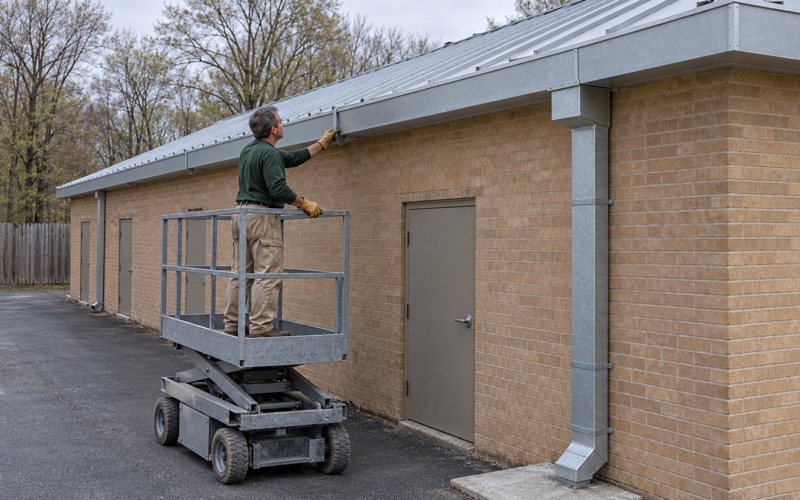
Middletown Quality Gutters brings more than 20 years of experience to gutters in Edgewater, where the first question on most jobs is not which profile to hang but who owns the roof edge. On many properties here the answer is a board rather than a single household, so we begin with the master deed or the management office and confirm responsibility before anyone signs an estimate.
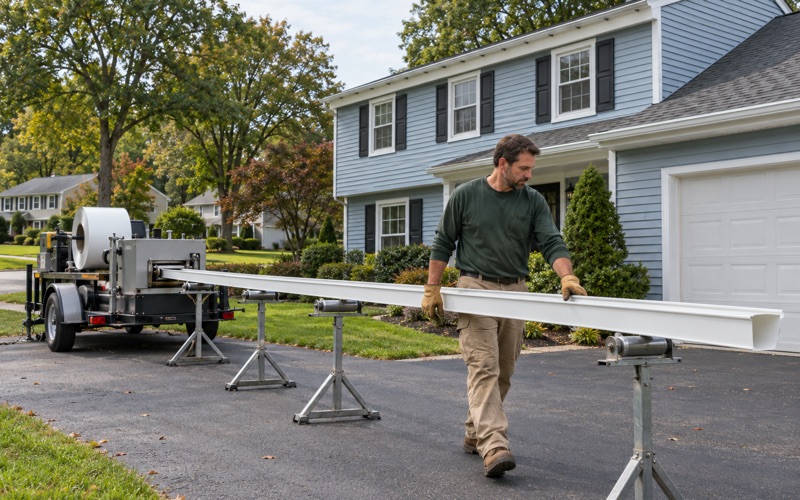
From there the work follows the water. We size gutters and downspouts for the roof area feeding each run, form seamless sections on site from coil, and trace every leader to the point where its water actually lands. When that point is a foundation wall, a garage ramp or a walkway that already holds water, the estimate proposes a fix and states where each outlet will discharge.
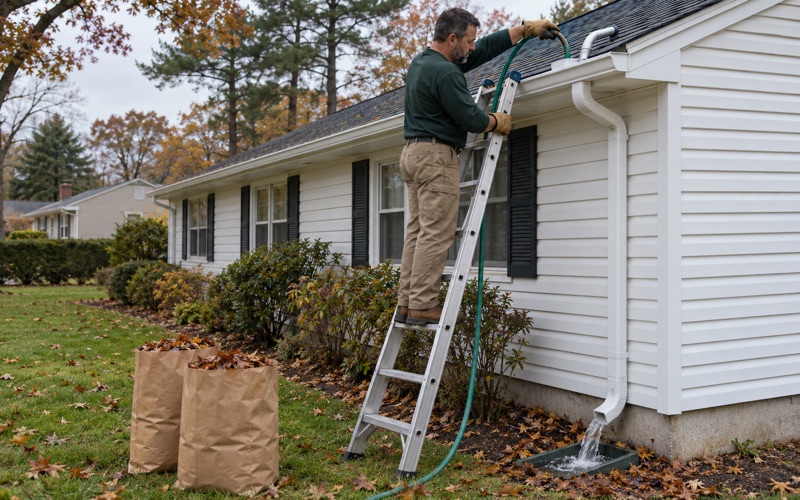
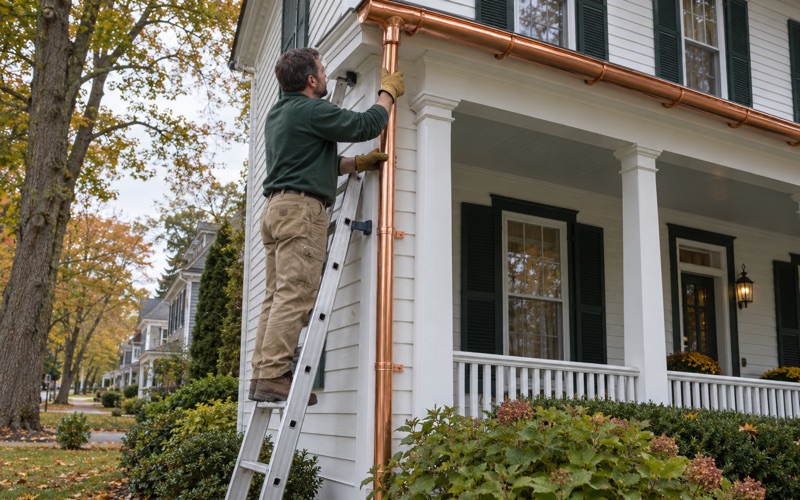
Cleaning visits flush every downspout and bag the debris, so nothing is left on a walkway or at the curb for building staff to clear. Copper and half-round work, where an older building calls for it, is matched to the age and style of that structure rather than dropped in from a catalog.
Gutter and Roof Drain Work for Edgewater Associations
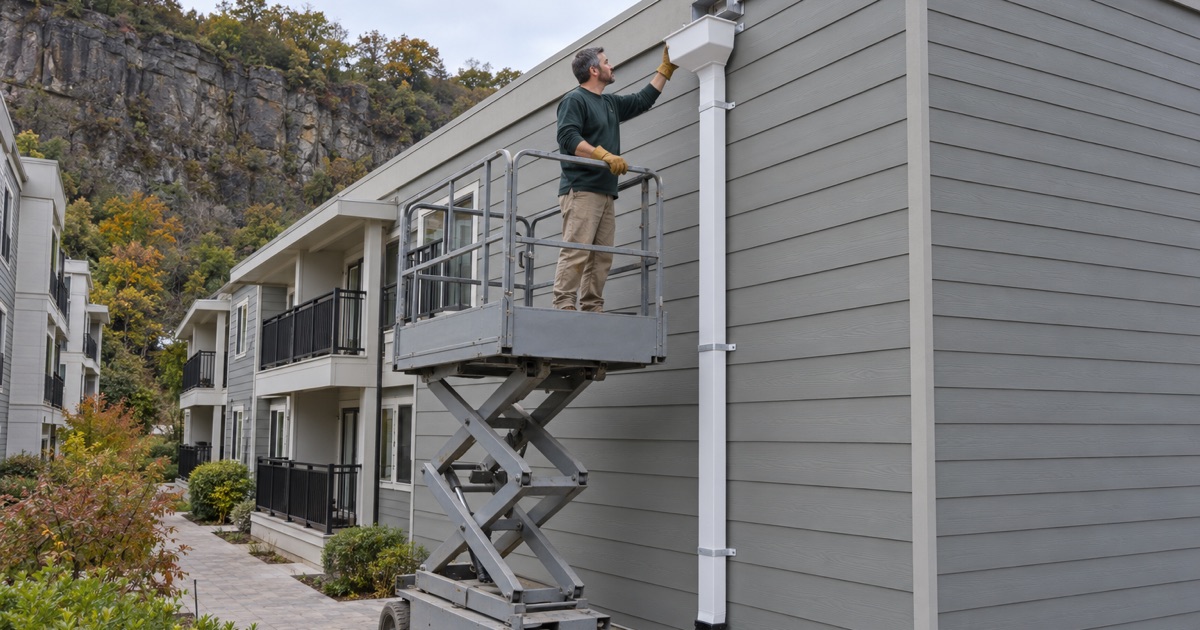
Edgewater’s housing is unusual for a gutter contractor. Census figures show 60 percent of the borough’s 7,872 housing units sit in buildings of 20 or more units, and 1,073 owner-occupied units are apartments in buildings of 50 or more. Detached houses make up only 5.8 percent of the stock. That shapes who calls us and how a job gets approved.
Starting With the Master Deed
On a condominium, gutters, leaders and roof drains are often treated as common elements maintained by the association, but we do not assume that for any building. We ask the management office, or read the relevant master deed language with the unit owner, so a resident is not paying for work the condominium association budgets for, or the reverse.
That step saves time on both sides. A board usually wants one proposal covering the whole roof edge, while an individual owner in a townhouse row may own only a short run between two party walls. Knowing which case we are in decides whether we measure one building or one bay.
Mid-Rise Roof Drains and Leaders
Larger buildings rarely shed their main roof water through a gutter. Water collects at interior roof drains or scuppers and travels down through leaders, while lower roofs, canopies and entrance overhangs often carry conventional gutters. We inspect the parts we service, check outlets and elbows for blockage, and report what drains where before quoting any replacement.
Where a building does use exterior gutters, we size them for the roof area behind each run, often a 6-inch K-style profile with 3x4 downspouts, and use wide-flange outlets so a heavy cell drains instead of overtopping. Hidden hangers hold the section tighter to the fascia than spike and ferrule, which matters on a high, exposed elevation.
Board Paperwork and Inspections
Associations run on records, so every cleaning and repair includes before-and-after photos a manager can attach to a work order. Our estimates also split new gutters from repairs on separate lines, because the New Jersey Division of Taxation treats new gutters as an exempt capital improvement on Form ST-8 while repairing gutters is a taxable repair.
Unit sales and condo rentals in the borough trigger continued-occupancy inspections through the Edgewater Building Department at Borough Hall. Gutter and leader replacement itself is ordinary maintenance under the state construction code, but a loose section or a dangling leader is the kind of item a seller would rather fix before a buyer’s home inspector, who must report roof drainage deficiencies, writes it up.
Looking for gutters closer to Warren? See Warren Gutters.
When the Water Comes Down From the Palisades
Most towns worry about rain falling on their own roofs. Edgewater also receives water from uphill. The borough’s 2016 Strategic Recovery Planning Report states that nearly all of its non-coastal flooding is generated outside its boundaries, with runoff from communities west of the Palisades flowing down into Edgewater, and that parts of the borough flood about once a month.
Gorge Road and Tropical Storm Ida
On September 1, 2021, Tropical Storm Ida brought strong wind and rain, and The Aventine at 100 Thompson Lane flooded inside its building from water running off Gorge Road. The borough later found that the County roadway could not handle the overflow of stormwater from the neighboring borough above the cliff, and it began designing additional storm drains along Gorge Road.
The Aventine above the Hudson Condominium Association filed suit seeking correction of the Gorge Road drainage rather than damages. In August 2024 the borough council authorized paying $86,425 toward County-led drainage improvements on that roadway, with the County of Bergen as lead agency. For a building at the foot of the cliff, that is the clearest local record of where heavy rain comes from.
Why Roof Drainage Still Matters Downhill
A gutter cannot stop runoff from a street above, and we will not pretend otherwise. What it can do is avoid adding to the problem. When a building’s own leaders empty next to an entrance, a garage door or a low walkway that already takes uphill water, the two sources combine at the worst spot on the property.
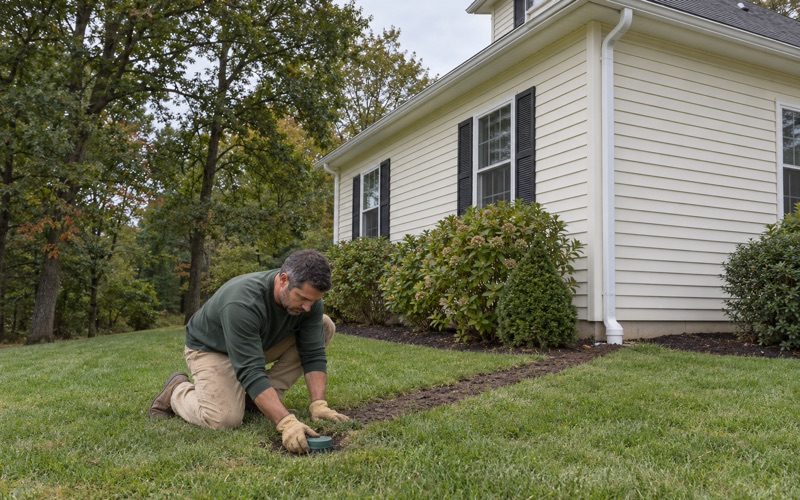
So we follow every downspout to its landing point. If it ends against a foundation, we propose an extension, a pop-up drainage emitter or a drywell, and state the planned discharge point on the estimate. Leader outlets are never tied into the sanitary sewer, which in Edgewater is owned and operated by Bergen County rather than the borough.
Sizing for Cloudburst Rain
Heavy downpours are when an undersized run overtops and sends a sheet of water off the roof edge. We size gutters and downspouts for the roof area that drains into each run, add downspouts on long elevations instead of stretching one outlet, and form box and strip miters tight so corners hold under load.
Seamless sections formed on site from .032 aluminum coil cut down on joints, and the end caps and miters that remain are sealed with tripolymer sealant. Where a lower roof meets a wall, kickout flashing turns water into the gutter instead of letting it run down the siding toward the door below.
Leaders, Outfalls and River Road Flooding
The riverfront side of Edgewater carries a different risk. The 2016 recovery report shows 38 percent of borough land in the Special Flood Hazard Area on the 2014 preliminary FEMA map, with another 10 percent in the moderate flood hazard area, and most land east of River Road and south of North Street falls in one or the other.
The 880 River Road Outfall
Edgewater police logged 38 road-flooding reports from 2013 through 2015, and 25 of them were at 880 River Road, the site of an outfall to the Hudson River that the report says commonly backs up and overflows. When an outfall cannot drain, water arriving from the pipes behind it has nowhere to go.
That is why we ask where a site’s storm piping goes before connecting new leaders to it. A roof drain or leader feeding a system that empties through a backed-up outfall, or discharging to grade beside a garage entrance below River Road, puts more water exactly where the borough already floods. We note those conditions on the proposal so a board can decide with the full picture.
Discharge Points on Low Riverfront Sites
Low sites leave fewer options. A drywell only works when its bottom sits at least 2 feet above the seasonal high water table, as the state stormwater rule requires, and on low land near the Hudson we confirm that before proposing one. Where it cannot be met we suggest surface solutions instead, such as extensions and emitters carried to ground that slopes away.
We also look at grade. The residential code calls for ground to fall 6 inches within the first 10 feet from a foundation, and a downspout extension only helps if the ground under it carries water away. Where it does not, the estimate says so rather than selling a drainage product that will sit in a puddle.
Townhouses Between the Cliff and the River
Not every Edgewater customer lives in a tower. Attached townhouses make up 8.9 percent of the borough’s housing units, on land that, like the rest of the borough, lies between the cliff and the river. Their gutters look like suburban work, but the water around them behaves like Edgewater water.
Townhouse Rows and Shared Runs
On a townhouse row one gutter often spans several units, and a downspout serving a neighbor may drain past your door. We check the governing documents or the management office first, then plan outlets so each unit’s water leaves without crossing a shared walkway or pooling at the next garage.
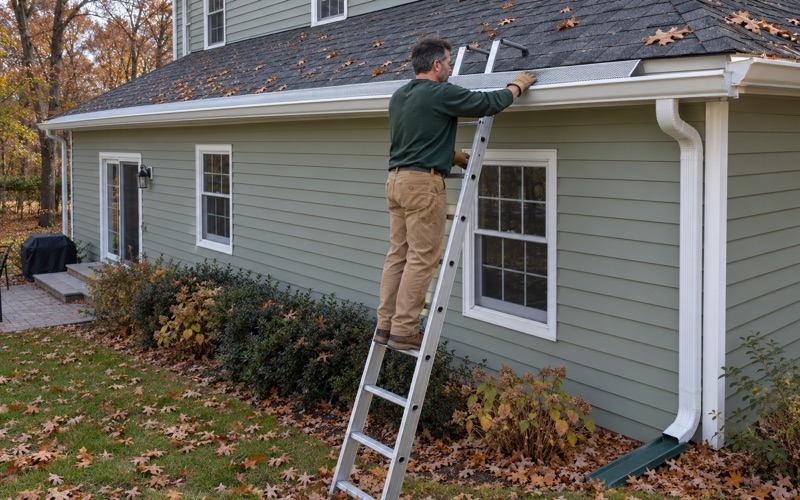
Before hanging new sections we examine the fascia board behind them, since rot there loosens hangers. Any soft wood is shown to the owner before it is replaced, and on older painted trim we follow the EPA Renovation, Repair and Painting rule for pre-1978 work. Guards are matched to what drops on the roof, with stainless steel micro-mesh where fine debris clogs coarser screens.
What Sandy Left Behind
Sandy hit Edgewater on October 29, 2012 with winds over 76 miles per hour, and some areas stood under six feet of water. After the storm the building department issued 65 repair permits, 60 of them for water and electrical damage at Shelter Bay condominiums. Flood damage of that kind starts at ground level, which is why we keep roof water away from it.
Gutters do not prevent coastal surge, and nothing we install is sold as flood protection. What we can control is the drainage a building adds on its own: leaders that run clear, outlets that land where they should, and runs sized so a storm does not dump roof water onto ground already carrying the Hudson or the cliff.
Planning Work Around Storm Season
Ida arrived on the first of September and Sandy at the end of October, so we suggest a cleaning and inspection ahead of late summer and another after the leaves come down. Downspouts are flushed and outlets verified before the storms that test them, and the photos from each visit give a board’s next capital plan a starting record.
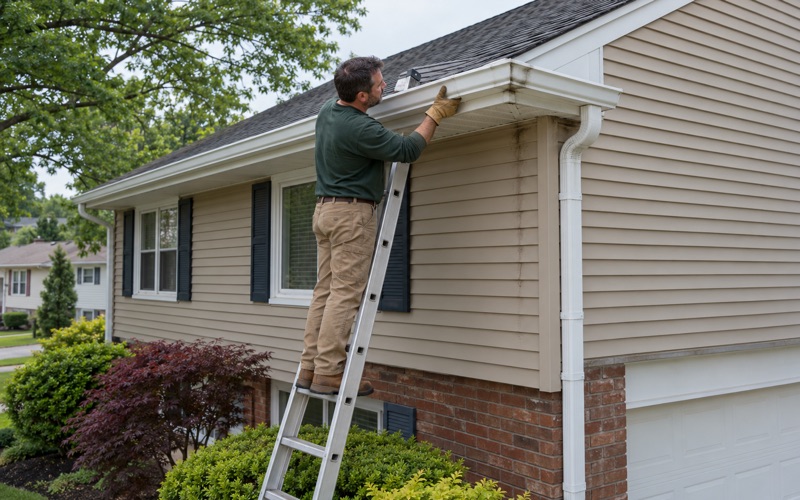
When we find a problem a cleaning cannot fix, such as a cracked outlet, a separated elbow or a run pitched the wrong way, we write it up as its own repair line with its own photo. The board can approve it alone or fold it into a larger replacement once the reserve allows.
- 20+ Years on Gutters
- Seamless, Formed On Site
- Before-and-After Photos