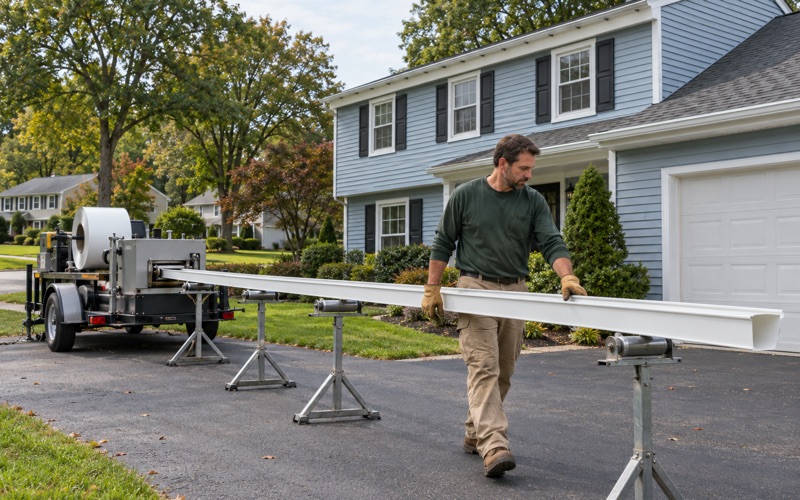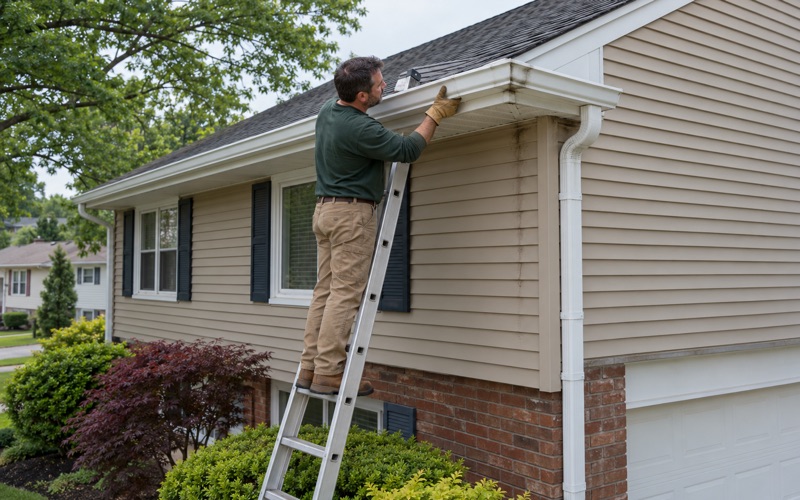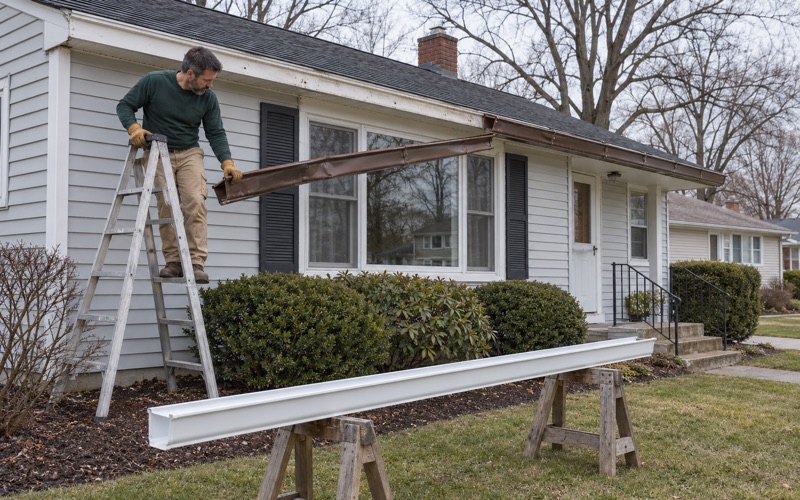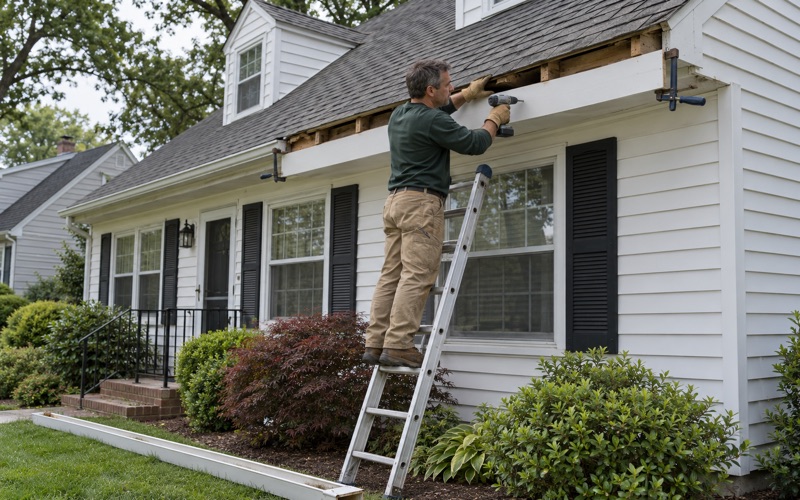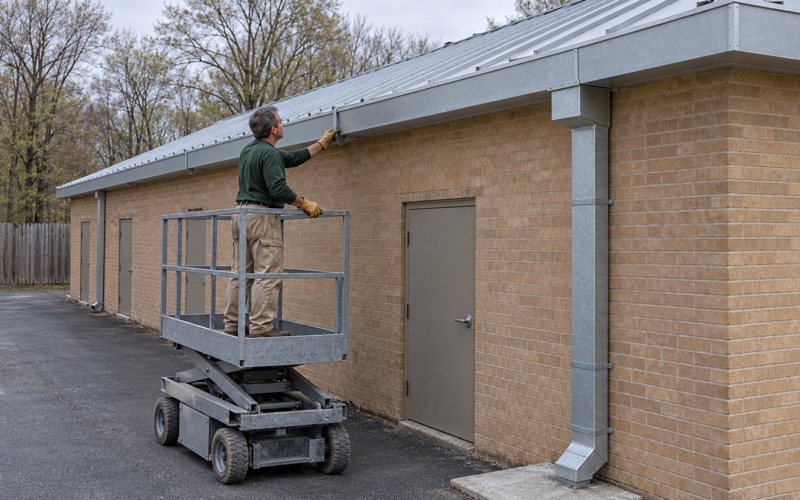
Middletown Quality Gutters installs, repairs and cleans gutters in Fairview, and more than 20 years of this work stand behind every estimate we write. We form seamless gutters on site from coil, one piece for each run of the house, and we size each gutter and downspout to the roof area that actually drains into it rather than reaching for the same profile on every job.
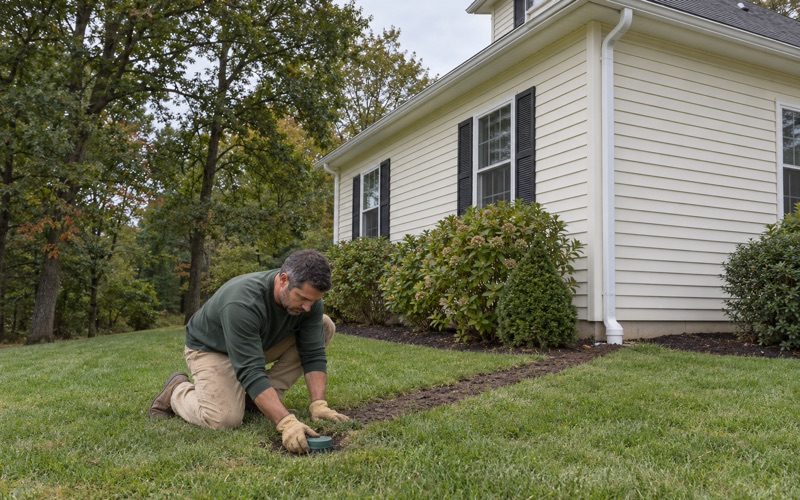
On a job here, the part that matters most is often not the gutter itself but the last few feet of the leader. Before we quote, we follow each downspout to the spot where its water lands. If that spot is a foundation, a wall or a neighbor’s side yard, the estimate proposes an extension, a pop-up emitter or a drywell instead.
Our estimates also state where every leader outlet will discharge, and none of them is ever tied into the sanitary sewer. New gutters and repair work sit on separate lines, because New Jersey taxes the two differently, and the owner of a two-family or attached house can see exactly which part of the job covers which part of the roof.
Gutters on a Hillside Borough
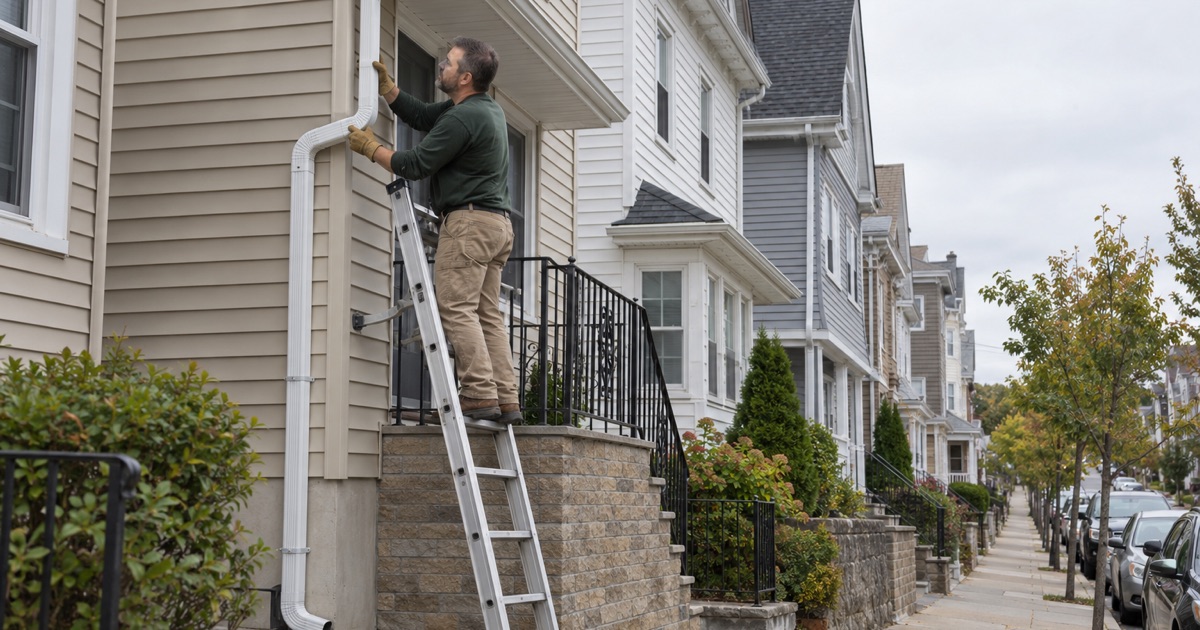
Built on the Palisades Ridge
Fairview sits on the Palisades ridge and down its western slope, at an elevation of about 259 feet, and the borough was named for its view of the Hackensack River valley. That view comes with a grade. Rain that leaves a roof here does not sit still; it keeps moving downhill toward the next lot, the next wall or the next basement.
The borough also covers only 0.85 square miles, at roughly 17,800 people per square mile. Lots are tight, side yards are narrow, and the distance between one house’s downspout and another house’s foundation can be a few steps. On a hillside packed that densely, where a leader lets go is a decision that reaches past the property line.
Reading the Slope Before Choosing a Discharge Point
We walk the lot before drawing anything. The question is which way the ground falls from each corner of the house, and whether water released at a given downspout will run back toward the building, across a walkway, or over the edge of a terraced yard. On a slope, the uphill and downhill sides of the same house usually need different answers.
The residential code New Jersey adopted calls for the grade to fall 6 inches within the first 10 feet from the foundation. Plenty of older lots were graded long before anyone measured that, so we check what the ground actually does near each outlet and plan the extension or emitter around it, not around a drawing.
Extensions, Pop-Up Emitters and Drywells
An extension is the simplest fix when there is open ground below the house to receive the water. Where the downhill side is a paved strip or a neighbor’s wall, we look at running an underground downspout line to a pop-up drainage emitter placed where the grade can carry the flow away safely.
A drywell is an option only where the soil and water table allow it, and on a steep, built-up lot that is never a given. When we cannot place one responsibly, we say so on the estimate and explain the alternative, rather than burying the water somewhere it will resurface against a foundation.
Looking for gutters closer to Leonardo? See Gutters Services in Leonardo.
Protecting Retaining Walls and Foundations
What Happened at Fairview Gardens
Slope water has already done serious damage in this borough. In August 2018, about 40 apartments at the Fairview Gardens complex were evacuated after flood-weakened ground beside the building caved into a sinkhole and a large retaining wall collapsed. Residents told CBS New York that the property owner attributed it to rain and flooding that came down Fairview Avenue and pooled on the property, followed by heavy rain that Saturday.
Gutters were not named in that account, and we do not suggest they were involved. The lesson for owners is narrower: water that collects above or below a retaining wall adds to the load the wall already carries, and every downspout on a sloped lot either adds to that water or steers it away.
Keeping Leaders Off the Top of a Wall
Where a yard steps down behind a retaining wall, a leader that dumps right above it keeps the soil behind the wall saturated through every storm. We route those outlets along the wall to a point where the water can leave on a surface built to take it, or we pipe them below grade to an emitter further downhill.
When the wall belongs to the property next door, the conversation includes that owner too. A discharge point that protects one foundation by soaking a shared wall has only moved the problem, and on a hill as crowded as this one the next building is usually close enough to feel it.
Foundations on the Downhill Side
A foundation on the low side of a lot takes water from its own roof and from the ground above it. On those walls we pay closest attention to downspout capacity, because an undersized leader that overflows in a heavy storm sheds water straight down the wall it was meant to protect. Moving to 3x4 downspouts with wide-flange outlets often stops that overflow at the source.
We also look at where the roof meets the gutter. Gutter apron, drip edge and kickout flashing keep water that overshoots or runs behind the gutter from soaking the siding and sheathing above a basement wall, which matters most on the side of the house that sits lowest on the slope.
One Gutter Run, Several Units
Fairview’s Housing Stock
The typical gutter job in Fairview is not on a detached single-family house. According to the American Community Survey, 29.2 percent of the borough’s housing units are in two-unit buildings, another 18.4 percent are in three- and four-unit buildings, and 7.8 percent are attached single-family houses. Two-thirds of households, 66.8 percent, rent their homes.
Much of that stock is old as well. The same survey counts 1,362 housing units built in 1939 or earlier, with hundreds more from the 1940s and 1950s, so the fascia, hangers and painted trim on many of these buildings have seen decades of weather before we ever set a ladder against them.
Shared Runs and Shared Walls
On an attached house or a two-family building, a single gutter run frequently spans more than one unit or crosses a shared wall. A sag, a leak or a clogged outlet over one unit can send water toward a neighbor’s entry, and a downspout placed for one household’s convenience can drain onto another household’s walkway.
We map each run against the unit lines before we size anything. A seamless gutter helps here because one continuous piece has no joint to open up at the point where two units meet, and hidden hangers spaced along the full length hold the run straight across the whole building.
Who Makes the Call
In most two-to-four-family houses here, the decision rests with an owner-landlord whose own apartment is one of several under that roof. We write the estimate so it makes sense to that owner and to anyone they need to show it to, with each run, outlet and discharge point listed in plain terms.
Where a building is a condominium or is run by an association, we check the master deed or ask the management office first. Knowing who is responsible for the gutters before work starts avoids the situation where one unit owner pays for a run the association was supposed to maintain.
Gutter Upgrades for Fairview Landlords
Permits and Street Dumpsters
New Jersey’s construction code rules list the repair, replacement or installation of exterior gutters and leaders as ordinary building maintenance, and that provision names no building type. Gutter work therefore needs no construction permit, even on a three- or four-unit building where re-covering the roof would need one.
A street dumpster for a tear-off is a different matter. The Fairview Building Department, on the third floor of the Municipal Building at 59 Anderson Avenue, requires a permit for any dumpster placed on the street: $50 for the first three days and $25 for each added day, up to seven days. The department also notes that final inspections are required for all work.
The Capital Improvement Charge
The Fairview Rent Leveling Board, at 53 Grant Street, uses a rent increase form that lists a separate Capital Improvement Charge beside base rent and the tax surcharge, with base rent increases capped at 10 percent. The form does not define a capital improvement, and we do not decide that question for any owner.
What we can do is give a landlord clear paperwork. Our estimates put new gutter installation and gutter repair on separate lines, which is how New Jersey sales tax treats them: new gutters are exempt on Form ST-8, while repairs are taxable. That sales tax split is its own question, but the separate lines make the scope easy to document.
Fascia, Paint and Older Trim
Before new gutters go up, we check the fascia board behind them for rot, and any soft wood is shown to the owner before it is replaced. On older buildings that board often carries layers of paint, and on houses built before 1978, disturbing painted fascia and trim falls under the EPA Renovation, Repair and Painting rule.
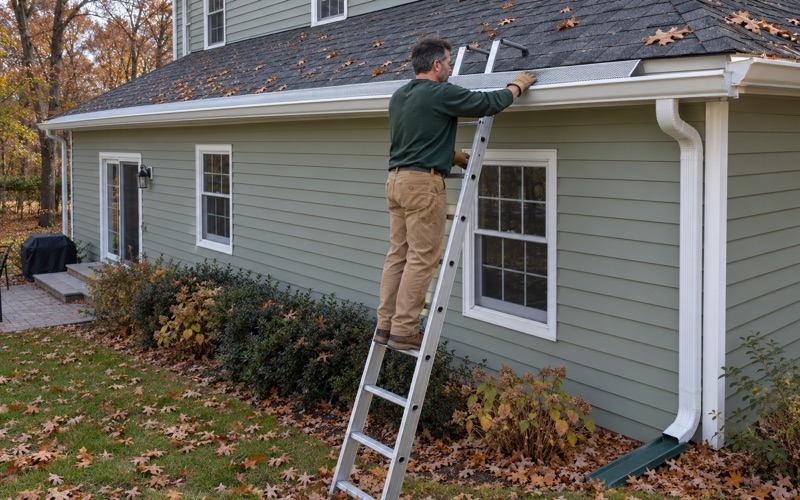
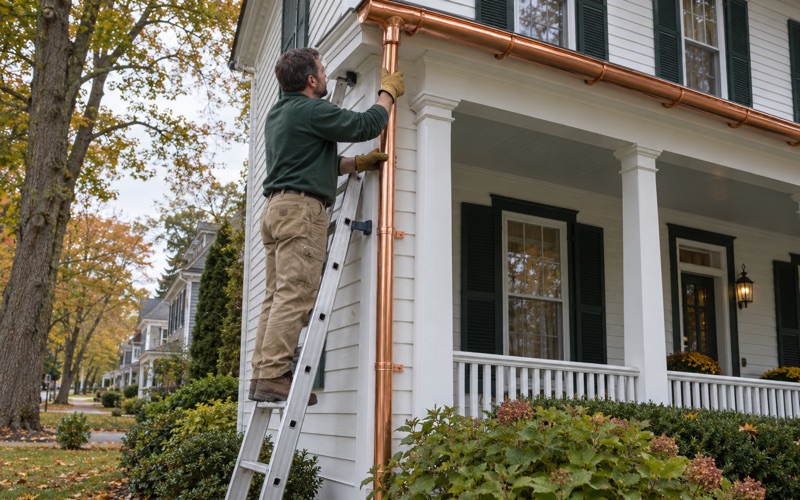
For owners who want the gutters to suit the age of the building, copper and half-round work can be matched to the house. Elsewhere, .032 aluminum coil in a 6-inch K-style profile handles the runoff from a steep, compact roof, and stainless steel micro-mesh guards are chosen to suit the trees that actually shade the lot.
Cleaning Visits on Tight Lots
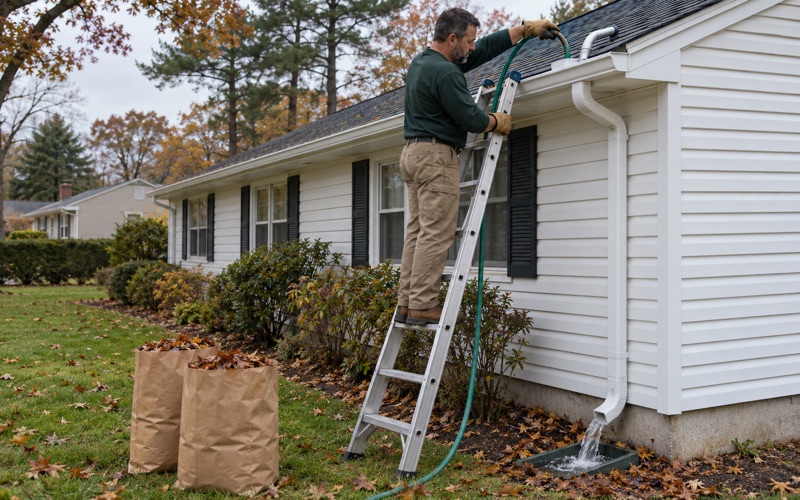
Cleaning in a dense borough has its own courtesy rules. We flush every downspout to confirm it runs clear to its outlet, bag the debris rather than leaving it on a small front yard or at the curb, and send before-and-after photos so a landlord who lives in another unit, or elsewhere entirely, can see the result.
Those photos also give an owner a record of each run’s condition from one visit to the next. On a building where one gutter serves several households, that record makes it easier to spot a sagging section or a slow outlet early, before its overflow reaches a wall, a walkway or the unit below.
- 20+ Years on Gutters
- Seamless, Formed On Site
- Before-and-After Photos