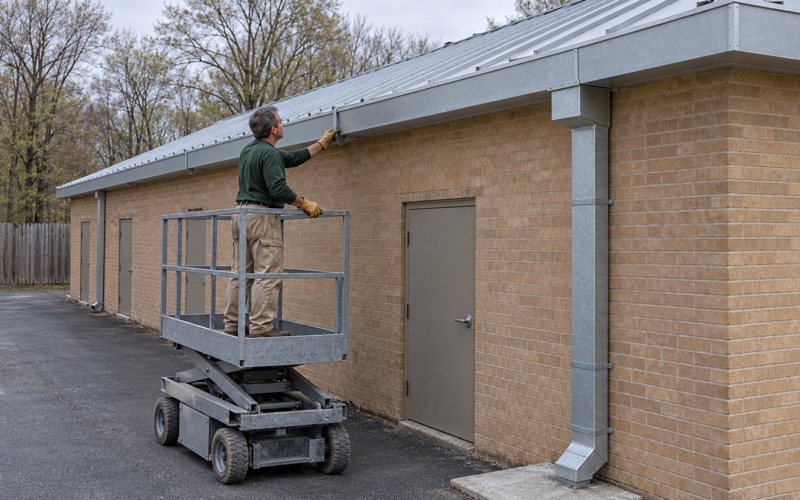
Middletown Quality Gutters handles gutters in Guttenberg with more than 20 years of practice behind every run we hang, and the work here begins with one practical question: where does each leader send its water? We size every gutter for the roof area that drains into it, form seamless runs on site, and follow each downspout to the spot where it empties.
That question matters because a gutter is only half of a drainage system. The other half is the leader, the elbow at its foot and whatever it empties into, whether that is a pipe, a sidewalk or a narrow strip of yard. We check all three before quoting, so the estimate describes the whole path from roof edge to final discharge point, not just the trough.
Almost all of the housing in town is attached, with roofs that meet a neighbor’s at a shared wall and gutters that run toward the next house. That changes how a replacement is measured, how a leader is rerouted and how the work is staged. The sections below cover the sewer the water ends up in, the buildings it comes from and how we plan a visit.
Where Roof Water Goes in Guttenberg
A Combined Sewer the Town Runs Itself
Guttenberg runs its own combined sewer system and its own CSO line rather than sending flow through a regional sewerage authority. In a combined system, rain from roofs and streets shares pipes with household wastewater, so a heavy storm can push the mix past capacity and out through an overflow point. Every leader that reaches that line adds volume at exactly the wrong moment.
That is why we never tie a leader outlet into a sanitary line, and why our estimate states where each one will discharge. On a small lot the choices are limited, but naming them in writing lets the owner weigh the tradeoff before any pipe is cut, rather than discovering it after the next storm.
The Woodcliff Plant and the CSO Permits
The town’s combined flow goes to the North Bergen Municipal Utilities Authority’s Woodcliff treatment plant. Draft CSO permits released by NJDEP during December 2022 covered both the Woodcliff plant and the Town of Guttenberg, including an ongoing expansion so Woodcliff can accept more combined flow from North Bergen and Guttenberg. The drafts also called for green stormwater infrastructure.
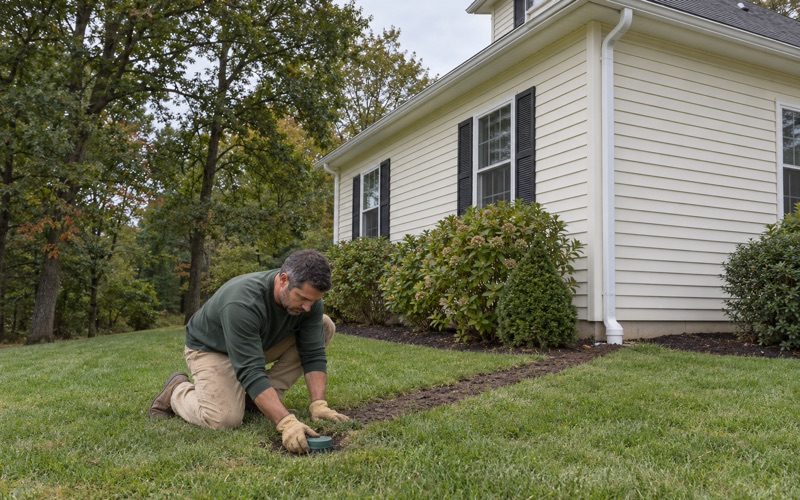
Green stormwater infrastructure means holding or slowing rain near where it falls instead of piping it straight into the sewer. For a homeowner, the small-scale version is a leader that empties onto a pop-up emitter, into a planted strip or toward a drywell where soil and space allow. We point out those options when a lot can take them and say plainly when it cannot.
Clay Mains Under the Street
Much of the pipe beneath Guttenberg’s streets is vitrified clay. During the first quarter of 2022, the town’s ongoing sewer improvements contract replaced 103 linear feet of 12-inch, 160 feet of 15-inch and 595 feet of 18-inch clay main and made 14 spot liner repairs, according to the town’s quarterly CSO report to PVSC.
How an individual house’s leaders connect to that system is not something any survey has mapped. Whether a given downspout runs into the lateral, onto the sidewalk or into a yard is a building-by-building question, and we answer it by tracing the pipe on the property rather than assuming.
Looking for gutters closer to Edgewater? See Gutters Services in Edgewater.
What the Galaxy Towers Separation Means for Smaller Buildings
The Largest Roof Already Moved
The biggest single source of roof water in town has already been taken off the combined line. Galaxy Towers, at 7000 Kennedy Boulevard East, is three 44-story towers completed during 1976 and run as condominiums since 1980. The town’s CSO report for the first quarter of 2022 recorded that the Galaxy Towers storm discharge to the county storm sewer was completed and its storm flow removed from the town’s CSO line.
That was one large building with its own engineering, and it does not set a rule for anyone else. What it does show is that the town treats roof water and sewer capacity as connected, which is a useful frame for any owner deciding where a new leader should go.
Tracing Each Leader on a Smaller Building
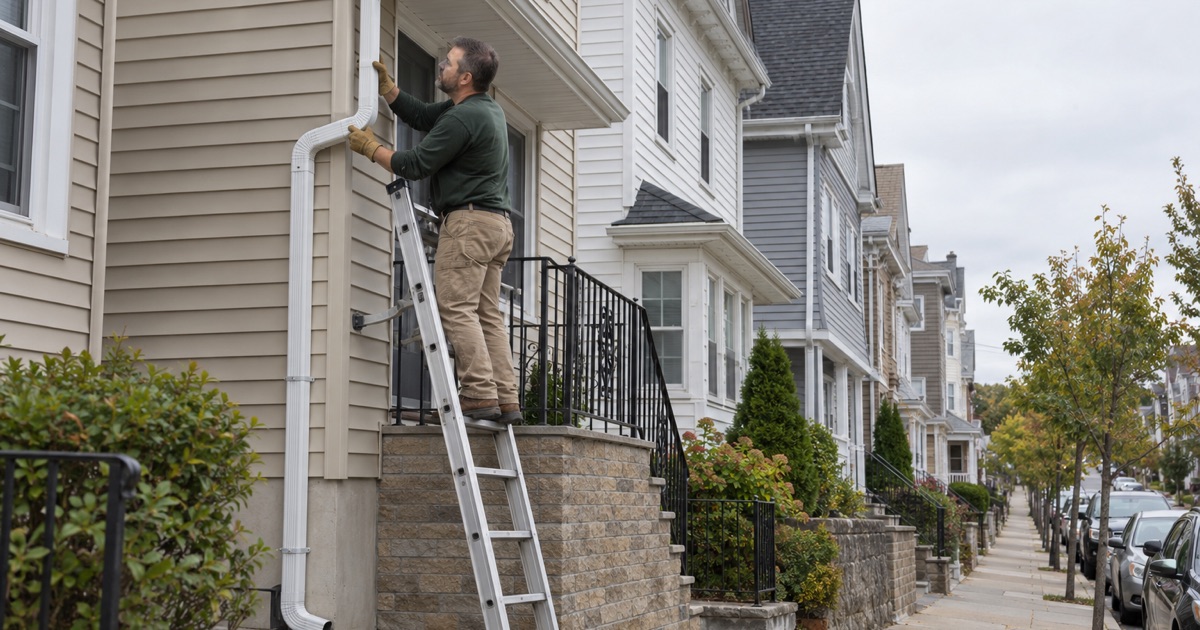
On a row house or a two-family building, the same question plays out at a much smaller scale. A leader may drop into a pipe at the foundation, run under the sidewalk to the curb, or empty onto a strip of concrete beside the next house. We follow every downspout to its end point before writing anything down.
Where a leader empties against the foundation, we propose an extension, a pop-up emitter or a drywell if the lot has room for one. Where the pipe disappears underground and its destination is unclear, we say so on the estimate rather than guessing, and we leave the existing connection alone unless the owner decides to change it.
What the Estimate Spells Out
Every estimate we write for a Guttenberg building names the discharge point for each leader, along with gutter size, downspout size and outlet locations. New gutters and repair work appear on separate lines, because New Jersey treats new gutters as an exempt capital improvement on Form ST-8 while repairing gutters is a taxable repair.
That split also helps owners of multi-unit buildings who budget the two kinds of work differently. A two-family owner replacing one failing run and patching a seam on another can see exactly which charge is which, and why the tax treatment differs between them.
Gutters and Leaders on Row Houses and Two- and Three-Family Homes
Where One Roof Meets the Next
Only 3.1 percent of Guttenberg’s housing units are in detached houses. The rest are in attached and multifamily buildings, including blocks a 1983 New York Times description called two-story row houses. On those blocks one roof meets the next at a party wall or parapet, and gutters either run continuously or end at the property line.
That means a gutter change on one house can touch the neighbor’s run and the shared wall. We look at where the two systems meet, whether the joint drains toward one leader or two, and how a new end cap or outlet will sit against the adjoining gutter, so a fix on one side does not move water onto the other.
Owner-Occupied Two- and Three-Family Houses
About 60 percent of occupied homes in town are rented, and a large share of those rentals sit inside two-, three- and four-unit buildings. Owner-occupied two- and three-family houses are a category the town itself recognizes: they are the only dwellings eligible for the Building Department’s short-term rental certificate, which requires home insurance with the application.
For an owner who lives in one unit and rents the others, the gutters protect several households at once. We schedule work with tenants in mind, keep ladders clear of shared entries and confirm with the owner which leaders serve which unit before anything is moved.
Sizing and Forming Each Run
Attached buildings often have short gutter runs with uneven roof areas behind them, so habit is a poor guide. We size gutters and downspouts for the roof area that drains to each run, which on a two-story row house may mean a 6-inch K-style gutter with a 3x4 downspout on one face and a smaller profile on another.
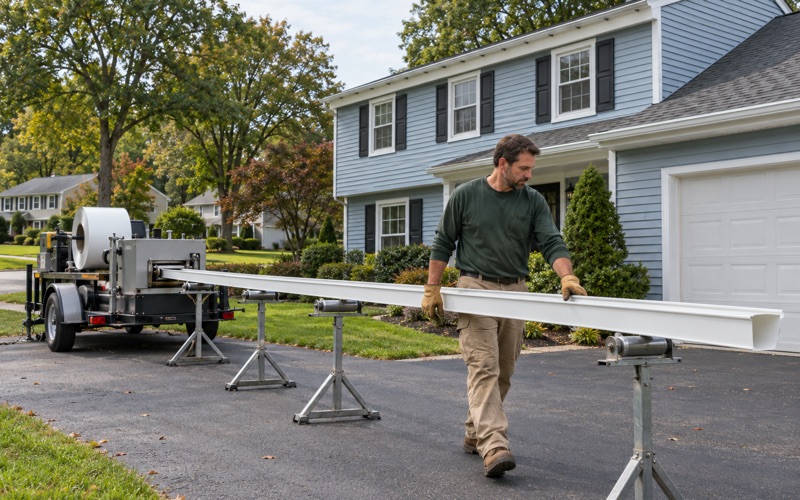
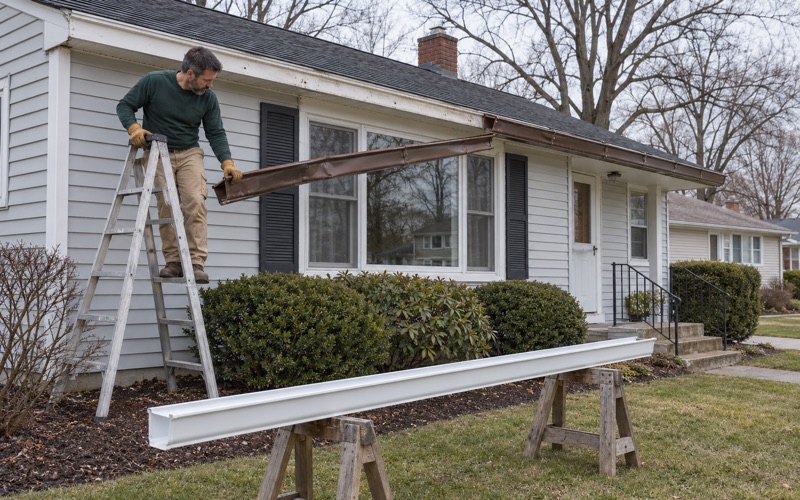
Seamless gutters are formed on site from .032 aluminum coil, one piece for each run, which removes the mid-run seams that tend to leak first. Hidden hangers hold the gutter snug to the fascia and leave a cleaner line where a neighbor’s gutter meets ours at the property line.
The Fascia Behind the Gutter
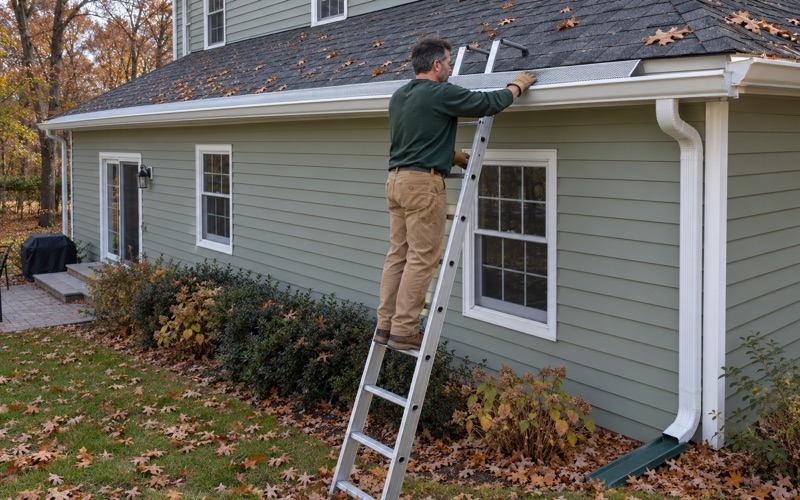
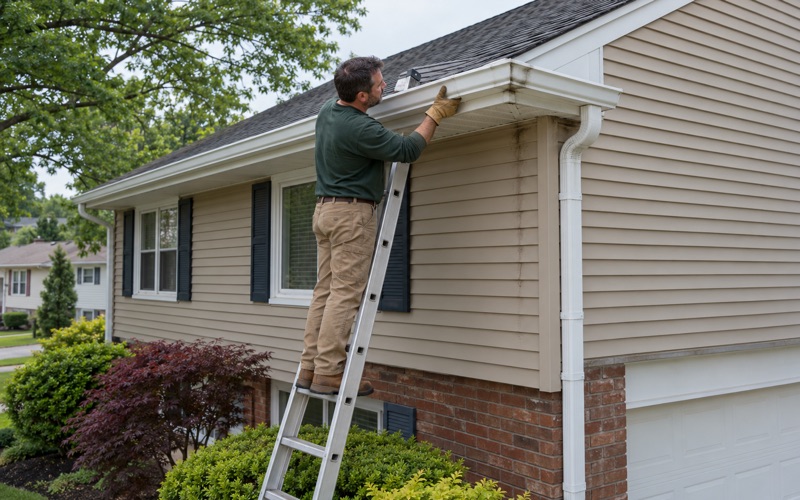
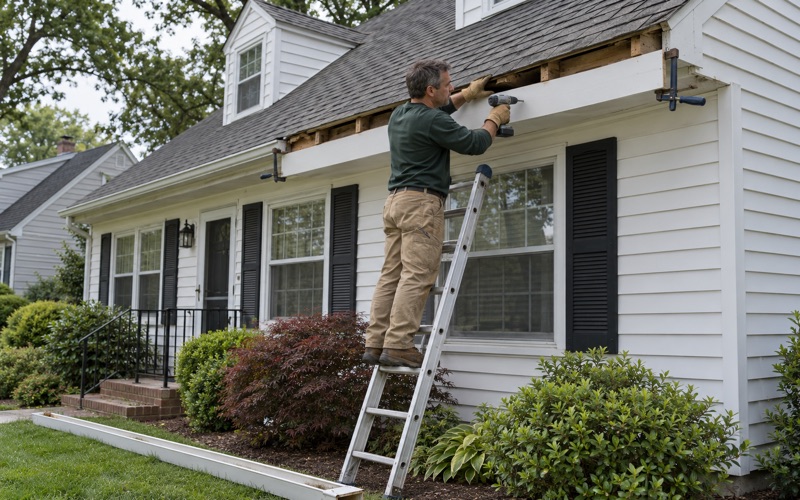
Before a new gutter goes up, we check the fascia board behind it for rot. On older attached houses, water that has backed up behind a failing gutter for years often softens the wood, and soft fascia will not hold hangers. When we find it, we show the owner before replacing anything.
Painted fascia and trim on houses built before 1978 fall under the EPA Renovation, Repair and Painting rule, 40 CFR 745, which governs how painted surfaces are disturbed. More than a third of Guttenberg’s housing units were built before 1970, so we plan for those work practices whenever old painted wood has to come off.
Planning a Visit on the Palisades
Setup Near Kennedy Boulevard East
Guttenberg sits on top of the Hudson Palisades. A Hudson County study of the cliff roads describes retaining walls up to 40 feet high along Kennedy Boulevard East and River Road through four towns including Guttenberg, and a 2023 rockfall somewhere between those two roads limited access while the roadway was inspected and repaired.
On the Boulevard East side, we plan ladder placement around county roadways, wall tops and narrow sidewalks before the crew arrives. Where a building fronts a busy road, we look at the setup from the street first and choose the face of the house we can work safely.
Cleaning Visits on Tight Blocks
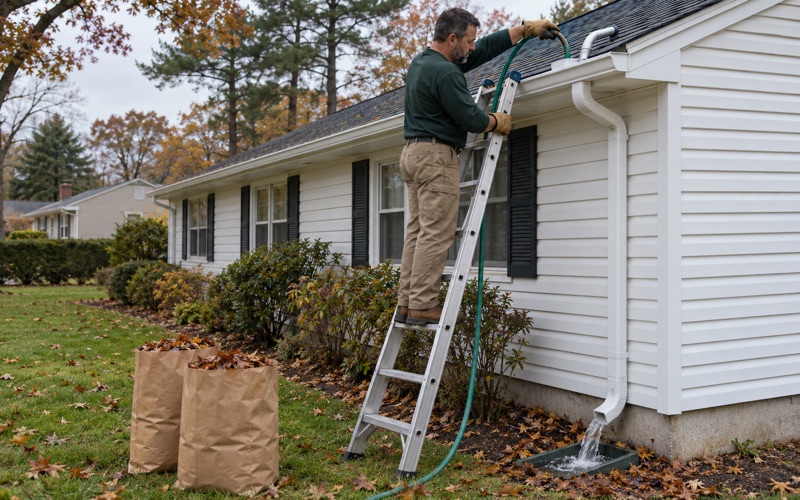
Row-house blocks leave little room for a tarp or a pile of debris, so our cleaning visits bag everything that comes out of the gutter and take it with us. Nothing is left on the sidewalk or at the curb, which matters on streets where several households share the same frontage.
Every downspout is flushed during a cleaning, since a clear trough feeding a packed leader still overflows. Before-and-after photos come with each cleaning and repair, which helps an owner who does not live in the building see exactly what was done.
Scheduling and Responsibility
We schedule outdoor work against the National Weather Service forecast for zone NJZ006, Hudson, which covers Guttenberg, rather than the Eastern Bergen zone used for the boroughs just to the north. That keeps a cleaning or install from landing on the wrong forecast.
For a unit in a condominium building, we check the master deed or management office first, so the owner knows whether the gutters belong to the unit or the association before anything is quoted. Leader decisions on a shared building then go to whoever actually holds that responsibility.
- 20+ Years on Gutters
- Seamless, Formed On Site
- Before-and-After Photos