
Middletown Quality Gutters installs gutter guards in Middletown Township, NJ, serving surrounding cities including Red Bank, Holmdel, Eatontown, Aberdeen and Tinton Falls. We have spent more than 20 years cleaning, repairing and replacing gutters, and that time on ladders is how we learned which guards hold up under which trees. A guard that works beautifully under a maple can fail within one season under a white pine.
So we start with the trees, not the product catalog. Before recommending anything, we walk the lot, note what overhangs each section of roof and look at what is already sitting in the gutters. Broad leaves, needles, seed pods and shingle grit each call for a different kind of screen.
We also check the gutters themselves, because a guard is only as good as the system beneath it. Undersized, sagging or leaking gutters need fixing first, and we will say so rather than covering a problem. When the gutters are sound, we fit a guard matched to your trees and send you photos of the finished work.
Types of Gutter Guards We Install
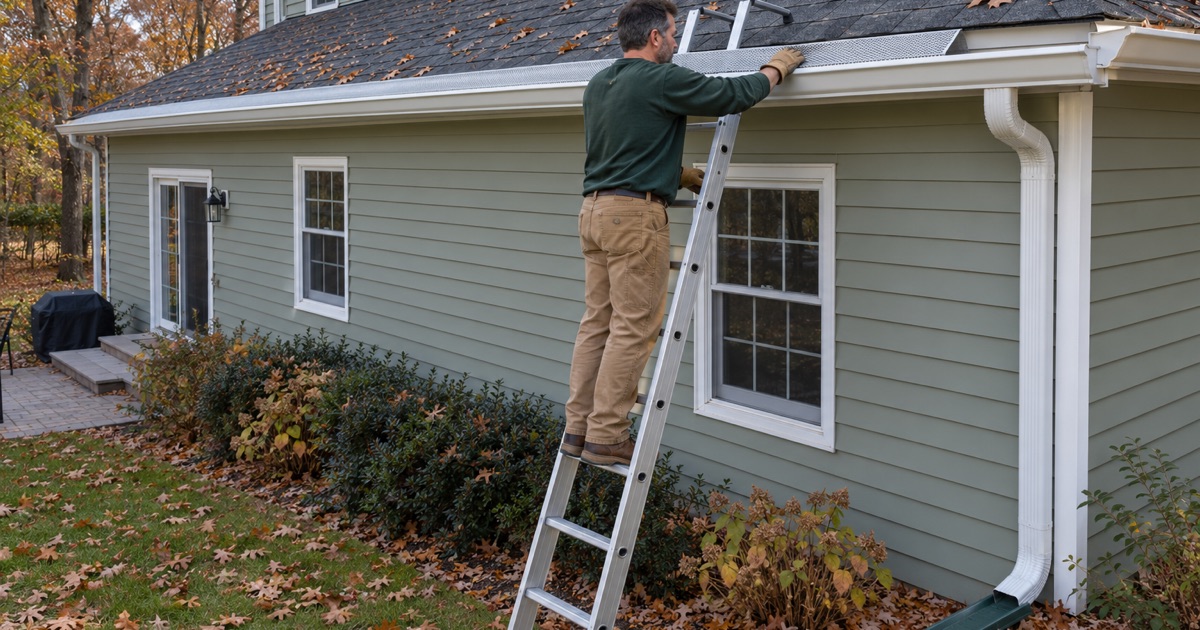
Stainless Steel Micro-Mesh Guards
Micro-mesh guards use a fine stainless steel screen stretched over a rigid frame that spans the gutter. The openings are small enough to stop pine needles, maple seeds and most shingle grit, yet water clings to the mesh and is drawn through it. For houses under conifers, it is usually the only guard type worth installing.
The frame matters as much as the mesh. A stiff aluminum frame keeps the screen from sagging into the gutter under wet leaves or snow, which is how cheaper mesh products end up holding debris in a trough. We fasten the frame to the gutter lip and the fascia so it stays put through wind and ice.
Perforated Aluminum Screens
Perforated screens are sheets of aluminum punched with holes, laid over the gutter and fastened along the front. They cost less than micro-mesh and handle broad oak and maple leaves well, since those leaves sit on top and blow off once dry. They are a good fit for houses under deciduous trees with few conifers nearby.
Their limit is fine debris. Pine needles, seed pods and shingle grit can pass through the holes and collect inside the gutter over time. Where the lot mixes hardwoods with a few pines, we often use screens on the hardwood side of the house and micro-mesh on the side under the conifers.
Reverse-Curve Hooded Systems
Hooded guards cover the gutter with a solid cap that curves over its front edge. Rain follows the curve around and into a narrow slot, while leaves slide off the edge to the ground. Some systems are a separate hood fitted to existing gutters, and others are one-piece units with the hood built into a new seamless gutter.
Hoods shed large leaves well, but the slot can admit needles and small seeds, and in very heavy rain water can overshoot the curve. Published comparisons place the leading hooded and branded mesh systems in a similar price range per foot. We explain those tradeoffs so you can weigh them against a mesh guard on your own gutters.
Brush and Foam Inserts
Brush guards are long cylindrical brushes laid in the trough, and foam inserts are wedge-shaped blocks that fill it. Both go in quickly and cost little. They keep large leaves from settling to the bottom of the gutter.
The drawback is that both hold onto debris. Leaves catch in the bristles, needles work into the foam, and the inserts have to be pulled out and cleaned on a schedule. We install them less often than mesh or screens, mainly on short runs where a homeowner wants a simple, low-cost fix.
Matching the Guard to Your Trees
Pine Needles
Pine needles are the hardest debris for a gutter guard to handle. They are narrow enough to slip through ordinary screens and long enough to lie across a slot, and once inside a gutter they mat together into a dense layer that holds water. A gutter full of matted needles can overflow even when it looks only half full.
Under pines, spruces and other conifers, we recommend stainless micro-mesh. Its fine openings keep needles on the surface, where they dry and blow away or can be brushed off. It is the clearest example of why we match guards to trees instead of selling one product to every house.
Oak and Maple Leaves
Oak and maple leaves are large, flat and arrive mostly in one season. They tend to sit on top of a guard rather than slipping through, and once they dry, wind usually clears them. Almost any well-installed guard keeps them out of the trough.
Oaks add a second problem: catkins in spring and acorns and caps in fall. Those small, heavy pieces can lodge in coarse screens or slots. Under big oaks, we lean toward screens with smaller openings or micro-mesh, so the spring and fall debris stays on the surface too.
Seeds, Pods and Shingle Grit
Maple seeds, locust pods and similar debris fall in large numbers and can sprout in a gutter that stays damp. Shingle grit from an aging asphalt roof washes into the trough with every storm and settles at the outlets. Over time, that grit can clog a downspout as surely as leaves can.
Fine mesh keeps most of this material out while letting water through. On an older roof shedding a lot of grit, we also check the downspouts and elbows during installation and flush them clean. A guard over a gutter that already holds a layer of grit simply hides the clog.
Installing Gutter Guards the Right Way
Guards on Existing Gutters or With New Ones
Guards can be fitted to existing gutters when those gutters are sound, properly pitched and sized for the roof. That keeps the cost down and avoids replacing gutters that still have years left. We inspect and clean the gutters first, flush every downspout and fix any leaking joints before a guard goes on.
When the gutters are undersized, sagging or near the end of their life, it makes more sense to install guards with new seamless gutters. The hangers can then be placed to support the guard, and the gutter size can be chosen with the guard in mind. We price both routes when the choice is close.
Protecting the Roof Edge
Some guards are designed to slip under the first row of shingles. Doing that lifts the roof edge and can break the seal of the shingles above, which is not something we want to do to a sound roof. We favor guards that fasten to the front lip of the gutter and rest against the roof edge or drip edge without lifting shingles.
We also check the roof-edge flashing while we are up there. A missing gutter apron or drip edge lets water run behind the gutter whether or not a guard is in place. Adding the flashing during guard installation costs far less than repairing rotted fascia later.
Snow, Ice and Gutter Guards
Guards do not cause ice dams; those form when attic heat melts roof snow that refreezes at the cold eave. A guard can, however, let snow and ice sit on the gutter longer than an open trough would. On eaves that have a history of icing, we choose a guard with a smooth surface that sheds snow.
Where ice is a recurring problem, we can pair guards with self-regulating heat cable along the gutter and into the downspout. The cable keeps a channel open for meltwater on the coldest days. We recommend it only where the icing history justifies the running cost.
Cost, Value and Upkeep
What Gutter Guards Cost
Guard prices vary widely by type and by who installs them. Published local pricing for basic screens and mesh sits in the range of roughly $7 to $10 per linear foot installed, while national branded systems have been reported at around $40 per linear foot. Most of that difference is in sales and branding rather than in the metal.
We measure the gutters, recommend the guard that suits your trees and give a fixed written price. If your gutters need repair before guards can go on, that work appears on its own line. New Jersey taxes repair differently from new installation, so separating them keeps the tax correct.
Are Gutter Guards Worth It?
Guards pay for themselves when trees hang over the roof, when cleaning means a tall two-story ladder, or when clogged gutters have already sent water toward the foundation. They also suit owners who would rather not climb a ladder at all. On an open lot with no trees nearby, a yearly cleaning may cost less.
We price a guard installation and a regular cleaning plan side by side and let you decide. Neither answer is right for every house. The point is to keep water moving through the gutters and away from the foundation, whichever way is more sensible for your lot.
Keeping Guarded Gutters Working
Guarded gutters need far less attention, but they still need some. Fine debris and pollen can build up on top of mesh, and a dry spring can leave a film that slows water entry. A light brushing or rinse of the guard surface once or twice a year keeps it taking in water as designed.
The downspouts deserve a check too, since a guard does not protect what is below the outlet. If water spills over a guarded gutter during a storm, the cause is usually a blocked downspout or elbow. We offer inspection visits that check the guards, flush the downspouts and send photos of what we found.
- 20+ Years on Gutters
- Seamless, Formed On Site
- Before-and-After Photos