
Middletown Quality Gutters handles gutter installation for houses and commercial buildings in Middletown Township, NJ, serving surrounding cities including Red Bank, Holmdel, Eatontown, Aberdeen and Tinton Falls. After more than 20 years on this work, we install seamless aluminum, copper and half-round systems, each formed or fitted to the house in front of us. A new gutter is planned from the roof down to the spot where its water finally soaks in.
That planning is where most installations go wrong. A crew that replaces old gutters in kind repeats every mistake built into them: the undersized profile, the downspout in the wrong corner, the leader that empties against the foundation. We start by measuring the roof area that drains to each run and walking every downspout to where its water lands.
The result is an installation sized for your roof rather than for whatever came off it. Every estimate lists the gutter size, the downspout locations, the hanger type and the discharge point for each leader. If the fascia behind your old gutters is soft, we show you before we replace it, so nothing on the bill is a surprise.
Residential and Commercial Gutter Installation
Seamless Gutters for Houses
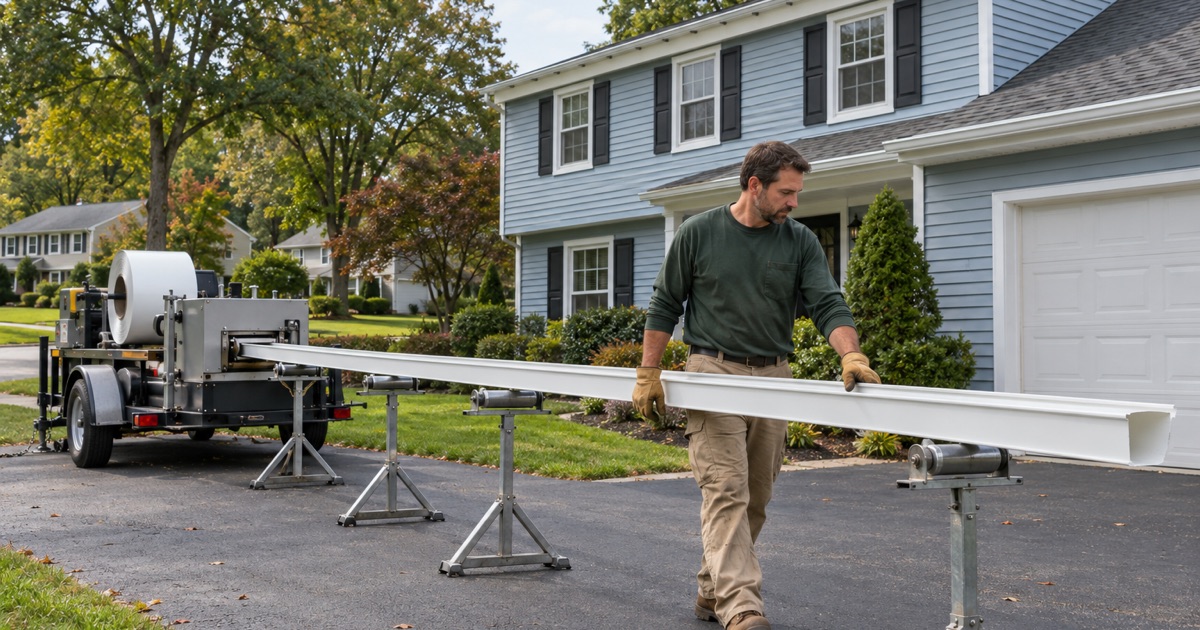
Most of our installations are seamless aluminum gutters on single-family houses. We roll each run from coil in a forming machine parked at the house, so a long eave gets one continuous piece instead of several joined sections. The only joints left are at the corners and end caps, which is where a seamless system is easiest to keep sealed.
Those houses range from small ranches to large two-story colonials with complicated rooflines. Each needs a different number of outlets, a different gutter width and a different plan for the water at ground level. We treat a dormered Cape and a hip-roofed colonial as different jobs, because they drain differently.
Gutter Installation on Commercial Buildings
Commercial roofs shed far more water per gutter than houses do, and they are designed to a stricter standard. In Monmouth County, the New Jersey plumbing subcode sets the design rainfall for commercial and multifamily roof drainage at 5 inches per hour. We size commercial gutters, leaders and outlets to carry that rate rather than borrowing residential sizes.
On offices, retail strips, churches and apartment buildings we install oversized K-style and box gutters, larger downspouts and wide-flange outlets. Many of these buildings also have flat roofs draining through scuppers into collector boxes. We coordinate the installation with property managers so the work fits around tenants and business hours.
Condominiums and Townhouse Associations
In a condominium or townhouse community, the first question is who owns the gutters. The master deed decides whether they are a common element maintained by the association or each owner’s responsibility. We check the deed or ask the management office before quoting, so an owner never pays for work the board is obliged to do.
For associations, we can price a whole building or a whole community at once. Matching profiles, colors and downspout layouts across many units keeps the buildings looking consistent. We schedule the work section by section and document each unit with photos for the board’s records.
Sizing, Profiles and Materials
Sizing Gutters to the Roof Area
A gutter’s job is set by the roof area that drains into it and how steep that roof is. A long, steep slope on a two-story house delivers water faster than a shallow porch roof of the same length. We measure each section and choose 5-inch or 6-inch gutters to match, along with standard or oversized 3x4 downspouts.
Sometimes the better fix is more outlets rather than a bigger gutter. Adding a downspout to the middle of a long run halves the distance water must travel, which lowers the peak load in the trough. We work out where outlets can go without dumping water onto a walkway or driveway.
K-Style and Half-Round Gutter Profiles
K-style gutters are the most common profile on houses here, with a flat back that sits tight to the fascia and a front edge shaped like crown molding. For a given width, they carry more water than a half-round gutter. They also take hidden hangers easily, which keeps the front face clean.
Half-round gutters are an open semicircle with a rolled double-bead edge, hung on brackets and paired with round downspouts. They suit older houses, Victorians and colonials where a K-style profile would look out of period. We match half-round work to the age and style of the house rather than offering it as a generic upgrade.
Aluminum Coil Thickness and Finish
We form residential gutters from .032 aluminum coil, heavier than the .027 stock common on budget installs. The thicker metal resists dents from ladders, falling limbs and ice, and it holds its shape between hangers on long runs. On a house with large roof sections, that stiffness keeps the pitch true for years.
The coil comes prefinished in a range of colors, so the gutters can match the trim, the roof or the siding. Downspouts, elbows and end caps come in the same finishes. On bayshore houses we also check the coil maker’s salt-air warranty terms before choosing a finish.
Copper Gutter Installation
Copper gutters, usually 16-ounce sheet, are a long-lasting choice for older homes and for owners who want the look. New copper is bright, weathers to brown within a few seasons and eventually turns the green patina seen on old churches. Joints are soldered rather than sealed, which is part of why copper lasts so long.
On a house in one of Middletown’s historic districts, such as Middletown Village, Navesink, Locust, Chapel Hill or Monmouth Hills, exterior work goes before the Landmarks Commission. Copper half-round gutters are often the right match there. We provide profile and material details for that review when they are needed.
The Details That Make a New Gutter Last
Hidden Hangers in Sound Fascia
We hang new gutters on hidden hangers screwed into the fascia, not on the spike-and-ferrule system that older gutters used. Spikes work loose as wood swells and shrinks, which is why so many old gutters lean away from the house. Screws hold their grip, and closely spaced hangers stiffen the gutter against snow and ice.
None of that matters if the fascia behind the gutter is rotten. When the old gutters come down, we probe the boards, show you any soft wood and replace it before hanging anything. On houses built before 1978 with painted trim, we follow the EPA lead-safe work practice rule whenever that repair disturbs paint.
Pitch, Outlets and Miters
A gutter must slope toward its outlets enough to drain completely between storms, but not so steeply that it looks crooked on the house. We snap a line for each run, set the hangers to it and check for standing water before calling the work done. Long runs often pitch both ways from the middle to two outlets.
Corners are joined with box, strip or bay miters, and outlets are cut with wide-flange drops that let water into the downspout quickly. Every joint is riveted and sealed with tripolymer gutter sealant. Downspouts turn at the wall and at the ground with A and B elbows chosen to keep the run tight to the house.
Roof-Edge Flashing
A new gutter cannot catch water that slips behind it. Where the roof edge lacks a gutter apron or drip edge, rain can run under the shingles’ lip and down the back of the gutter, rotting the fascia over time. We add the missing flashing so the water drops into the trough.
Where a lower roof meets a sidewall, a kickout flashing at the bottom of the wall steers water into the gutter. Without one, that water runs down the siding and into the wall cavity. We check every roof-to-wall joint during an installation and add kickouts where they are missing.
Our Step-by-Step Gutter Installation Process
Step 1: Measuring the Roof and Walking the Drainage
We measure every eave, note the roof areas and slopes draining to each run, and look at the fascia and roof edge. Then we follow each existing downspout to where its water ends up. Water pooling at the foundation, a soggy flower bed or a buried line that never drains all shape the new layout.
Step 2: A Written, Itemized Estimate
The estimate names the gutter size and material, the hanger type, the number and position of downspouts, and where each leader will discharge. New installation and any repair work appear on separate lines because New Jersey taxes them differently. You get a fixed written price before any work is scheduled.
Step 3: Tear-Off and Fascia Check
On installation day we remove the old gutters and hangers and inspect the fascia behind them. Any rotted board is shown to you before we replace it, so you see what you are paying for. Missing drip edge or kickout flashing is added at this stage, while the roof edge is open.
Step 4: Forming, Hanging and Testing
We form each run from coil, hang it on hidden hangers to a snapped pitch line, and seal every corner and outlet. Downspouts go up with their elbows and extensions, and each discharge point is set as the estimate described. Finally we run water through the system, confirm every outlet drains, and send you photos of the finished work.
- 20+ Years on Gutters
- Seamless, Formed On Site
- Before-and-After Photos