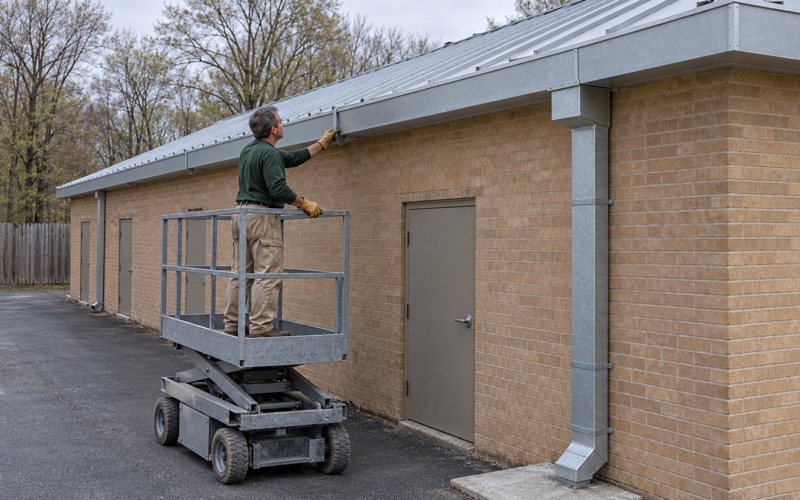
Middletown Quality Gutters has spent more than 20 years on gutters in Holmdel and across this part of Monmouth County, and on a large lot the first thing we ask is where the water goes after it leaves the roof. A gutter only collects. The downspout decides whether that water soaks in harmlessly, pools beside the house, or ends up somewhere it was never meant to be.
That question carries extra weight on a property with its own septic system. A disposal field depends on the soil around it being able to take what the house sends it, and a roof sheds a great deal of water during a short, heavy storm. When a leader empties straight toward the field, the system receives a load its design did not plan for, and the owner rarely sees the connection until something goes wrong.
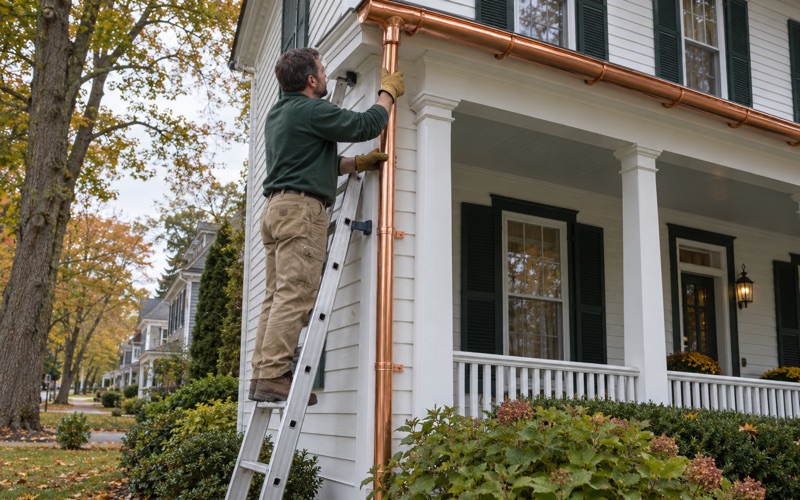
So every Holmdel estimate we write starts with a walk around the property. We follow each downspout to the spot where its water lands, note the septic tank and field if the owner knows where they sit, and propose an extension, pop-up emitter or drywell wherever an outlet works against the house or the system. The written estimate names the discharge point for every outlet we install.
Gutters on Holmdel’s Septic-Served Four-Acre Lots
The R-2H and R-4 Districts
Holmdel’s zoning code, Chapter 30, sets aside two single-family districts that are served by septic rather than sewer. Section 30-130.5a gives the R-2H and R-4 districts a minimum lot of 4 acres, a minimum width of 250 feet and a maximum coverage of 12 percent. That is a lot of open ground around each house, and some of it is working ground that treats wastewater.
Not every home in town is on septic, and we never assume. Parcel records for a number of Holmdel properties place them in the Bayshore Regional sewer service area, and service area is not the same as a connection. We ask the owner first, and when nobody is sure, we look for the tank lid and inspection ports before deciding where a new downspout should empty.
Why Coverage and Frontage Matter for Drainage
A 12 percent coverage cap means the house, driveway and outbuildings take up a small share of the lot, so roof water has plenty of lawn to spread across. That room is useful, but it also tempts a crew to aim a leader at the nearest stretch of open grass. On one of these lots, the nearest open grass is sometimes the disposal field itself.
Wide frontage brings long side yards and long distances between the roof and the street. We use that space to pick a discharge point that suits the grading, the field and the property line together. A downspout should not end three feet from a corner simply because that is where the last elbow happened to land when the gutters were first hung.
Seamless Runs Along Long Eaves
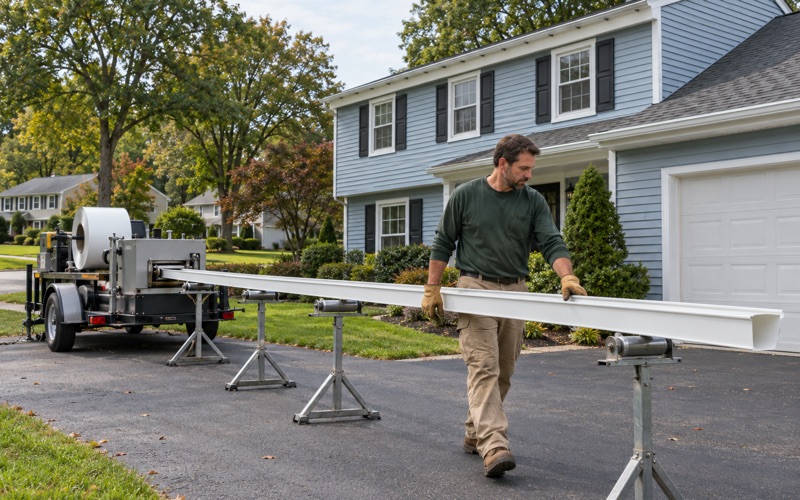
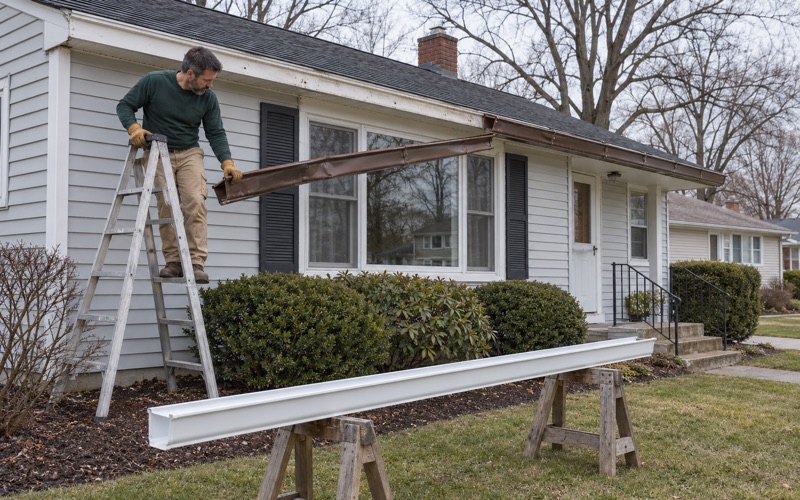
Houses on large lots are often stretched out, with long eave lines and wings that turn corners. We form seamless gutters on site from .032 aluminum coil, one piece for each run, so a long eave carries no mid-span joint to drip onto a walkway or a planting bed. Corners get box or strip miters, sealed with tripolymer gutter sealant and fastened on hidden hangers.
Looking for gutters closer to Eatontown? See Eatontown Gutters.
Keeping Roof Water Off the Leach Field
What the State Septic Standards Say About Surface Drainage
New Jersey’s septic standards include a surface drainage section, found in Chapter 9A of Title 7 of the state’s Administrative Code. It keeps disposal areas out of topographic depressions and places where runoff or groundwater tends to collect, unless the approved engineering design handles those conditions. It also allows swales to divert surface runoff away from the disposal field, but only as that approved design specifies.
That section never mentions roof drains or downspouts; it governs how the system is designed and built. What it does show is the assumption behind the design: surface water stays off the field. A leader aimed at the field works against that assumption, so we keep outlets clear of it and leave the approved swales exactly as the system’s design laid them out.
Finding the Field Before Choosing an Outlet
Many owners do not know exactly where their field lies. A few clues help: a rectangle of grass that greens up early or stays soft, a slight mound in the lawn, capped inspection ports, or the layout on the original permit drawings if the owner kept a copy. We ask about these before planning any extension, and we leave an outlet alone until the field is located.
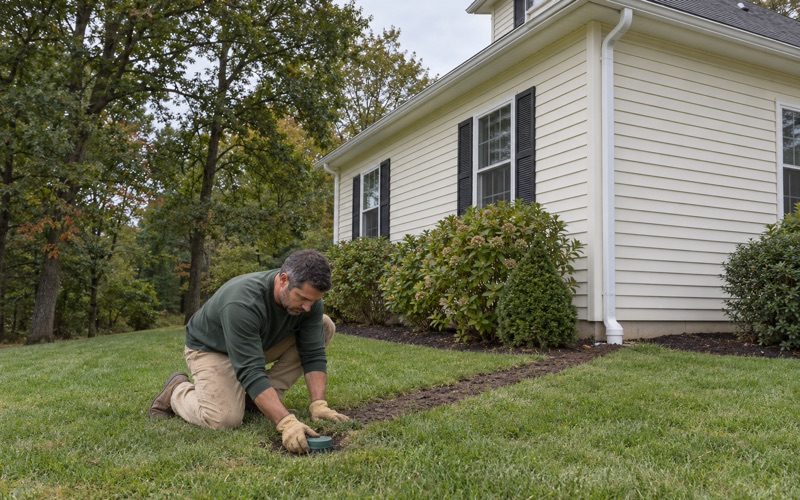
Once the field is placed, each downspout gets a destination that drains away from it and away from the foundation. On a slope that usually means turning the outlet downhill on the side opposite the field. On flatter ground it may mean a longer extension or a pop-up emitter set well clear of the field edge, where the lawn can absorb the water.
Buried Leader Lines and Where They Can Run
Underground downspout lines are popular on big lots because they keep extensions off the lawn and out of the mower’s path. They also cover more ground than a surface extension, and that is where the risk lies on a septic property. A trench dug straight across the field to reach a low corner disturbs the field and delivers water right where it does the most harm.
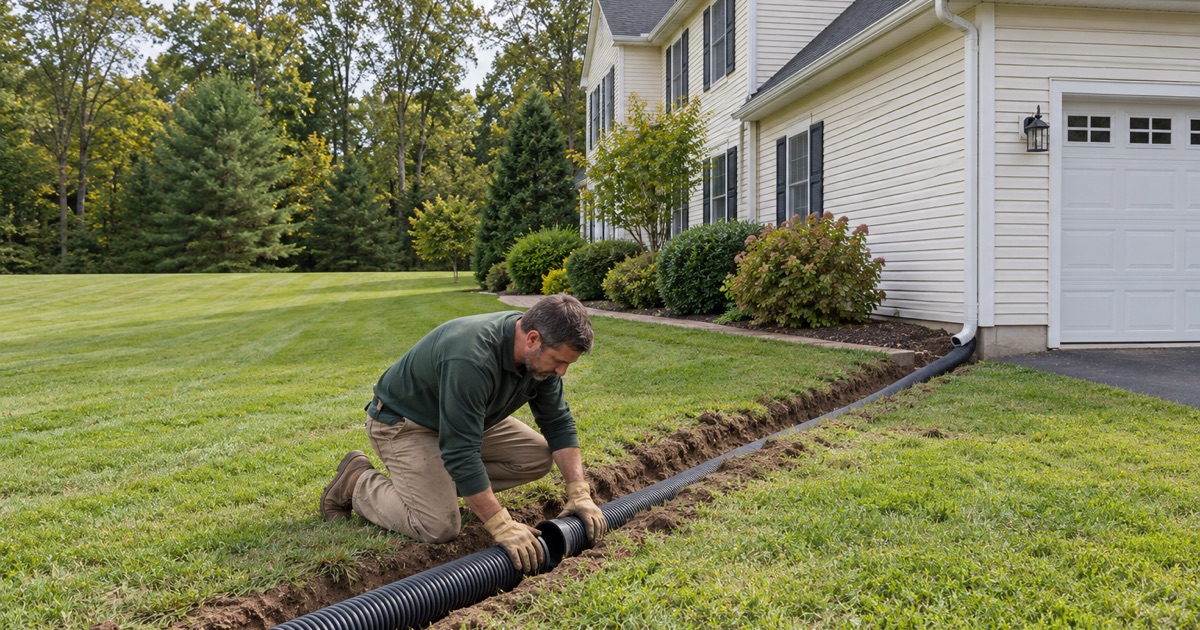
We route buried lines around the tank and the field, never over them, and end each one at a pop-up emitter or drywell placed where the grade carries water away. One section of Holmdel’s code, 30-137(k)(4), permits HDPE piping methods and materials for roof drain systems. Whatever the pipe, we never tie a leader outlet into a sanitary line or a septic tank.
Placing a Drywell on a Septic Lot
A drywell can absorb roof water close to where it falls, but on a septic lot its location deserves as much thought as the field’s. The state stormwater rule sets dry wells 2 feet above the seasonal high water table, and we keep any drywell well apart from the disposal area so the two are not asking the same patch of soil to take water at once.
Runoff Toward the Neighbor on a Large Lot
The Property Line Is Part of the Plan
The same surface drainage section adds one more requirement: a septic system must not increase stormwater runoff to, or ponding on, adjoining properties, including during construction, unless every affected owner agrees in writing beforehand. That language covers the system rather than the gutters, but it states a fair principle for any drainage choice on a big lot. Water should stay on the property that shed it.
Large lots can hide this problem for years. An extension that points toward a property line two hundred feet away looks harmless on a dry afternoon, until a long storm sends a sheet of water across that distance and into the yard next door. We look at where each outlet points, where the ground falls, and where the water will be after an hour of steady rain.
Slopes Around Crawford Hill
Holmdel is hilly by Monmouth County standards. Crawford Hill, at about 391 feet, is the highest point in the township and in the county, and the highest summit of New Jersey’s coastal plain. The township’s zoning recognizes grade as well, requiring at least two extra parking spaces near the street where a driveway exceeds an 8 percent slope.
On a sloped lot, an outlet aimed downhill can carry water toward a driveway, a foundation or the house below. We set extensions and emitters where the ground can take the water before it gains speed, and we pitch the first stretch away from the foundation, so the house is protected before the property line ever comes into question.
Kickout Flashing and Splash Points
Not every runoff problem starts at a downspout. Where a lower roof meets a sidewall, a missing kickout flashing can send water down the siding and onto the ground at a spot no gutter serves. We check the gutter apron, drip edge and kickout flashing along every run, because water that misses the gutter still lands somewhere on the lot, and often somewhere nobody planned for it.
Leaves From Big Lots and Township Buffer Trees
Canopy Trees in Township Buffers
Holmdel’s zoning leans on trees. Under Section 30-154.9, required landscaped buffers carry two canopy trees, meaning large deciduous trees, for every 1,500 square feet of buffer area, and the township has a Shade Tree Committee that approves landscaping in some applications. Large lots tend to keep mature trees along their edges, and every autumn a share of those leaves ends up in the gutters.
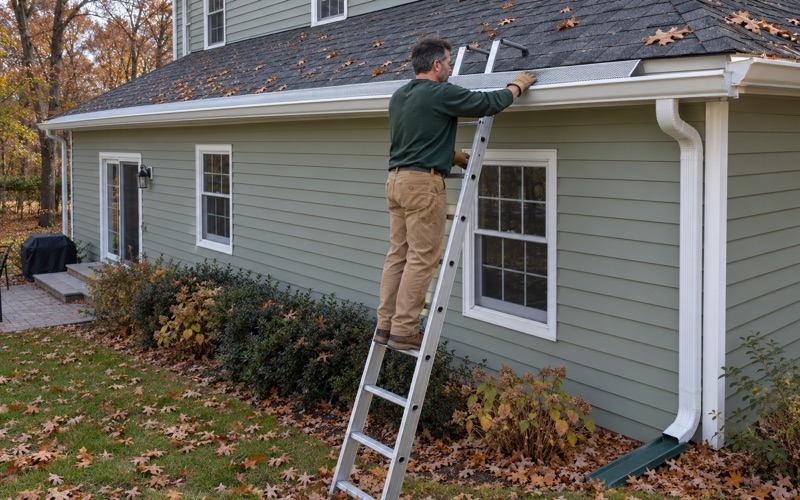
A clogged gutter on a septic lot fails in the wrong place. Water overtops the front lip and falls in a sheet along the foundation and wherever the eave happens to sit, instead of leaving through the outlet we chose with the field in mind. Keeping the troughs clear is what keeps the whole drainage plan doing its job between visits.
Guards Matched to the Trees on the Lot
Pine needles and oak leaves call for different screens. Needles slip through coarse guards and mat on top of others, so where pines hang over the roof we usually recommend stainless steel micro-mesh gutter guards. Where broad oak and maple leaves dominate, a sturdier screen that sheds whole leaves may fit better. We look at what actually grows over the roof before quoting any guard.
Cleaning Visits, Photos and the Fascia Behind
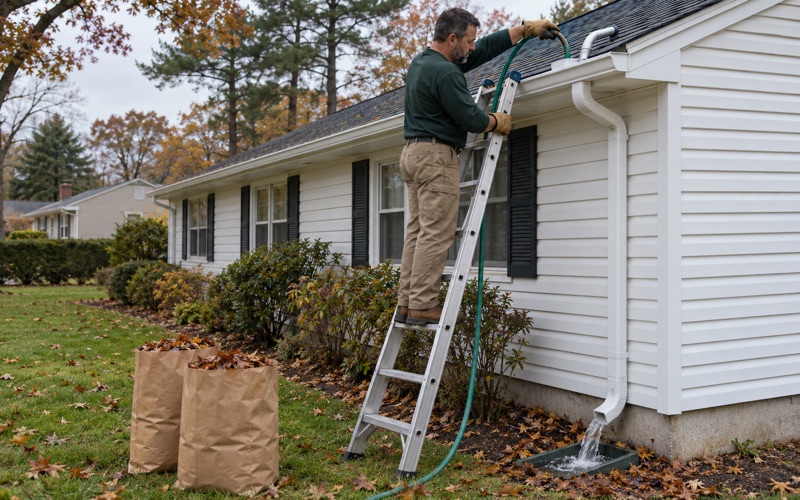
Our cleaning visits flush every downspout, including buried lines that have a cleanout, and bag the debris so nothing is left on the lawn or at the curb. Owners receive before-and-after photos with every cleaning and repair, which matters on a big property where the back of the house sits far from where anyone usually stands.
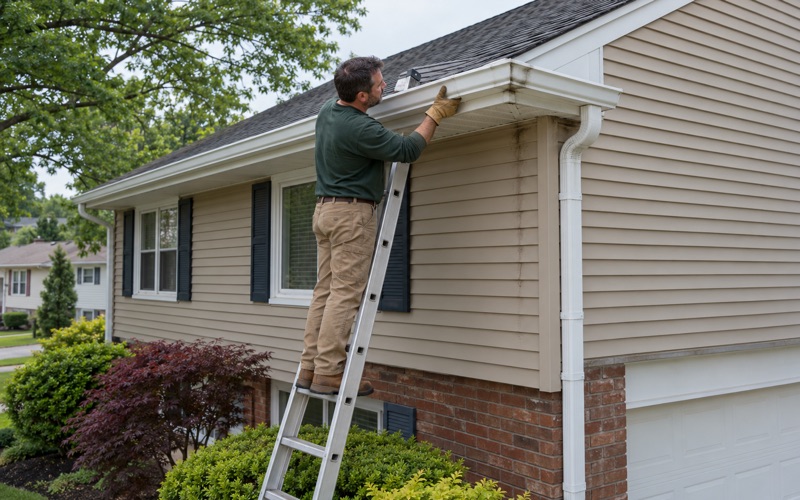
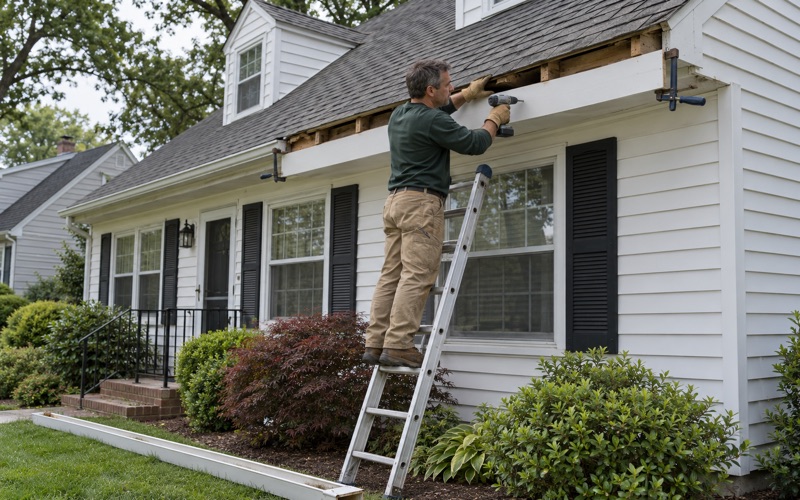
Before new gutters go up, we probe the fascia behind them for rot and show the owner any soft wood before replacing it. Our estimates list new gutters and repair work on separate lines, because New Jersey taxes them differently: new gutters count as an exempt capital improvement, while repairing existing gutters is a taxable repair.
- 20+ Years on Gutters
- Seamless, Formed On Site
- Before-and-After Photos