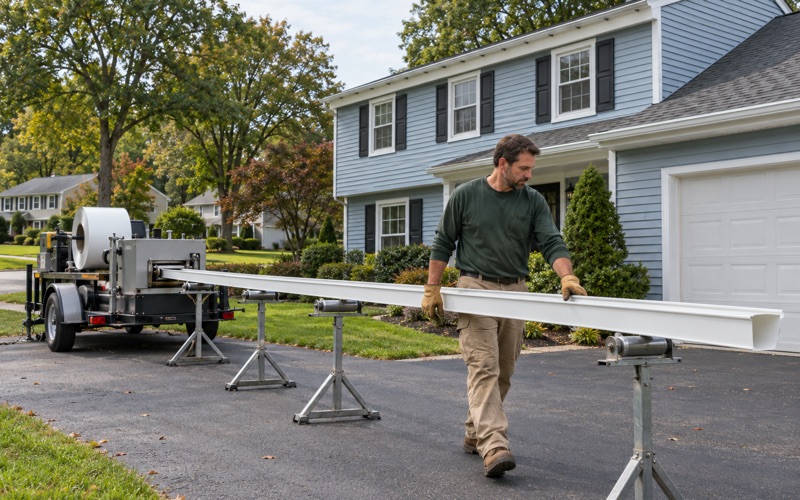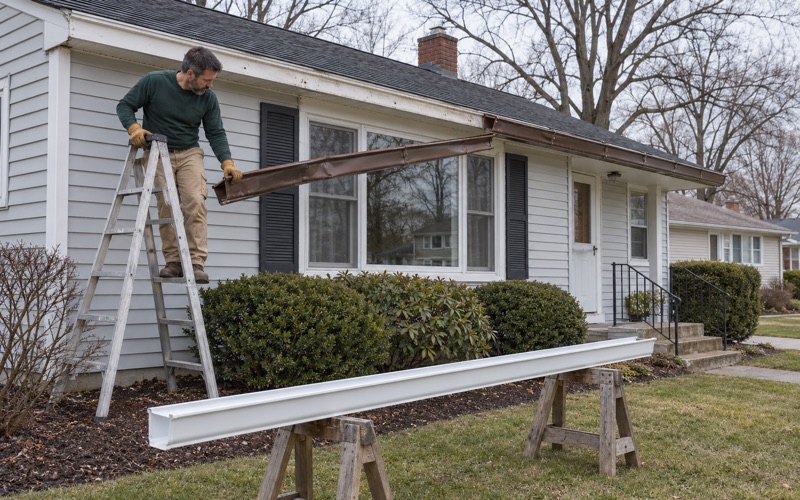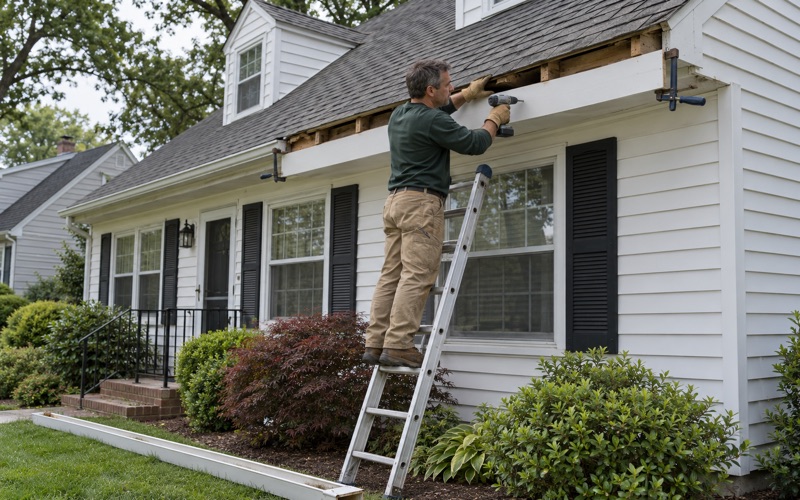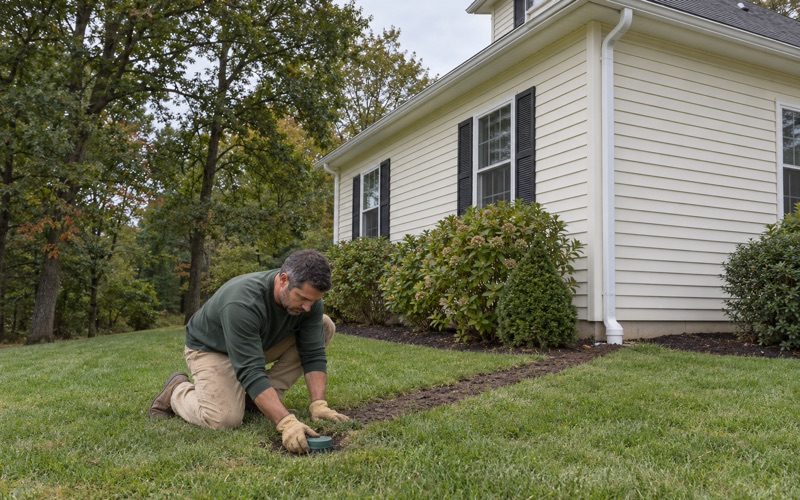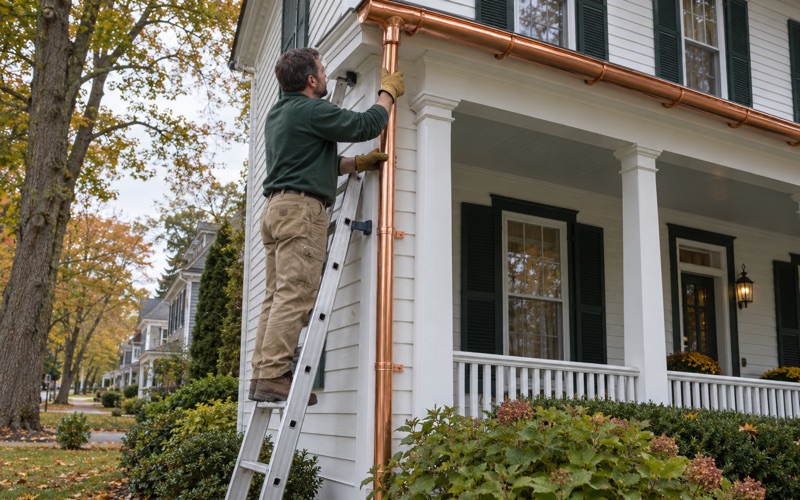
Middletown Quality Gutters has spent more than 20 years installing, repairing and cleaning gutters in Leonardo, and on this stretch of the bayshore the work comes with a question most gutter jobs never raise: where does the house sit on the flood map? We size every run to the roof area that feeds it, form seamless gutters on site, and follow each downspout to where its water lands.
For many Leonardo owners, gutters are not a stand-alone project. They come up during a renovation, an addition or a repair after a storm, and that matters because Middletown Township counts gutter and downspout costs when it decides whether a flood-zone project has grown large enough to require the house to be elevated. Knowing that before the estimate is written prevents surprises later.
This page walks through how we handle it: the flood zones that apply here, the township’s 50 percent test, drainage on raised houses, the paperwork a larger permit carries, and how bay air and an older housing stock shape the materials we suggest. Our estimates put new gutters and repair work on separate lines, because New Jersey taxes the two differently.
Gutters for Leonardo Homes in the AE and VE Flood Zones
What FEMA’s Flood Map Shows Here
Leonardo is an unincorporated community on the north shore of Middletown Township, set along the Raritan Bayshore. When we queried FEMA’s National Flood Hazard Layer at the village’s own coordinates, it returned zone AE with a base flood elevation of 12 feet. A second point closer to Sandy Hook Bay returned zone VE, the coastal high hazard zone where wave action is expected, with a base flood elevation of 13 feet.
Zone AE carries a set base flood elevation, and zone VE adds the force of breaking waves on top of it. Both are Special Flood Hazard Areas, and that designation is what brings the township’s rules on work to existing buildings into play for a Leonardo house. Those rules are Middletown’s, since Leonardo is a census-designated place inside the township rather than a separate municipality.
Checking the Zone Address by Address
Flood zones follow the map, not the community name. A third point near the southern edge of Leonardo reads zone X, the 0.2 percent annual chance area, which sits outside the Special Flood Hazard Area. Two houses a few blocks apart can fall under different rules, so we never assume a zone from the street or the neighborhood.
When a gutter job is part of a larger project, we ask the owner to confirm the zone for that exact parcel, or we look it up together before the estimate is finished. If the house reads zone X, the gutter work is priced as ordinary work. If it reads AE or VE, we write the estimate knowing the township may add it to a running total.
Where Gutters Enter the Flood-Zone Math
A gutter replacement by itself is a modest line item against the value of a house. The picture changes when gutters ride along with a kitchen renovation, a new roof, an addition or repairs after a storm. In that case Middletown looks at the whole project’s cost, and the gutters and downspouts are part of the sum it compares to the building’s value.
That is why we ask early whether other work is planned on the house. If a roof, siding or interior renovation is coming, the owner benefits from seeing the gutter number alongside those estimates. It lets them and their general contractor judge the total against the township’s threshold before anything is signed.
Looking for gutters closer to Red Bank? See Gutters in Red Bank.
Why Middletown Counts Gutters Toward the 50 Percent Rule
Roofing, Gutters and Downspouts on the Included List
Middletown’s Construction Official, Joseph Kachinsky, issued a notice for work on existing buildings in Special Flood Hazard Areas, with substantial improvement and substantial damage worksheets attached. Its list of included costs, under structural elements and exterior finishes, names ‘Roofing, gutters, and downspouts’ directly. Those costs are added to the rest of the project when the township checks the total.
The same attachment lists what is left out, such as clean-up and trash removal, permit fees, and outside improvements like landscaping, sidewalks, driveways and fences. Gutters are not on that excluded side. On a Leonardo house that is already close to the line, the gutter and leader portion of an estimate is a number worth knowing precisely.
Market Value and the Tax Assessment
The test compares the project’s cost to 50 percent of the building’s market value, counting the structure only and excluding land, accessory structures and landscaping. The notice says the township will use the tax assessment value of the building as its estimate of market value. That gives an owner a way to see roughly where the line sits before the estimates come in.
The notice also points out that a building can be substantially damaged by any cause, including fire, flood, high wind, land movement or neglect. Repair costs after any of those events count the same way, gutters included. Questions about a particular house go to the township at 732-615-2106, and we point owners there rather than guessing at an answer.
What Happens When a Project Crosses the Line
A building that is substantially improved or substantially damaged must be brought into compliance with the requirements for new construction. In Middletown that means the lowest floor elevated to one foot above the base flood elevation. The township’s base flood elevation page calls this the Design Flood Elevation: the FEMA base flood elevation plus one foot of freeboard.
That is why we keep gutter costs separate and clearly itemized on any Leonardo estimate that belongs to a bigger project. The owner, the general contractor and the township can all see exactly what the gutter work adds, and nobody has to guess whether it was folded into another trade’s number.
Downspouts on Raised Houses and Flood-Zone Permits
Longer Leaders on Elevated Homes
Middletown requires new construction and elevated homes to meet the Design Flood Elevation under Flood Hazard Ordinance 2022-3346, adopted June 2022, so raised houses are part of what we work on along the bayshore. On a house lifted several feet above grade, the downspouts run longer, the leader leaves the gutter higher, and every joint and strap has more distance to cover.
We size each downspout for the roof area that drains to it, and on a tall run we fasten it at closer intervals so wind off the bay does not work it loose. Elbows are placed so the leader follows the structure rather than hanging free in the open space beneath the house.
Where the Water Lands Under a Raised House
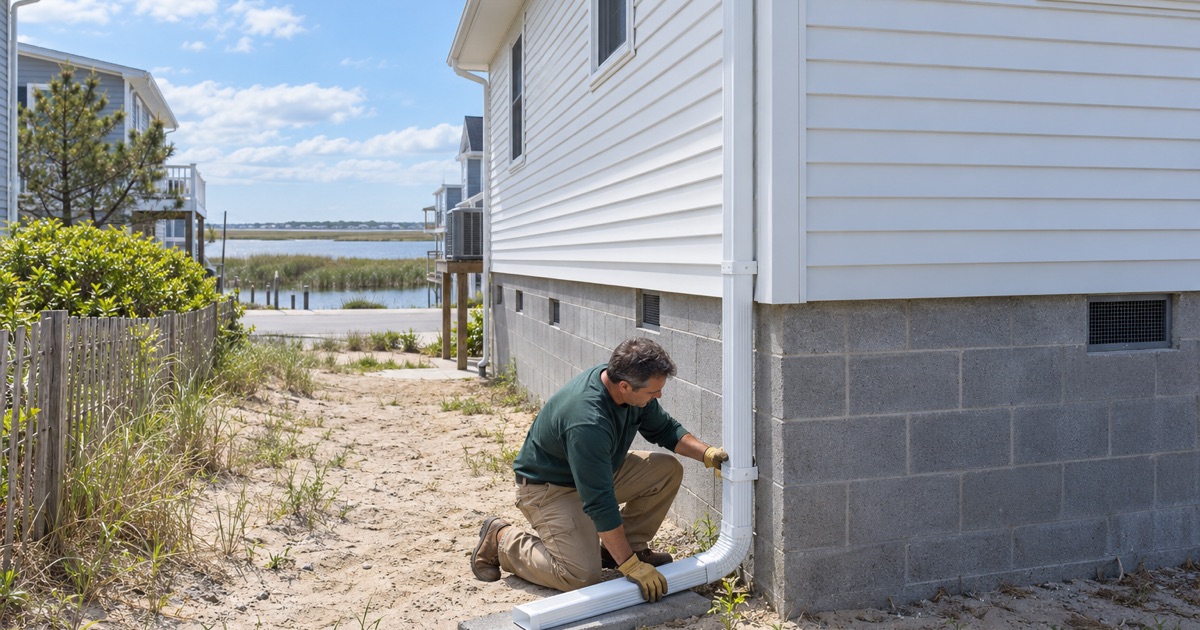
Discharge is the part most often overlooked on an elevated house. The bottom of a leader can end up beside a pier, against a breakaway enclosure or in the open area under the floor, places where steady runoff does damage over time. We follow every downspout to where its water lands and propose an extension, a pop-up emitter or a drywell where it collects at the foundation.
Our estimates state where each leader will discharge, and none is ever tied into the sanitary sewer. On a lot with little room between the house and the property line, that decision is made before the gutters go up, not after the first heavy rain shows where the water wants to go.
Gutter Work Inside a Larger Flood-Zone Permit
When gutters are one part of a substantial improvement review, the township’s notice asks for a full package: exterior photographs, a detailed description, a cost estimate, a copy of the insurance claim estimate, an elevation certificate, and signed affidavits from the owner and the contractor. We supply our portion of the estimate in a form the general contractor can include without retyping it.
The contractor’s affidavit attests that the estimate covers all of the work and that any added work requires a revised estimate. That is one more reason we write the gutter scope completely the first time. A downspout added halfway through the job can mean a revised estimate, not a quiet extra.
Elevation Certificates and the Final Sign-Off
On a house being elevated or built new, Middletown requires an elevation certificate when the lowest floor is placed and again at completion, as a condition of the certificate of occupancy. Gutters usually go on near the end of that sequence. We schedule our work so it does not hold up the final certificate, and we leave the downspouts finished and discharging where the plan shows.
Bay Air, Older Detached Houses and Gutter Materials
Salt Air off Sandy Hook Bay
Leonardo fronts Sandy Hook Bay, and salt air changes how we think about materials. Some manufacturers exclude salt or salt-spray atmospheres from their finish warranties, and Englert’s seamless aluminum gutter finish warranty is one that does. Whether a given product’s warranty applies on a bayfront house is a question for that manufacturer’s own document.
So on Leonardo houses near the water we choose gutter coil, hangers and fasteners with the manufacturer’s salt-air terms in hand, and we tell the owner what the warranty does and does not cover. Matching fasteners to the gutter material also matters near the bay, since mixed metals tend to corrode faster where salt is present.
Older Houses and the Fascia Behind the Gutter
Leonardo’s housing is mostly older and detached. Census estimates count 359 of the community’s 979 housing units as built 1939 or earlier, and 887 of them are detached single-family houses. On a house that old, the fascia board behind the gutter may have spent years taking water from a failing gutter before anyone looked closely.
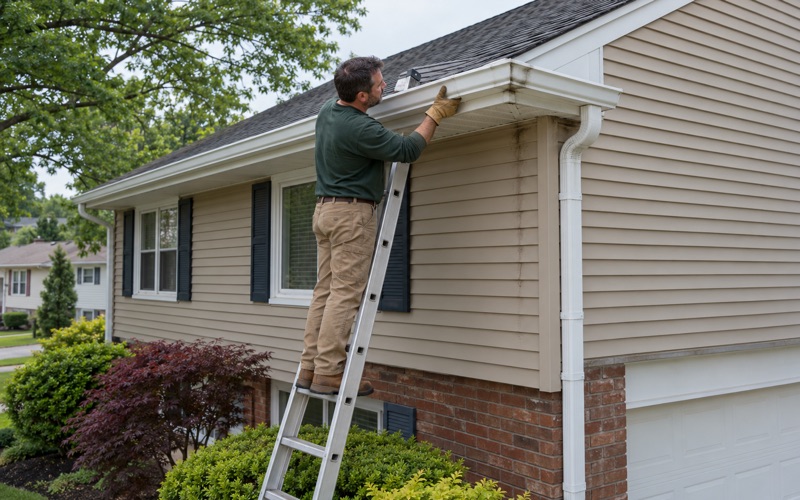
We check the fascia for rot before any new gutter is hung, and we show the owner the soft wood before we replace it. On pre-1978 houses with painted fascia and trim, that repair falls under the EPA Renovation, Repair and Painting rule, so we plan the work around it rather than discovering it midway.
Copper and Half-Round for Period Houses
Some of Leonardo’s older houses suit something other than a standard K-style profile. Where the age and style of the house call for it, we fit half-round gutters with a double-bead profile or 16-ounce copper that weathers to a patina. For most houses, 6-inch K-style seamless gutters formed on site from .032 aluminum coil, one piece per run, remain the practical choice.
Guards and Cleaning on Bayshore Lots
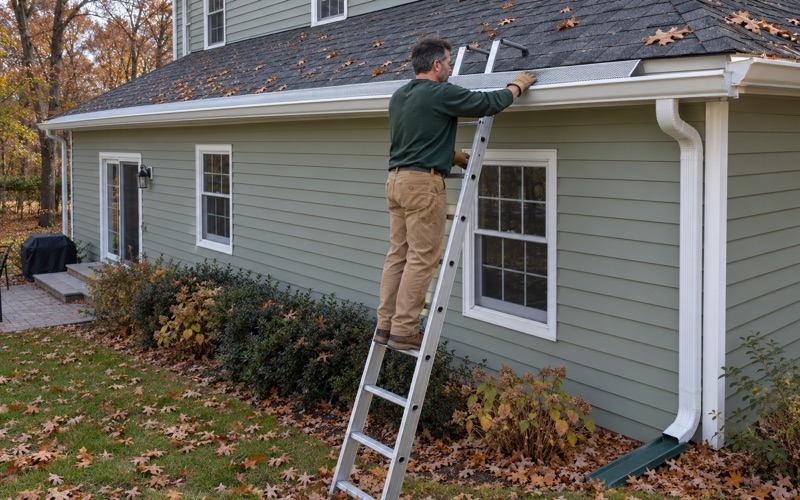
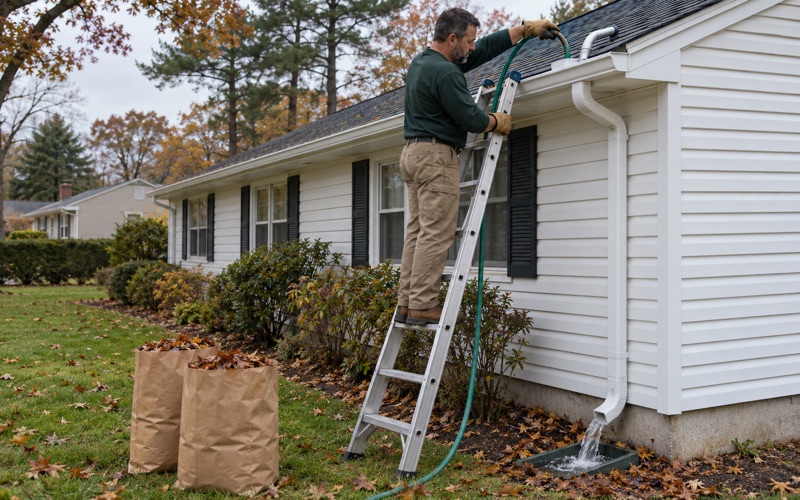
Guards are chosen for the trees on the lot, since pine needles and oak leaves call for different screens, and stainless steel micro-mesh suits lots where the debris is fine. On cleaning visits we flush every downspout, bag the debris so nothing is left on the lawn or at the curb, and send before-and-after photos of the work.
We also set outlets and elbows so a cleaning visit can reach them. Box, strip and bay miters are sealed with tripolymer gutter sealant, and a kickout flashing goes where a roof edge meets a sidewall, so water from the bay-facing slopes ends up in the gutter rather than behind the siding.
- 20+ Years on Gutters
- Seamless, Formed On Site
- Before-and-After Photos