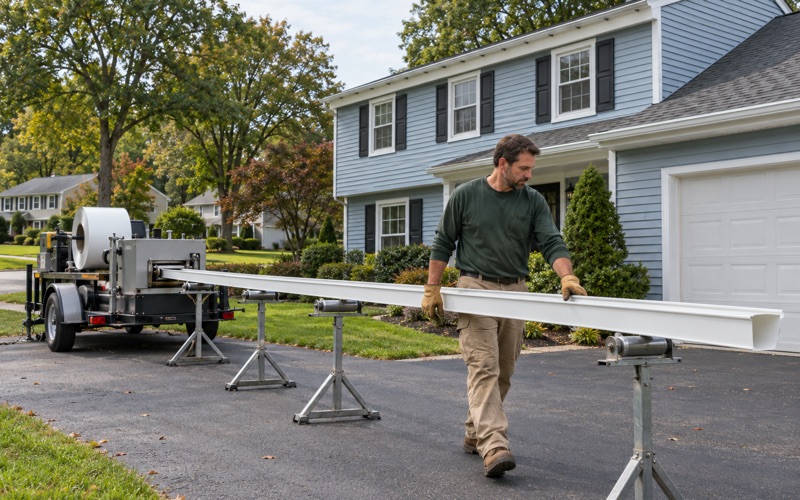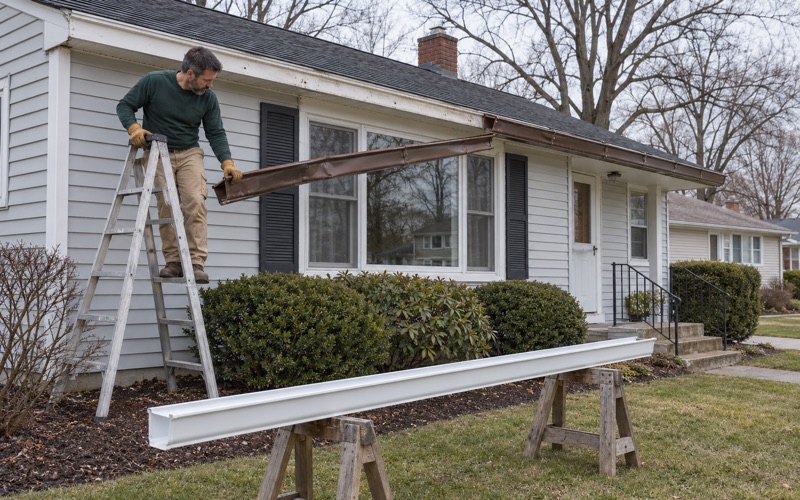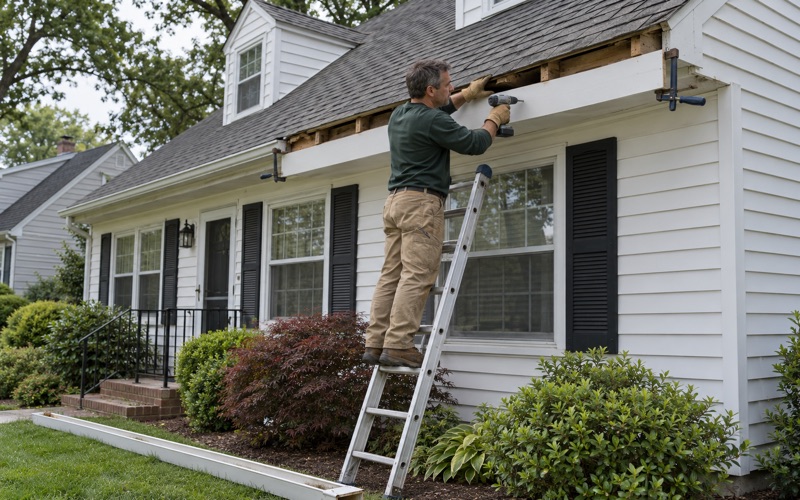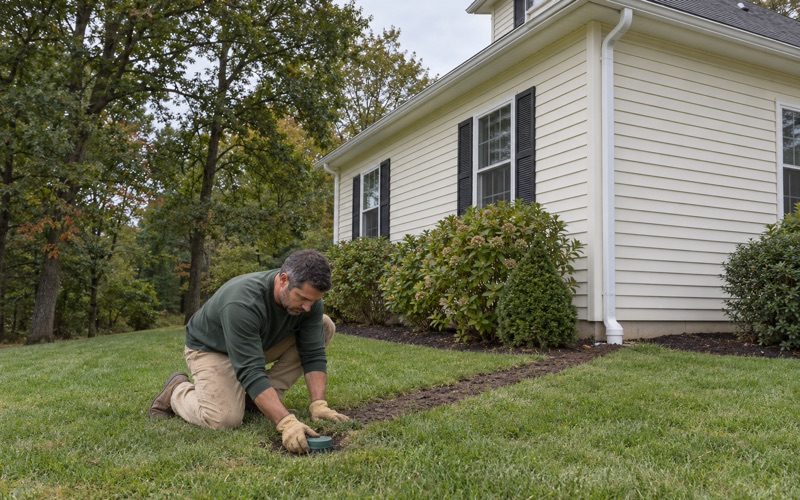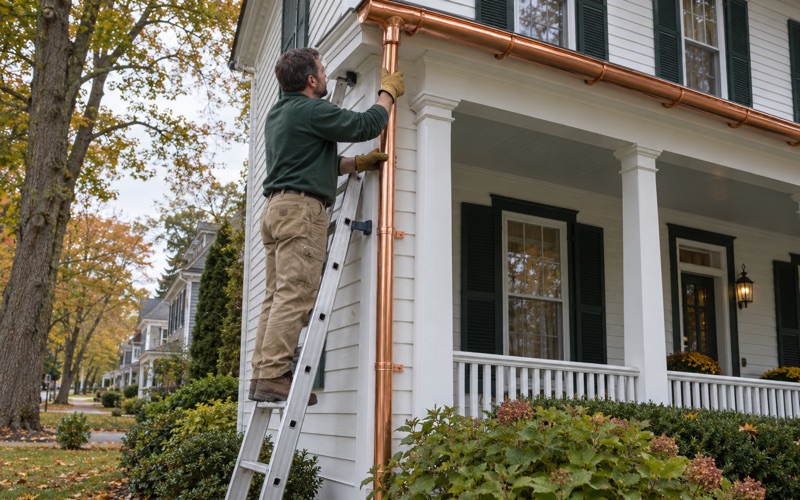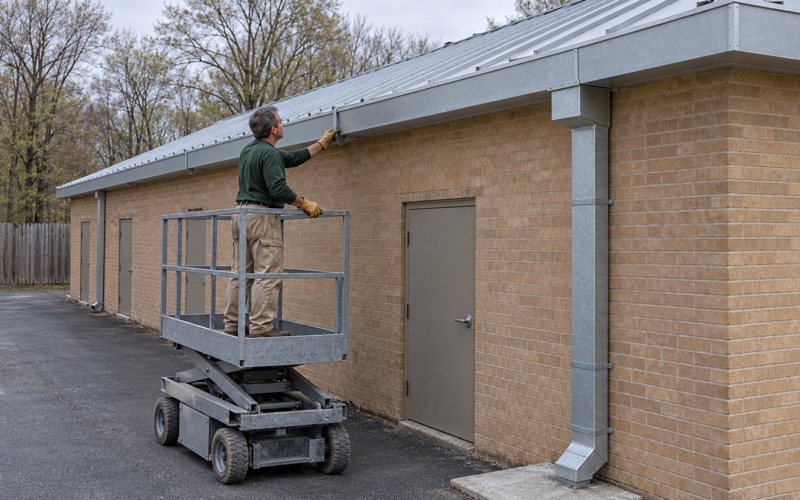
Middletown Quality Gutters installs, repairs and cleans gutters in Manville, and more than 20 years in the trade stand behind every run we hang. Our seamless gutters are formed on site from coil, one continuous piece for each run of the house, and the gutter and downspout sizes come from the roof area that actually drains into each run rather than from habit.
What sets a job here apart is where the water goes once it leaves the gutter. Every estimate we write says where each leader will discharge, and no leader outlet we install is ever tied into the sanitary sewer. In this borough that is more than good practice: it is a condition of selling, leasing or re-occupying the building.
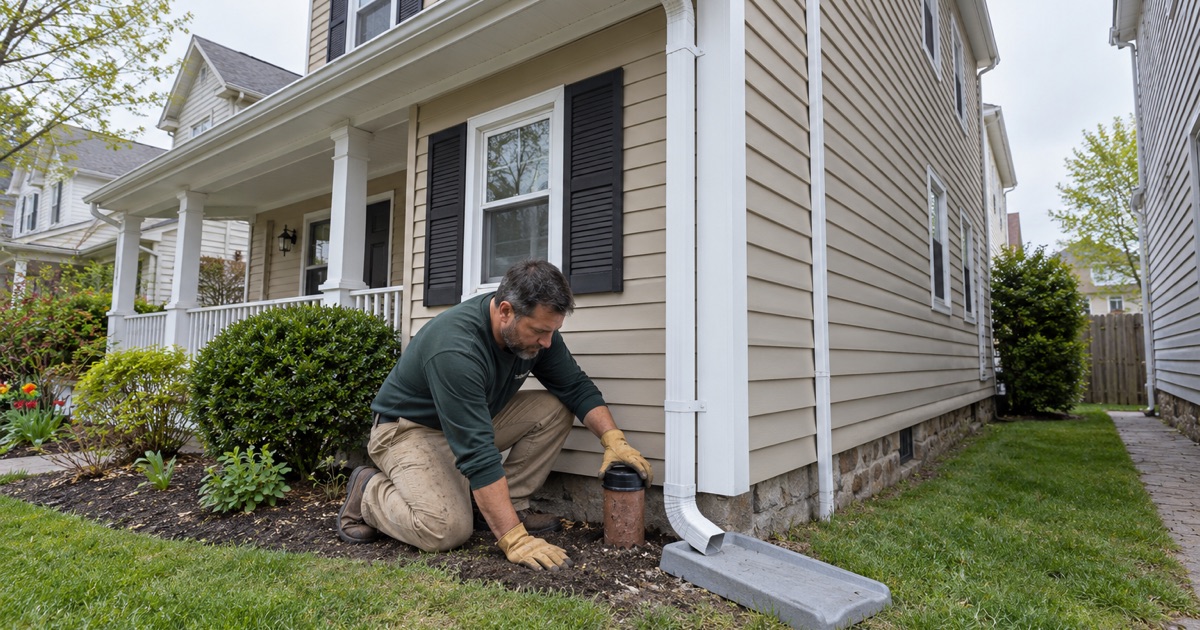
We also follow each downspout to the spot where its water lands. When it pours against a foundation, we propose an extension, a pop-up emitter or a drywell instead. New gutters and repair work appear on separate lines of the estimate, because New Jersey taxes the two differently, and before-and-after photos come with every cleaning and repair.
Gutters, Leaders and Manville’s Sewer Certificate
What Ordinance 2020-1233 Says
Borough of Manville Ordinance 2020-1233 took effect June 1, 2020, after the council introduced it on April 13 and adopted it on April 27. Its first section is short and direct: no sump pump or other device that discharges rainwater or ground water, ‘including but not limited to downspouts,’ may be connected to the borough sanitary sewer system.
The recitals explain the reason. Manville’s committed flow to the Raritan Valley Sewage Authority wastewater treatment plant had passed 80 percent of its permitted flow, and the ordinance quotes the state rule calling for roof leaders, sump pumps and other sources of inflow to be disconnected from sanitary lines. Roof water sent down a sanitary pipe counts against that same limited capacity.
A Certificate Before Any Sale, Lease or Change in Occupancy
Section 2(A) is the part most owners meet. No building in Manville may be sold, leased, rented or occupied by someone new until the Manville Building Department issues a certificate that no such device is connected. The seller or landlord applies at least ten days ahead and pays a $25 fee, and the Zoning Officer performs the inspection.
If the inspection finds a violation, the owner receives a notice and has 21 calendar days to correct it. Fines start at $100 per day once that remediation deadline passes, and the charges become a lien on the property. The seller and the new owner are jointly and severally responsible, so a leader left on the sewer does not simply become the buyer’s problem.
What the Certificate Is About
The certificate concerns sewer connections of sump pumps and downspouts. Nothing in the ordinance turns it into a review of gutter condition, so a sagging run or a leaking miter is not what it addresses. What matters for the certificate is that each leader on the house empties somewhere other than the sanitary sewer before the application goes in.
A sale is still a sensible moment to look at the gutters themselves, since New Jersey’s home inspector rules require a buyer’s inspector to report roof drainage deficiencies. We can answer both questions in one visit: where every leader goes today, and whether the gutters feeding those leaders are sound enough to keep through the next owner’s first few seasons.
Looking for gutters closer to Fairview? See Gutters in Fairview.
Taking a Downspout Off the Sanitary Sewer
Finding Where Each Leader Really Goes
Most of Manville was built long before the rule existed. Of the borough’s 4,639 housing units, 60.5 percent date from 1940 through 1969, and on houses of that age a leader that disappears into the ground at a corner does not always show where it ends up. We trace each one before we quote, rather than assuming a buried pipe runs to the street.
When a leader turns out to be tied to the sanitary line, it is cut above grade, the opening into the sanitary pipe is sealed, and the water gets a new discharge point. The state rule quoted in the ordinance favors sending roof leaders into storm sewer lines where storm sewers are available and to the extent feasible; where that is not practical, the water goes onto the lot.
Two-Family Houses and Rentals
Manville carries a lot of two-family housing: 24.2 percent of its units sit in two-unit buildings, and 523 renter households live in them. Because the certificate is required at every lease and change in occupancy, not only at a sale, a landlord who owns a two-family house meets the rule each time a unit turns over.
For those owners, settling every leader once is simpler than revisiting the question with each new tenant. We put the discharge point for each outlet in writing on the estimate, which leaves the owner a clear record to work from whenever the next application goes to the Building Department.
Sizing the New Run
Disconnecting a leader is often the right moment to reconsider the gutter above it. Because we size gutters and downspouts by the roof area draining to each run, a long rear slope may call for 6-inch K-style seamless gutters with 3x4 downspouts where a smaller section has been overflowing at the outlet during heavy rain.
New runs are formed from .032 aluminum coil and hung on hidden hangers, which hold better over time than the old spike and ferrule. Outlets are wide-flange, and joints and end caps are sealed with tripolymer gutter sealant. On an older house that suits it, we can match copper or half-round work to the age and style of the home instead.
Where Leader Water Should Land on a Manville Lot
Grade, Extensions and Pop-Up Emitters
Once a leader leaves the sewer, its water still has to go somewhere, and the foundation is the wrong answer. The 2021 New Jersey edition of the International Residential Code, Section R401.3, has the grade fall 6 inches within the first 10 feet from the foundation, and we place each discharge where that slope can carry water away.
On most lots that means an extension or an underground downspout line running out to a pop-up drainage emitter. We look at where the emitter will surface as well, so the water is not simply moved to a neighbor’s side yard or onto a driveway or walk that ices over in winter.
Drywells and the Water Table
A drywell can take roof water out of sight, but the New Jersey stormwater rule sets dry wells 2 feet above the seasonal high water table. The Raritan River and its tributary the Millstone meet in the borough’s northeastern corner, and on lots near the rivers that separation may not be there, so we confirm it before proposing a drywell.
Digging in the Claremont Development
Gutters work above ground, but a buried leader line or a drywell means digging. In the Claremont Development, EPA records residual contamination left beneath 21 properties under deed notices from August 2008, 15 of them shallower than 14 feet. On those lots we raise the deed notice with the owner before any trench is planned, and an above-ground extension is often the simpler route.
Cleaning and Guards Between Storms
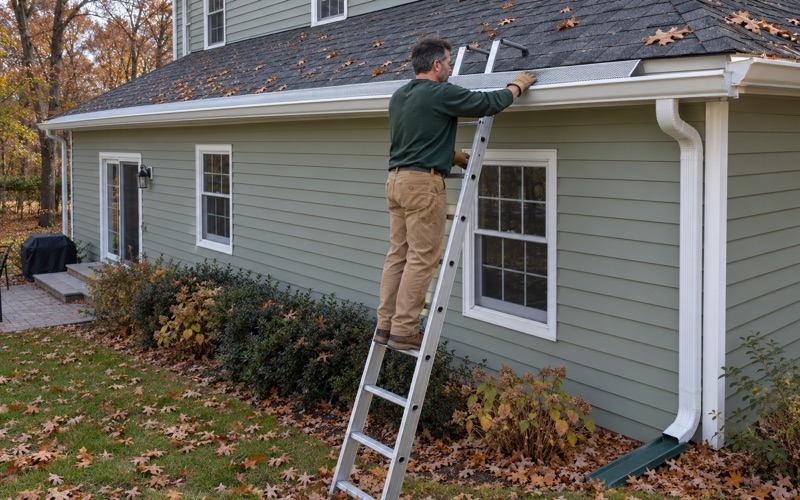
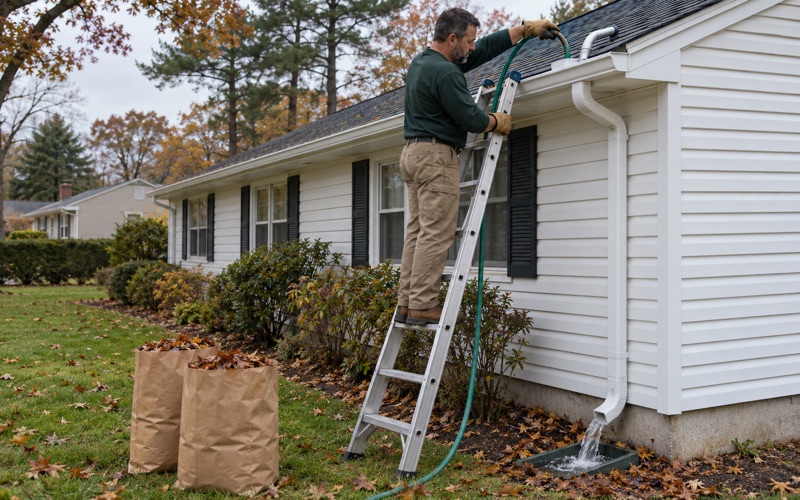
A leader that has just been rerouted only works if the gutter feeding it stays clear. Our cleaning visits flush every downspout and bag the debris, so nothing is left on the lawn or at the curb, and the photos show each run before and after. That matters most on a house where a clogged outlet now spills toward the yard.
Where trees overhang the roof, we match the guard to what falls from them, because pine needles and oak leaves call for different screens. Stainless steel micro-mesh gutter guards handle fine needles well, while a coarser screen can be enough under broadleaf trees, and either one cuts down on how often the leaders need flushing.
Gutters on Flood-Zone Houses After Ida
What Hurricane Ida Did Here
Hurricane Ida set the record on the Raritan River gauge at Manville: 27.66 feet on September 2, 2021, against a flood stage of 14 feet. That crest topped Floyd’s 27.1 feet from 1999 and Irene’s 26.24 feet from 2011. Afterward, borough teams checked more than 500 houses and found over 200 of them substantially damaged.
A substantially damaged house must either be elevated, with its first floor at least four feet above the Base Flood Elevation, or bought out. The borough’s own handout notes that NJDEP Blue Acres has purchased over 150 houses in Manville since the 1990s, and the same handout puts elevation at $100,000 to $150,000 or more.
Gutters on an Elevated House
Raising a house changes its gutters. Downspouts that once dropped a single story now run much longer, the leaders need new elbows and straps where they cross a taller foundation wall, and each discharge point has to clear the flood vents. We lay out every run with A and B elbows so it follows the new wall closely rather than standing off it.
We also check the fascia behind the gutter before anything new goes up, and any soft wood we find is shown to the owner before it is replaced. Most Manville houses predate 1978, so when painted fascia and trim are disturbed, the work falls under the EPA Renovation, Repair and Painting rule for older homes.
Gutter Work and the Floodplain Administrator
The state construction code treats the repair, replacement or installation of exterior gutters and leaders as ordinary maintenance. In the regulated flood area, though, Ordinance 2021-1260 has the Floodplain Administrator evaluate ordinary maintenance and minor work through a floodplain development permit and count its cost in substantial damage and improvement calculations.
That ordinance lists roofing, not gutters, so whether a gutter job falls under its ‘etc.’ is a question we put to the Floodplain Administrator rather than guess at. Since November 2022 the borough also adds future flood repair figures to the Ida numbers, and a total over 50 percent brings a substantial damage letter, so owners in the flood area should keep every invoice.
Planning Ahead of a Sale or Lease
If a Manville house is headed to market or to a new tenant, call us before the certificate application goes in rather than after a notice arrives. We trace the leaders, write down where each one will discharge, and handle any gutter repairs at the same visit, so the ten-day window is spent waiting on the inspection instead of on work.
- 20+ Years on Gutters
- Seamless, Formed On Site
- Before-and-After Photos