Middletown Quality Gutters brings more than 20 years of hands-on work to gutters in Middlesex, and we approach every house with one question in mind: where does the roof water go once it leaves the gutter? A gutter only collects. The downspout decides where hundreds of gallons from a single storm come down, and on a compact borough lot that choice shapes what the yard, the foundation and the property line have to absorb.
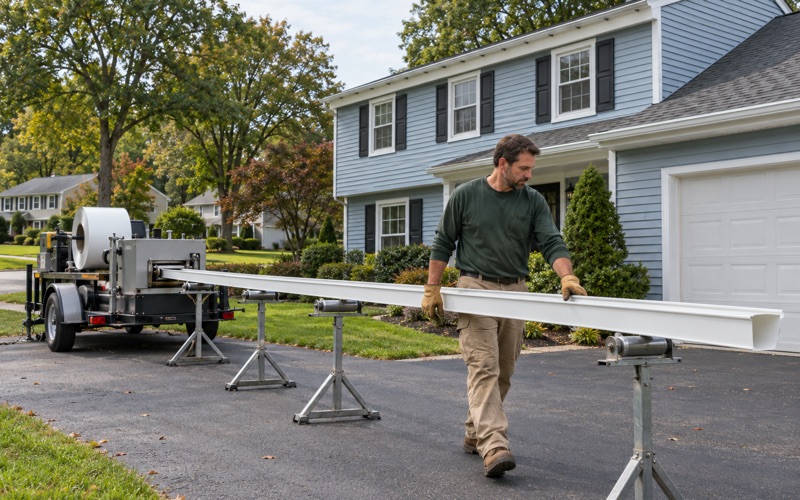
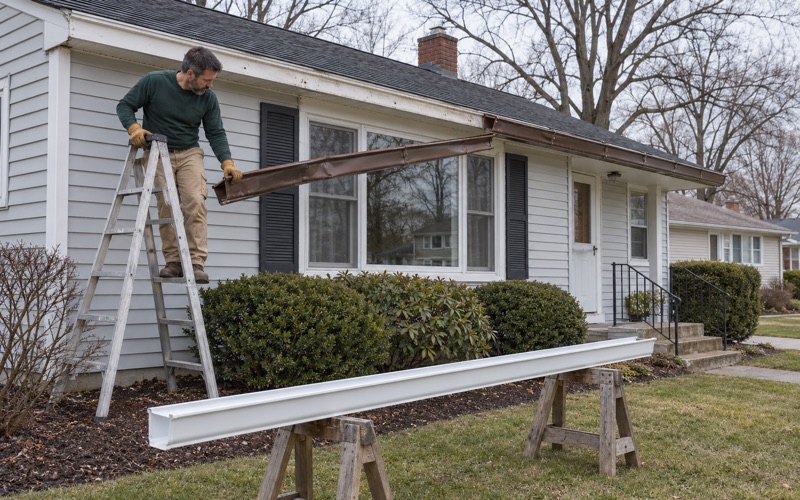
Our crews size each run to the roof area that drains into it rather than hanging the same profile on every house by habit. Seamless gutters are formed on site from coil, one continuous piece for each run of the home, so there are no mid-run joints waiting to open up. Before anything new is hung, we also check the condition of the fascia board behind it.
Repairs, cleanings and full replacements follow the same routine. We walk the house, trace each downspout to the spot where its water lands, and write down on the estimate where every outlet will discharge. That last line matters more in Middlesex than in many towns, because some backyards here end at a moving stream, and a discharge point is a decision the homeowner makes and then lives with.
Gutters on Middlesex Lots That Back Onto a Brook
What Heather Lane Residents Have Reported
The Green Brook runs behind a row of homes on Heather Lane, and residents there say the land has been sinking since Hurricane Ida. CBS New York reported in September 2023 that at least two homes on the street were at risk, that one of them had been condemned since 2022, and that one neighbor said he had lost 35 feet of land behind his home.
Residents pointed to a retaining wall and pump station built for flood control work along the brook. Representative Bonnie Watson Coleman said the area had not been impacted by the pumping stations or the work the Army Corps of Engineers had done. The cause remains disputed, and we found no report of what repair or funding, if any, followed after 2023.
Where Responsibility Landed
In a message posted in August 2023, the mayor called the Heather Lane situation an urgent environmental emergency and listed the agencies that first offered help: FEMA, the Army Corps, the Green Brook Flood Control Commission and the DEP. “One by one they all bowed out,” the message said, noting that one house had already been condemned.
The same message stated plainly that “the Borough cannot get involved with private property.” For anyone who owns a house on a stream-side lot in Middlesex, that sentence is worth reading twice. The bank behind the fence, the slope of the yard and the water sent toward it are matters the owner handles, with whatever help the owner arranges.
Why Discharge Direction Is Still Your Call
We have seen nothing that ties gutters or downspouts to what happened on Heather Lane, and we do not suggest a connection. We also found no Middlesex rule that dictates which direction a leader must discharge on a lot that backs onto a stream. That leaves the decision about where concentrated roof water comes down with the person who owns the yard.
What we can do is make that decision a visible one. On a brook-side lot we mark each downspout on a sketch of the property, note which ones currently empty toward the rear slope, and lay out the alternatives side by side. The owner sees the full picture before the estimate is signed, rather than inheriting whatever direction the last installer happened to choose.
Looking for gutters closer to South Orange Village? See Gutters in South Orange Village.
Pointing Downspouts Away From the Bank and the Foundation
Following Every Leader to the Ground
Every downspout we install or service is followed past the last elbow to the place its water actually lands. Some discharge onto a splash block that has sunk into the lawn. Some empty into a buried line that was crushed years ago and now backs up at the joint, and a few on older houses run straight into the ground with no record of where the pipe leads.
When water lands against the foundation, we propose a fix and price it as its own line. When it lands at the top of a rear slope that falls toward the Green Brook, we point that out as well. The residential code New Jersey adopted, the 2021 IRC, calls for grade that falls 6 inches within the first 10 feet from the foundation, and we check whether the yard actually does.
Extensions, Pop-Up Emitters and Drywells
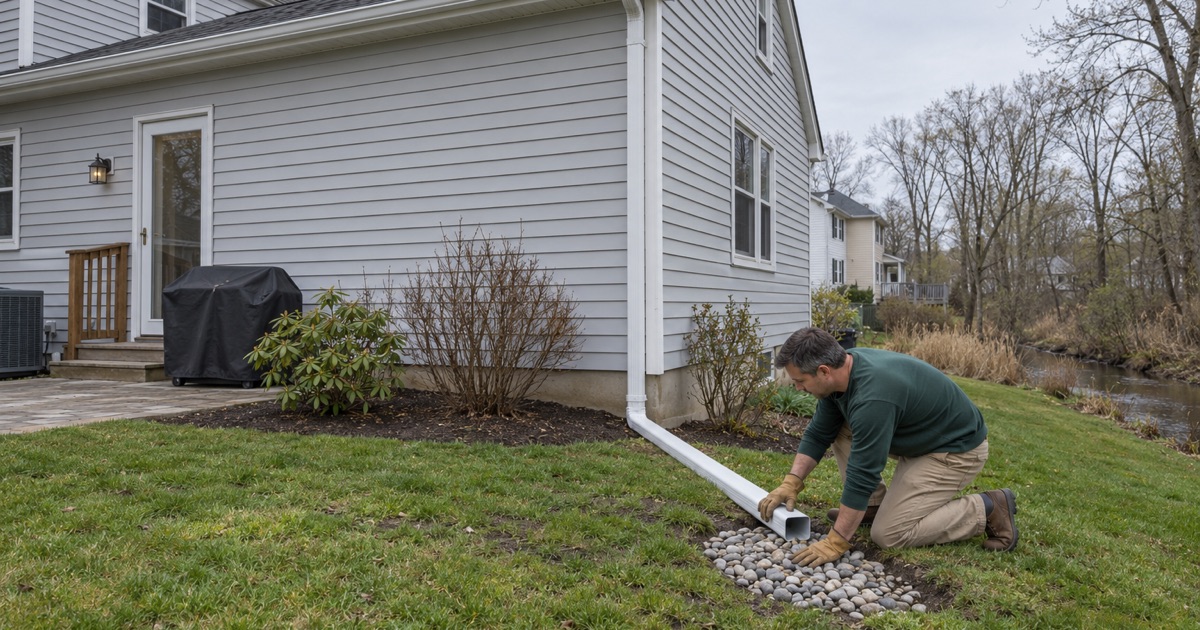
There are three common tools for moving roof water. A downspout extension carries it a few feet across the lawn. An underground downspout line can run it farther and surface at a pop-up emitter, which lifts a small cap and lets the water spread over grass. A drywell holds it below ground and lets it seep slowly into the surrounding soil.
Each choice suits some lots and not others. On ground near a stream, we look at where the yard drains naturally and whether a buried line would surface too close to the bank. The New Jersey stormwater rule expects a dry well to sit 2 feet above the seasonal high water table, so a drywell is proposed only where the ground can accept one.
Sizing the Run for the Roof Behind It
A gutter that overflows at one corner during every heavy storm sends water exactly where nobody planned for it to go. We measure the roof area draining to each run and choose the gutter profile and downspout size from that number. On a typical single-family house that often means a 6-inch K-style seamless gutter with 3x4 downspouts, though a short porch run may need less.
Placement matters as much as size. Moving a downspout from a back corner of the house to a side corner can keep its water off a rear slope altogether, and adding an outlet splits the load each leader carries. We cut wide-flange outlets, seal miters with tripolymer sealant, and hang the gutter on hidden hangers rather than spikes that work loose over time.
Where Middlesex Roof Water Is Not Allowed to Go
Never Into the Sanitary Sewer
Borough sewer use regulations bar roof drainage from the sanitary sewer, along with cellar drainage, surface water and groundwater from underground drainage fields. It is a standard clause shared by towns tied to the Middlesex County Utilities Authority. Rainwater entering the sewer takes up capacity meant for wastewater from homes and businesses.
Our crews never tie a leader outlet into a sanitary line, and when we find one already connected on an older house, we tell the owner and offer another place to send that water. Every estimate we write lists where each outlet will discharge, so the plan is on paper rather than left to whoever digs the trench on installation day.
The Borough’s Own Maintenance Standard
Middlesex wrote gutters into its own law in 1979. The Property Maintenance Code of the Borough, adopted by Ordinance No. 844, says “Exterior walls, sidings, gutters and leaders and roof shall be kept structurally sound, in good repair and free from defects.” It defines deterioration as holes, breaks, rot, crumbling, cracking, peeling, rusting or other evidence of physical decay or neglect.
That list reads like a description of a tired aluminum gutter: rusted spikes, a cracked end cap, a run pulling away from soft wood. We repair what can be repaired and say plainly when a run is past saving. New gutters and repair work go on separate lines of the estimate, so an owner can see exactly what each part of the job costs.
Flood Maps and the Green Brook Project
The borough flood damage prevention chapter adopts the FEMA flood maps for the area, effective July 6, 2010, and states that the borough’s flood hazard areas are subject to periodic inundation. If a house sits in a mapped flood hazard area, the owner should know that before planning drainage that adds water to the low parts of the lot.
Flood control construction reached the borough in October 2023, when work began on the Green Brook Flood Control Commission segment that adds closure gates and new floodwall along South Lincoln Avenue. Work at that scale addresses flooding across the basin. It does not change how water leaves a single roof, and the gutters on a private home remain the owner’s to plan.
Gutters on the Borough’s 1950s and 1960s Houses
A Postwar Housing Stock
Middlesex grew quickly at midcentury, from 5,943 residents counted in 1950 to 15,038 by 1970. Census estimates show 55.0 percent of the borough’s housing units were built between 1950 and 1969, and 73.9 percent of occupied homes are owner-occupied. Most gutters here hang on houses of that era, kept up by the people who live in them.
Houses from those decades have often had their gutters replaced more than once, and each replacement can leave a mark: extra nail holes in the fascia, downspouts in odd positions, an elbow added to dodge a later patio. We look at those layers before deciding whether a run needs a repair, a new section or a full replacement.
Fascia Checked Before New Gutters Go Up
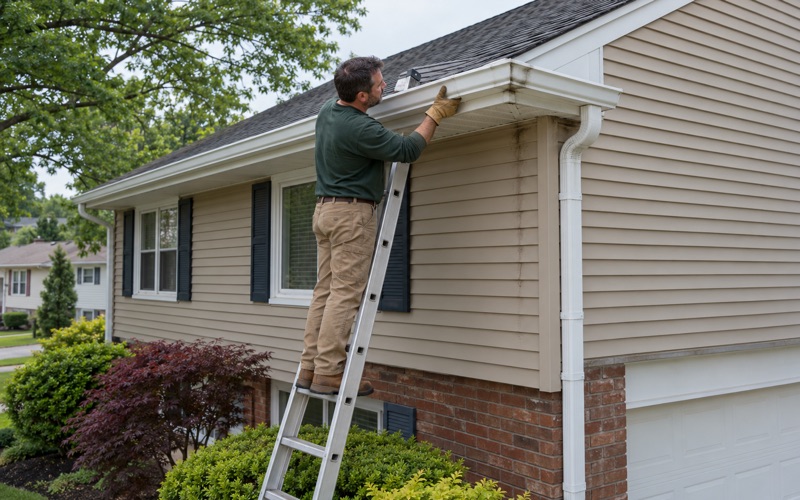
A new gutter is only as secure as the board it hangs from. Before installing, we press along the fascia and probe any soft spots, and when we find rot, we show it to the owner before replacing the wood. Nobody is asked to pay for carpentry they have not seen with their own eyes.
Once the board is sound, we look at the roof edge above it. Where a drip edge or gutter apron is missing, water can run behind the gutter and return to the same piece of wood that just rotted. Adding that strip, and kickout flashing where a roof meets a wall, keeps the repair from repeating itself in a few years.
Guards, Cleanings and Photos
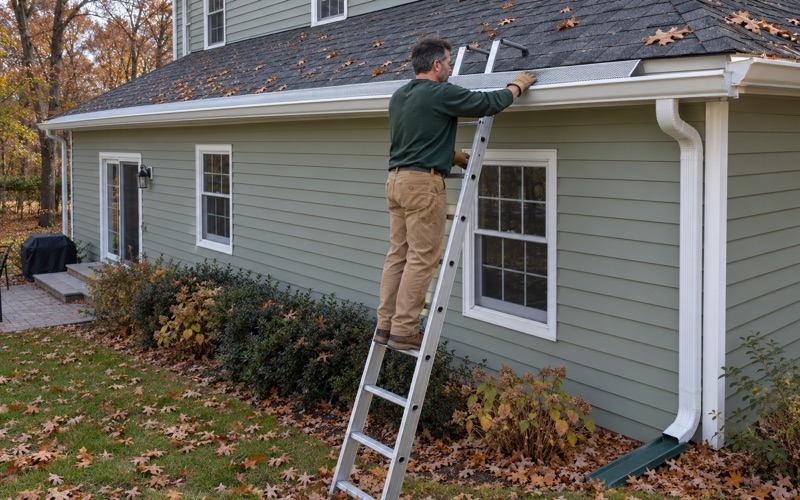
Guards should match the trees on the lot. Oak leaves call for a different screen than pine needles, which slip through coarse openings, so we look up at the canopy before recommending anything. Stainless steel micro-mesh handles fine debris well, while a simpler screen can be enough beneath broad leaves. No guard is maintenance-free, and we say so.
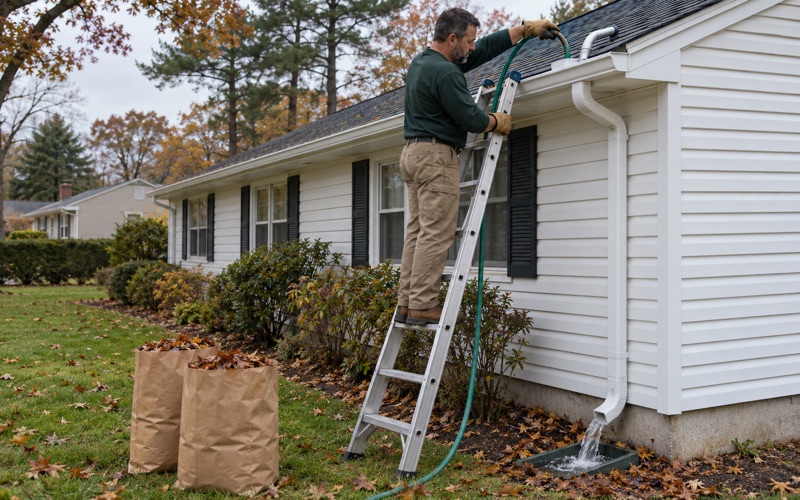
Cleaning visits include flushing every downspout, not just scooping the trough, and all debris is bagged and hauled away rather than left on the lawn or at the curb. Every cleaning and repair comes with before-and-after photos, which helps an owner who cannot climb a ladder see the roof edge, and adds to the records on an older house.
- 20+ Years on Gutters
- Seamless, Formed On Site
- Before-and-After Photos