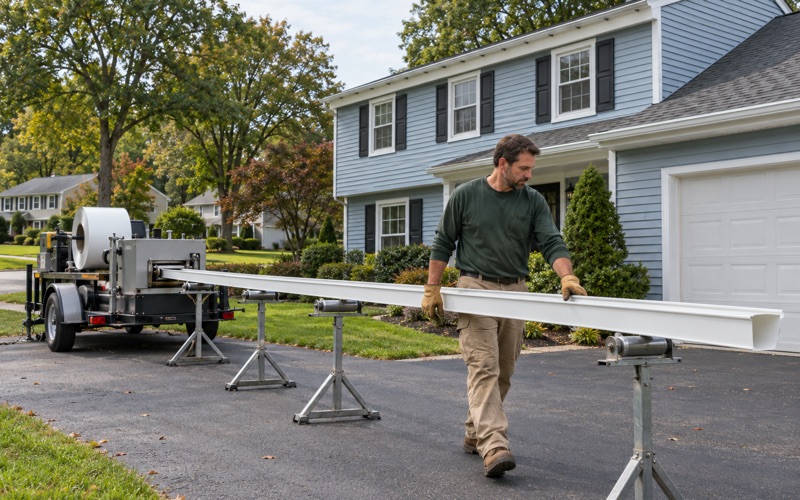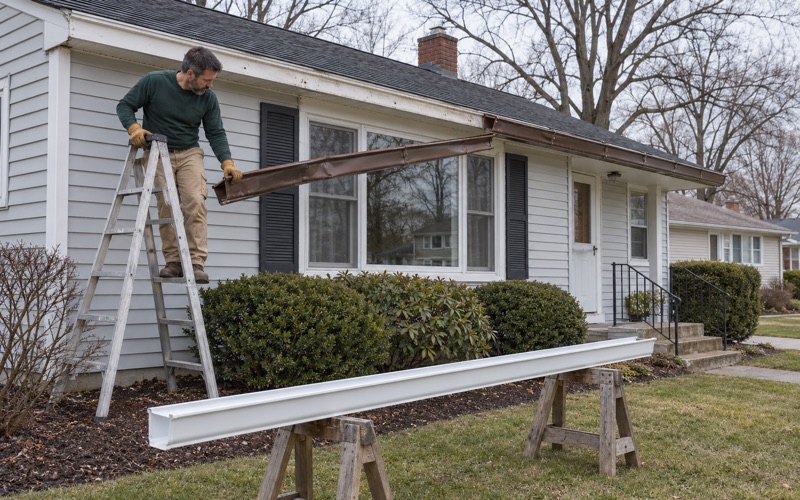
Middletown Quality Gutters has spent more than 20 years installing, repairing and cleaning gutters in Millstone Township, and the work here starts with the trees. We size every gutter and downspout for the roof area that feeds it, form seamless runs on site from coil, and plan each outlet before a single hanger goes up. That order matters on lots where woodland comes close to the eaves.
A gutter that faces open lawn on one side and trees on the other fills unevenly, clogs at the corners nearest the woods and overflows where nobody expected it. We look at which eaves sit under branches, which ones collect blowing litter from the tree line, and where each downspout drops its water, then build the system around what we find.
Our estimates put new gutters and repair work on separate lines, and every outlet on the estimate has a stated discharge point. After a cleaning or repair you receive before-and-after photos, so you can see the condition of eaves that are hard to judge from the ground or from a ladder at one corner.
Gutters on Millstone’s Wooded Lots
Forest That Stayed While Houses Arrived
Millstone’s land-cover record explains why so many roofs here sit beside trees. NJDEP land use and land cover figures shown at the township’s May 13, 2026 master plan reexamination meeting put 2020 forest at about 6,344 acres and wetlands at about 4,990 acres, out of roughly 23,800 acres mapped. That works out to about 26.7 percent forest and 21.0 percent wetlands.
The same table shows how development unfolded. Urban land grew 20.85 percent from 2002 to 2020 and agriculture fell 14.78 percent, while forest moved by only 1.17 percent. Those shares describe mapped acres, not individual lots, and the data come from aerial imagery that does not follow parcel lines. Still, the figures fit a pattern of building that took fields and left the forest largely in place.
Woodland on More Than One Side of the Roof
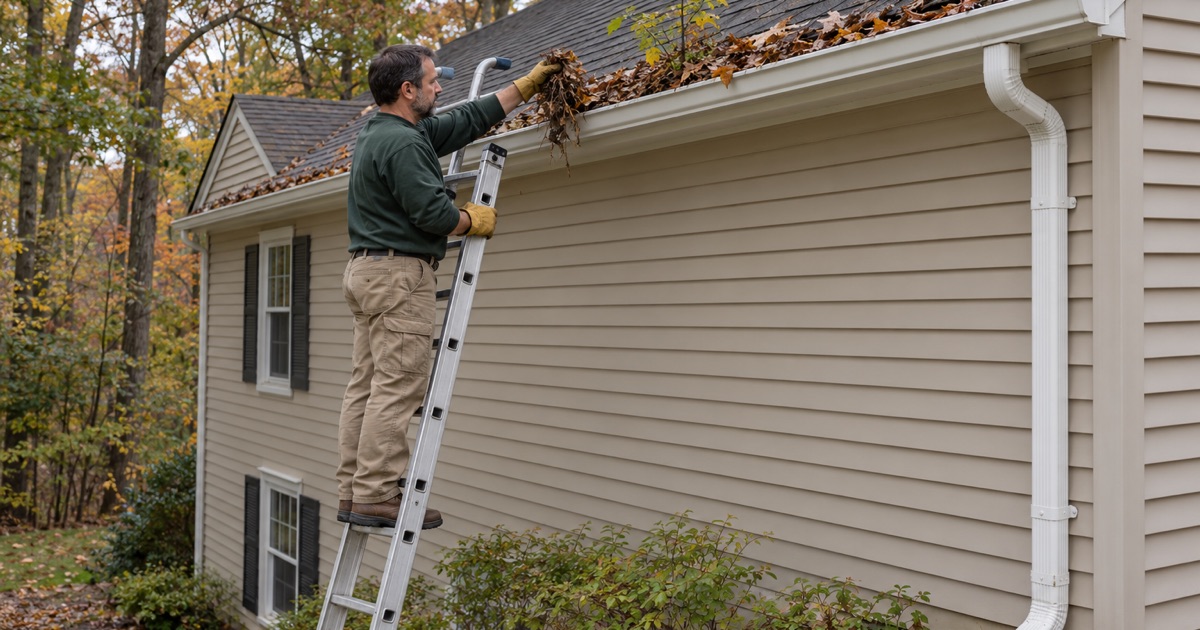
When a house is cut into woodland, the tree line can wrap around it rather than standing along one property line. Leaves, needles, seed and twigs then reach the gutters from the front, back and sides at different times, carried by wind as well as dropping straight down. A run cleaned last week can be loaded again after one gusty afternoon.
We walk the whole perimeter before quoting. Corners and miters next to the tree line are where debris piles first, and the outlets beneath them clog soonest. On those runs we often recommend wide-flange outlets, 6-inch K-style seamless gutters and 3x4 downspouts, so that twigs pass through the drop instead of lodging in the first elbow.
Twig Loads and the Fascia Behind Them
Twigs do more harm than leaves. They lie across the trough like a lattice, catch leaves behind them and hold water against the back of the gutter. Over a few seasons that standing water reaches the fascia board, and the wood behind the gutter can soften well before anyone notices a problem from the yard.
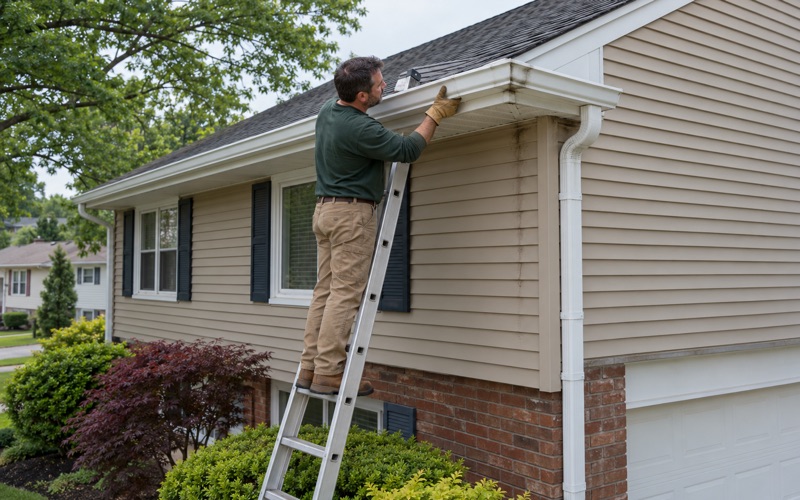
Before we hang new gutters we probe the fascia along every run. If the wood is soft, we show you the spot before anything is replaced, so the decision stays yours. On houses built before 1978, painted fascia and trim fall under the EPA Renovation, Repair and Painting rule, and we handle any disturbed paint under its work practices.
Looking for gutters closer to Springfield Township? See Gutters in Springfield Township.
Downspout Outlets Near Wet Ground
Wetland Cover and Soggy Outlets
About a fifth of Millstone’s mapped land is wetland, which the township’s legend defines as land wet for at least part of the year and marked by aquatic or water-loving plants. Wetland cover held nearly as steady as forest, down 3.85 percent from 2002 to 2020. On lots close to that cover, the ground at a downspout outlet can be saturated before the roof sheds a drop.
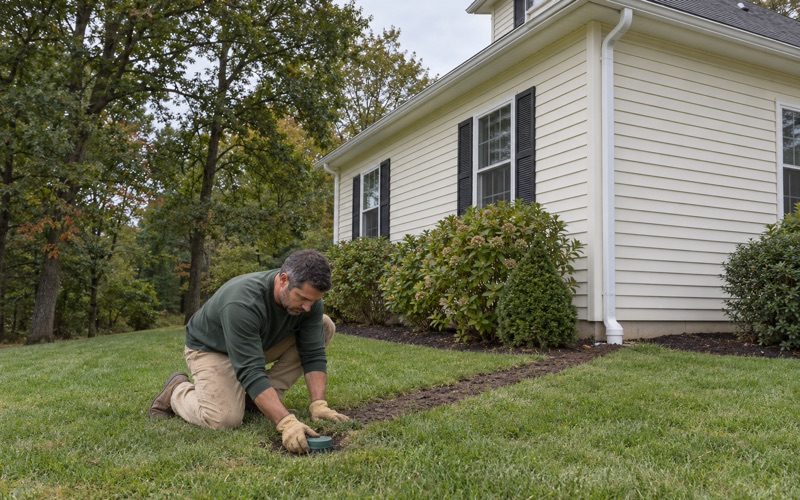
Water released onto ground that cannot absorb it simply spreads. It ponds near the foundation, softens the lawn and finds its way back toward the house. That is why we follow every downspout to the place its water actually lands, rather than assuming a splash block at the corner is doing the job it was set there to do.
Choosing Where Each Outlet Discharges
Most Millstone properties offer room to move water well away from the house. Outside the R-20 zone, township zoning requires every lot to hold at least one contiguous acre of usable area clear of wetlands, floodplains and steep slopes, and R-170 subdivisions approved after June 21, 2000 start at 4 acres. We use that usable ground to pick outlet points where the soil drains.
When an outlet lands against the foundation, we propose a fix: an extension, an underground downspout line to a pop-up drainage emitter, or a drywell where the ground allows it. The 2021 New Jersey edition of the residential code, Section R401.3, calls for grade to fall 6 inches within the first 10 feet from the foundation, and we check that slope at each discharge.
When a Drywell Is the Wrong Answer
A drywell only works where there is room between its bottom and the water table. The state stormwater rule, New Jersey Administrative Code 7:8, sets dry wells 2 feet above the seasonal high water table, and on a wet lot that clearance may not exist. For development applications, Millstone’s own stormwater code also limits a dry well to a 1-acre contributory drainage area.
Where the ground is too wet for infiltration, a surface outlet onto a gentle swale or a pop-up emitter farther out on drier ground is usually the better choice. We will tell you plainly when a drywell is not worth digging. Either way, the estimate names the discharge point for every leader, so you know where the water goes before we start.
Gutter Guards for Trees on More Than One Side
Matching the Screen to the Trees
No single guard handles every kind of tree litter. Broad leaves rest on top of a coarse screen and blow off, while pine needles slip through larger openings and stand upright in the trough. We look at the trees overhanging and bordering your roof before recommending a product, and a lot with mixed woodland on several sides may need more than one screen.
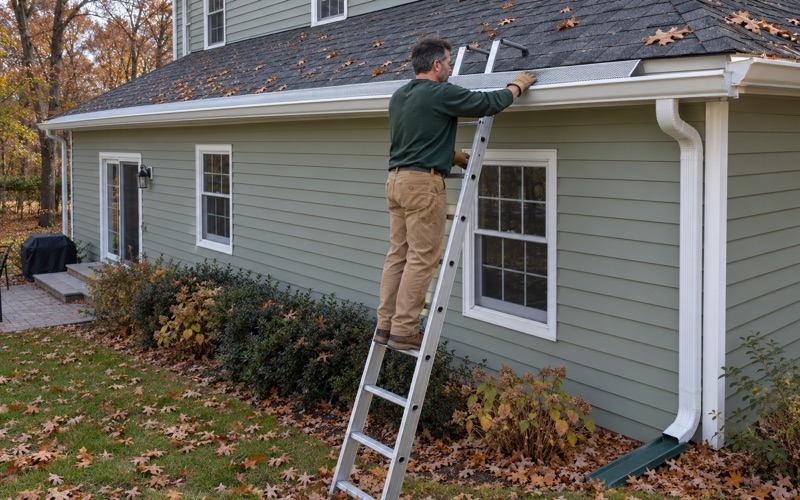
Stainless steel micro-mesh gutter guards are our usual starting point where needles and fine seed are part of the load, because the mesh stops small debris that perforated covers let through. Where heavy leaf fall is the main problem, a sturdier screen with a smooth top often sheds better. Either type has to sit correctly under the shingle edge and drip edge to work.
Hangers Strong Enough for Wet Debris
A gutter full of wet leaves and twigs is heavy, and guards add weight of their own. We hang seamless .032 aluminum gutters on hidden hangers spaced closely enough to carry that load, rather than relying on spike and ferrule fasteners that loosen as the fascia moves. Hidden hangers also keep the profile clean along the eave line.
Seams are the other weak point under heavy debris, since a joint that holds standing water eventually leaks. Because we form each run on site from coil as one piece, the only joints are at corners and outlets, and we seal those with tripolymer gutter sealant. Kickout flashing goes in wherever a roof edge meets a wall, steering water into the gutter instead of behind the siding.
Guards Reduce Cleaning, They Do Not End It
Even a good guard collects a mat of leaves and seed on top, and needles can lodge in the mesh. On a wooded Millstone lot we suggest checking guarded gutters at least once a year and after any storm that brings down limbs. Unguarded gutters near the tree line usually need attention more often, especially late in the fall.
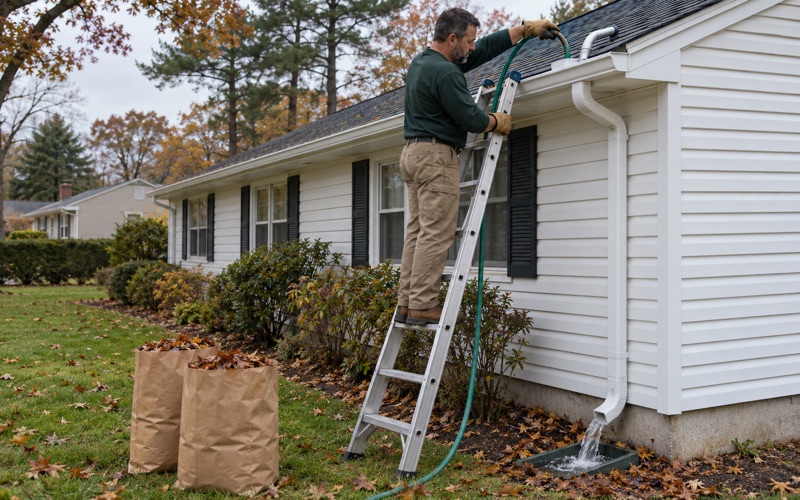
Our cleaning visits clear the troughs, flush every downspout to confirm water runs freely to its outlet, and bag the debris so nothing is left on your lawn or at the curb. You get before-and-after photos of each run. If we find a loose hanger, a failing seam or soft fascia, it goes on the estimate as a separate repair line.
Roof Water in a Headwater Township
Where Millstone’s Roof Water Goes
Millstone is where several of the state’s watersheds begin. The water-resources principle in the township’s 2017 master plan, shown again at the May 2026 meeting, describes the township as the origin for one-quarter of New Jersey’s twenty major watershed areas. Water leaving a Millstone lot is headed for headwater streams near the start of their course.
That is a good reason to let roof water soak in on your own property where the ground allows, rather than piping it straight to a ditch or the road. A downspout that discharges onto a lawn area or a vegetated swale well away from the house slows the water down and keeps leaf grit and shingle granules on the lot.
Storms and Overflow in Western Monmouth
Millstone falls in National Weather Service forecast zone NJZ013, Western Monmouth, issued by the Mount Holly office. When that office forecasts heavy rain with high wind, a wooded lot faces both problems at once: limbs and leaves drop into the gutters just as the water volume peaks. A clogged outlet at that moment sends water over the front edge and down the foundation.
Sizing is the defense. We measure the roof area that drains to each run and choose gutter width and downspout count to match, so one blocked outlet does not overwhelm a whole side of the house. On long eaves that can mean adding a second downspout rather than relying on a single outlet at the far corner of the run.
Estimates, Registration and Tax Lines
New Jersey requires home improvement contractors to register with the state under the Contractors’ Business Registration Act, and it is worth asking any gutter contractor for that registration before work starts. Our estimates also separate new gutters from repairs, because the New Jersey Division of Taxation treats the two kinds of work differently for sales tax.
Under the Division’s guidance, new gutters count as an exempt capital improvement documented on Form ST-8, while repairing existing gutters is a taxable repair. When we replace the runs on the most heavily wooded side of a house and repair the rest, the separate lines show you exactly which charges carry sales tax and which do not.
- 20+ Years on Gutters
- Seamless, Formed On Site
- Before-and-After Photos