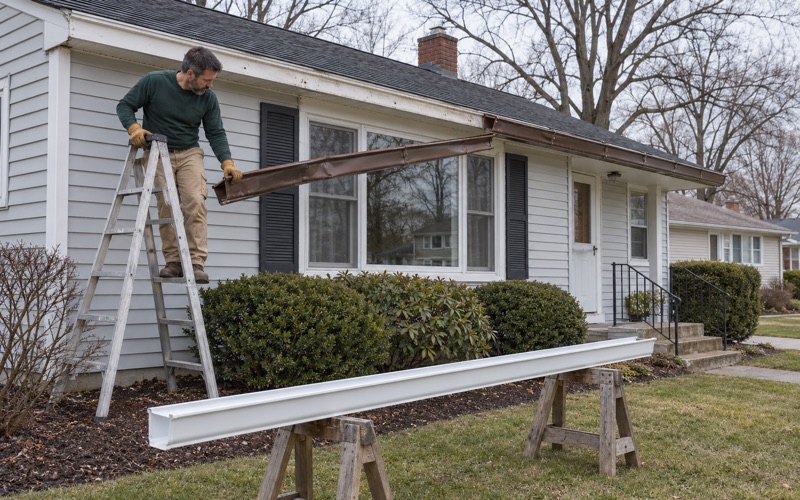
Middletown Quality Gutters has spent more than 20 years installing, repairing and cleaning gutters, and our work on gutters in North Arlington starts with one question: where does the water go after it leaves the roof? A gutter that catches rain and then drops it against a foundation has only moved the problem a few feet. We plan every run with its leader’s landing spot already decided.
That planning shapes the estimate before anything is ordered. We size gutters and downspouts for the roof area that actually drains to each run, form seamless gutters on site from coil, and write down where every outlet will discharge. New gutters and repair work appear on separate lines, because New Jersey treats the two differently for sales tax, and you should see that split plainly.
Most of our calls here fall into a few kinds of jobs: replacing tired aluminum on a two-family house, rerouting a leader that has been washing out a side yard, or cleaning a system that overflows in every heavy storm. Each job ends with before-and-after photos, so an owner who lives elsewhere, or upstairs, can see exactly what was done without climbing a ladder.
Living Above the Passaic: What River Road Floods Teach
A Lake at River Road and Arlington Boulevard
North Arlington’s western edge is the Passaic River, and River Road runs along it. On a Sunday afternoon in late August 2011, The Observer reported that the intersection of River Road and Arlington Boulevard was blocked by a good-sized lake extending across the road and into the park. Stretches of River Road were paved with mud and rain-sodden leaves, and parts of it stayed closed.
At a River Road shop just north of the Belleville Pike, the paper noted a flood level mark a foot or so above ground on the outside of the building, with debris clogging a driveway leading down to the Passaic. That is river water, and no gutter stops it. What gutters do control is the extra runoff that houses on the hill send toward that low ground.
Closures Between Hedden Terrace and Crystal Street
The road has closed again since then. On September 25, 2018, North Arlington Emergency Services sent a Nixle alert that River Road between Hedden Terrace and Crystal Street was flooded and blocked off, and advised residents to avoid the area. Those alerts are worth signing up for, because the storms that close the road are the same storms that test a gutter system.
When we schedule work near the river, we watch those closures and avoid sending a truck loaded with coil into a blocked stretch. A storm heavy enough to close River Road is also a good moment for an owner to look outside and note which gutters overflow and which leaders spill onto paths. Those notes point us straight to the sections that need work.
What the Flood Map Shows, and What It Does Not
North Arlington has been in the National Flood Insurance Program since its first flood insurance rate map was issued during 1978, and the current FEMA map is dated August 28, 2019. The mapped floodplain hugs the riverbank: the public riverside parcel at 451-453 River Road is about 98.44 percent within the AE zone, with a portion inside the floodway.
We have not read the map lot by lot for the houses on the River Road slope, so we will not guess about yours. If your lot’s flood status matters to a lender or an insurer, check the current map before we talk materials. Either way, gutters and leaders on a sloping lot should spread roof water out rather than concentrate it on the lowest corner of the yard.
Looking for gutters closer to Bound Brook? See Gutters in Bound Brook.
Two Families, One Gutter System
A Common North Arlington Building
The two-family house is one of North Arlington’s core building types. About 26.6 percent of the borough’s homes sit within two-unit buildings, and 55.6 percent of households rent, so many gutter systems here serve an owner’s flat and a tenant’s flat at once. When a downspout clogs, the household on the first floor often notices the overflow before anyone upstairs does.
That split shapes how we work. We settle scope and price with whoever owns the building, but we also want to hear from the tenant who sees water sheeting past the back door. A drip line above a rear entry or a puddle that never drains at the side path usually points straight to the failing section, and that saves time on the ladder for everyone.
Sizing for the Roof That Actually Drains There
Roof shapes vary from house to house, even on the same block, so we measure the roof area that drains to each run and pick the gutter and downspout size from that number. One side of a house may collect a whole slope and need a 6-inch K-style seamless gutter with 3x4 downspouts, while another stretch needs much less.
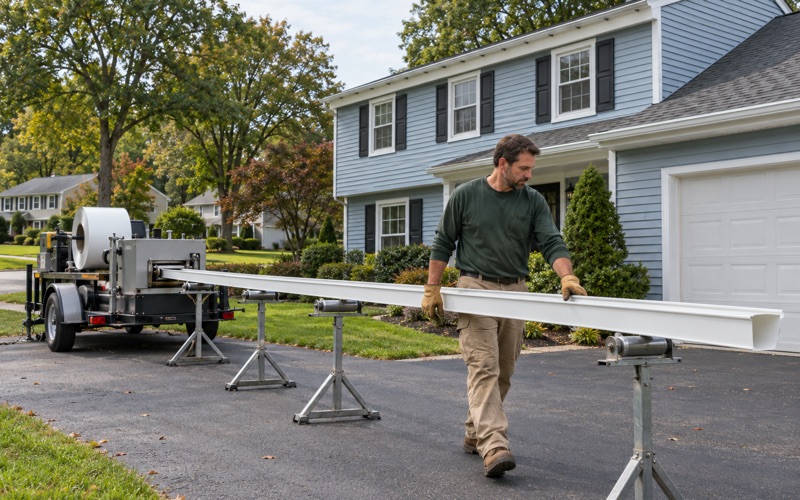
Each run is formed on site from .032 aluminum gutter coil in one piece, so the only joints are at the corners and outlets. We seal box, strip and bay miters with tripolymer gutter sealant, which leaves fewer places for a drip to start. On a building with two households under one roof, one fewer leak is one fewer phone call between owner and tenant.
Certificate of Occupancy Turnovers and Sales
The borough requires a Certificate of Occupancy on a sale or ownership change and each time an apartment is rented, with a fee of $125 for a two-family as of July 1, 2015. The borough’s posted information does not say whether that inspection looks at gutters, so we will not tell you it does. A vacant unit is simply an easy time to reach the yard and fix a bad run.
On a sale, the buyer’s home inspector is required under New Jersey’s home inspector rules to inspect and report roof drainage deficiencies. A sagging run, a split elbow or a leader dumping against the foundation tends to show up in that report. Owners getting ready to sell often call us first so the gutters are sorted before the inspector arrives.
Sending Leader Water Where the Slope Can Take It
The Hill Above the River
Most of North Arlington sits above the river on the Ridge Road side, and that changes the gutter question. On the hill, the concern is less about the river rising and more about where each leader sends roof water downhill. A leader that empties at the low end of a driveway pushes that water toward the next lot down, and from there toward River Road.
We know of no borough rule on leader discharge, and we plan the way good practice and the state’s residential code suggest. The 2021 New Jersey edition of the IRC, section R401.3, expects grade to fall 6 inches within the first 10 feet from the foundation. Leader water should land where that fall carries it away from your walls and not onto a neighbor’s.
Following Every Downspout to Its Landing
On every visit we follow each downspout to where its water actually lands. When it lands against the foundation, against a neighbor’s wall, or on a walk, we propose a fix and price it on the estimate. Newark’s airport weather station, outside the borough, averages 79.9 days a year at or below 32 degrees, so a leader spilling onto a path through winter becomes a sheet of ice.
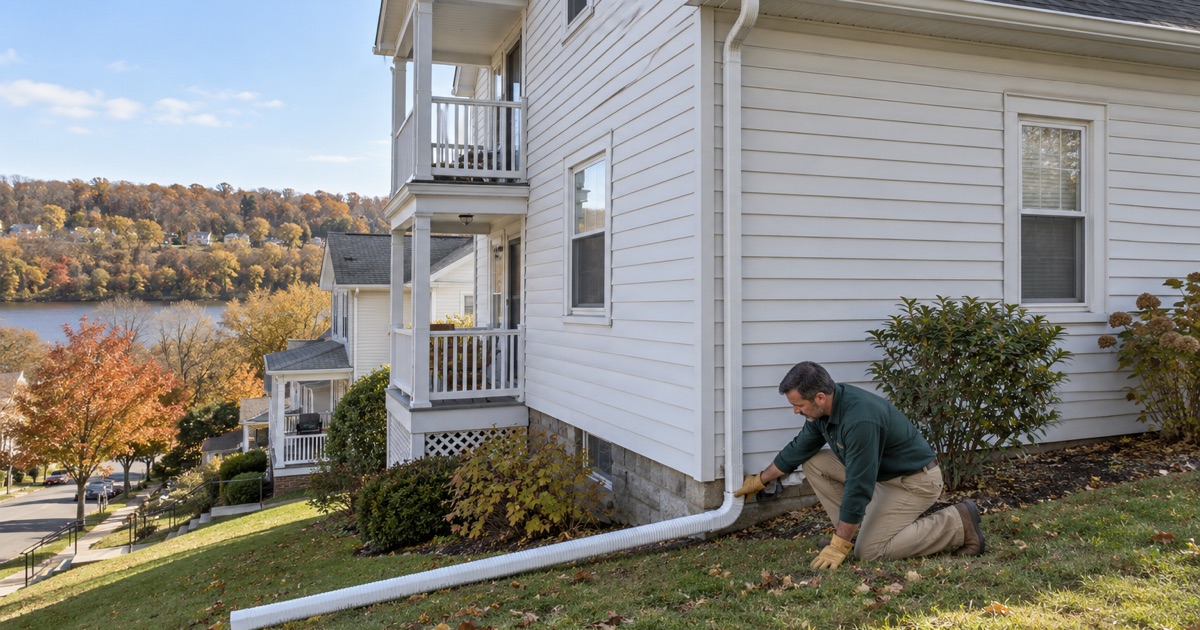
The fixes are simple and proven. An extension works where there is open lawn. On tighter lots, an underground downspout line can carry water to a pop-up drainage emitter at a lower, open part of the yard. Where soil and space allow, a drywell takes the water below ground, and we explain which option fits your lot and why.
Drywells, Groundwater and the Sanitary Sewer
A drywell only works when it sits above groundwater. New Jersey’s stormwater rule keeps dry wells 2 feet above the seasonal high water table, which is a real question on low ground near a river. On those lots we lean toward surface options, because a drywell that fills with groundwater simply stops taking roof water when you need it most.
Leader outlets are never tied into the sanitary sewer, and the estimate says where each one discharges. Older houses sometimes have a leader that disappears into the ground with no clear destination. When we cannot confirm where that pipe goes, we say so directly and offer a surface outlet instead, so you are not guessing about where your roof water ends up.
Gutters on North Arlington’s Postwar Houses
Fascia on Houses Built 1940-1959
About 49.3 percent of North Arlington’s housing was built 1940-1959, and another 19.8 percent dates to 1939 or earlier. On houses of that age, the fascia board behind the gutter has had decades to take on water from overflow and failed seams. We check it for rot before new gutters go up and show the owner any soft wood before we replace it.
Painted trim on pre-1978 houses brings the EPA Renovation, Repair and Painting rule into the job, so fascia work here follows lead-safe practices. Once the board is sound, a gutter apron or drip edge makes sure water leaving the shingles lands in the gutter instead of behind it, and kickout flashing goes where a roof edge meets a wall.
Hangers, Profiles and Copper
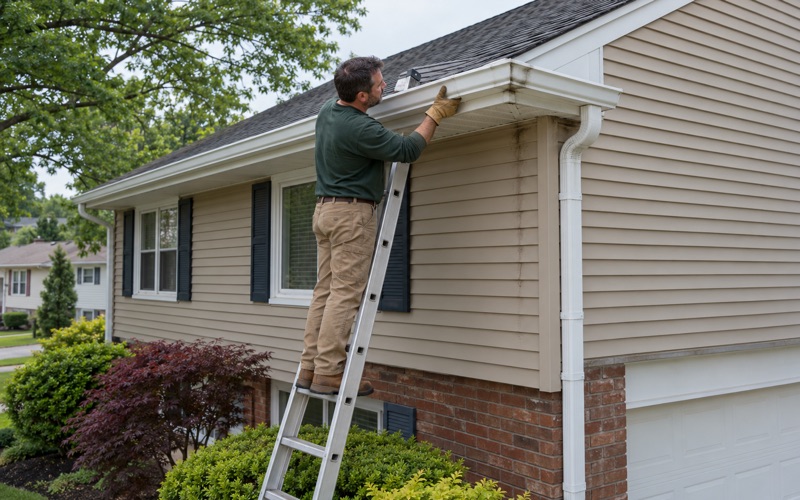
We hang seamless runs on hidden hangers rather than spike and ferrule, because spikes loosen in old wood and let a run sag until water pools at the low point. Wide-flange outlets and correctly set A and B elbows keep the downspout path clear around corners, which matters when a leader has to travel the full height of a two-story house.
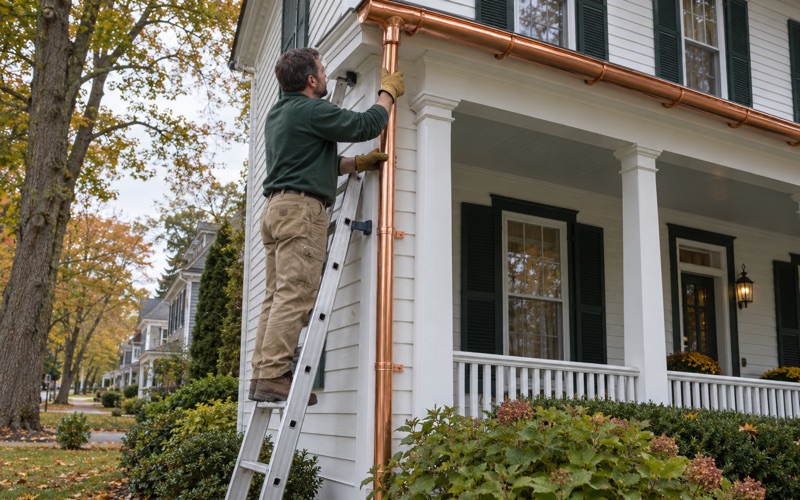
Some owners want a gutter that suits the age of the building rather than a standard profile. Where copper or half-round fits the house, we match the material and profile to its age and style, using half-round gutters with a double-bead profile or 16-ounce copper that weathers to a patina. We will also tell you plainly when aluminum is the better fit.
Trees, Cleaning and the Paperwork
Guards are matched to the trees on the lot, because pine needles and oak leaves call for different screens, and stainless steel micro-mesh handles fine debris well. Storm damage reaches the hill too: on June 12, 2026, the National Weather Service office at Upton logged a tree down on Prospect Avenue and Arlington Boulevard, with power lines down, after thunderstorm winds.
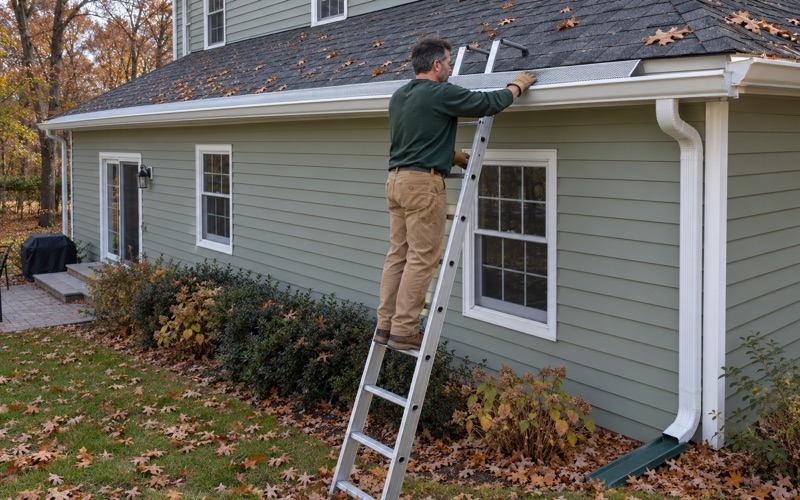
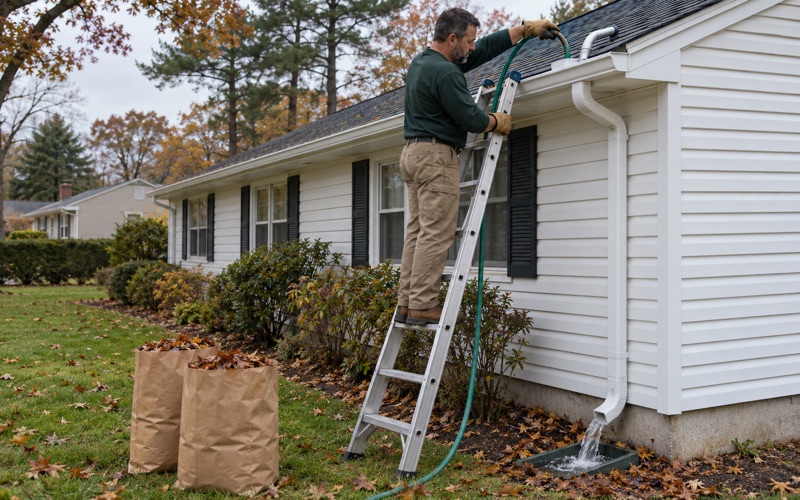
Our cleaning visits flush every downspout and bag the debris, so nothing is left on the lawn or at the curb. Gutter and leader work is ordinary maintenance under New Jersey Administrative Code section 5:23-2.7(c)1.xvi. New gutters count as an exempt capital improvement on Form ST-8 while repairs are taxed, which is why our estimates keep the two on separate lines.
- 20+ Years on Gutters
- Seamless, Formed On Site
- Before-and-After Photos