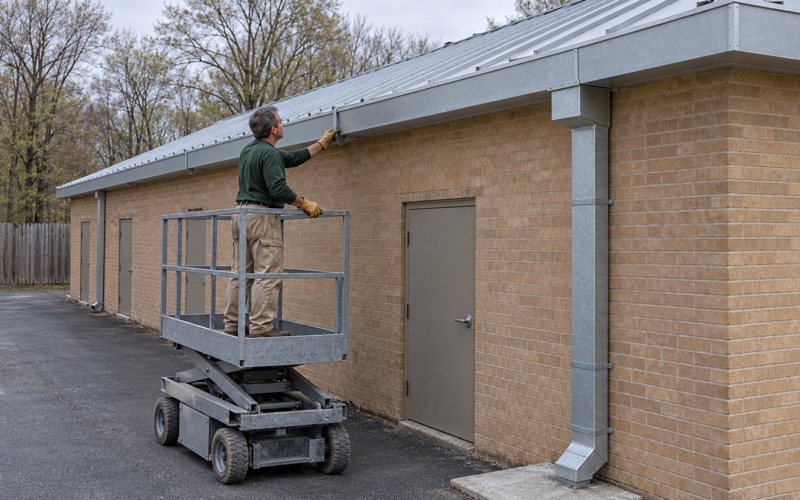
Middletown Quality Gutters has spent more than 20 years installing, repairing and cleaning gutters in Red Bank, and on every job here we start with one question the borough’s rules make unavoidable: where does the water go once it leaves the roof? A gutter is only half of a drainage system. The other half is the path each downspout sends that water along after it reaches the ground.
That path matters more in Red Bank than in most towns we serve. Roof leaders cannot be tied into the sanitary sewer here, so every gallon a downspout releases either soaks into the yard or runs toward the street, and what reaches the street drains toward the river. We plan gutters around that fact rather than treating the outlet as an afterthought.
Below we cover how we size, route and maintain gutters with that path in mind: what the borough’s sewer rules mean for your leaders, why the storm drain on your block deserves attention, what changes for homes near the water, and how a badly placed downspout can leave you responsible for an icy sidewalk in the middle of winter.
Where Red Bank’s Roof Water Goes
Roof Leaders Stay Off the Sanitary Sewer
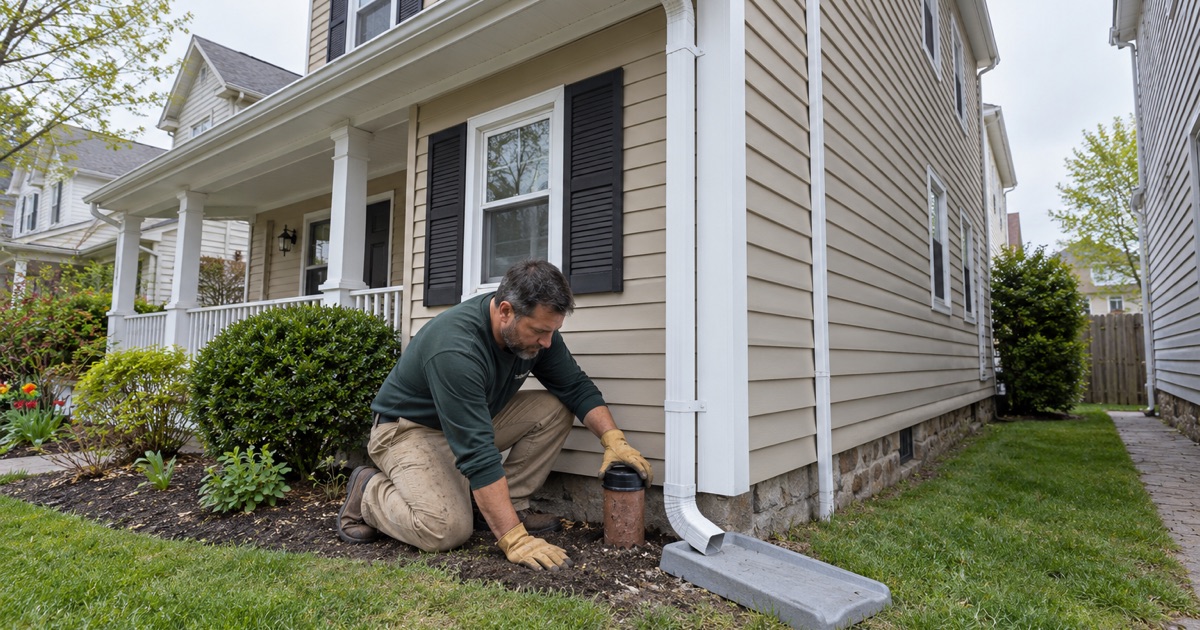
Red Bank’s sewer chapter is direct about it. Section 695-40G says no roof leaders and no downspouts shall be connected to the sewage system, and Section 695-40C bars roof runoff from any sanitary sewer. On older houses we sometimes find a leader disappearing into the ground beside the foundation, and that buried pipe can lead to an old sewer lateral rather than a drain.
When we find a buried leader, we trace where it goes before we hang anything new. A downspout tied into a sanitary line is a violation, not a drainage option, and we will not reconnect one. Our estimates name the discharge point for every outlet, so you can see exactly where each leader will send its water before any work begins.
Sizing the System for the Roof It Serves
With the sewer off the table, the gutters and downspouts have to carry the whole load to a spot on your lot that can take it. We size each run by the roof area that drains into it instead of using one stock size for the entire house. On large roof planes that often means 6-inch K-style seamless gutters paired with 3x4 downspouts.
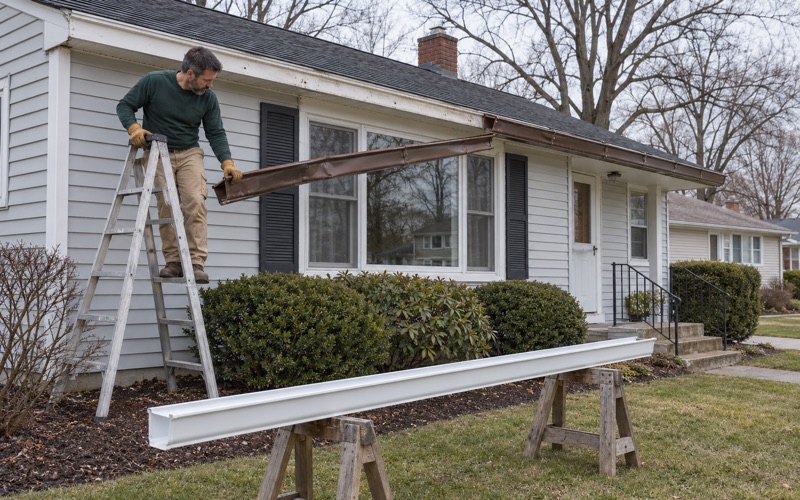
Every run is formed on site from .032 aluminum coil as a single piece, so there are no mid-run seams to drip onto a walkway or a step. Corners get box or strip miters sealed with tripolymer sealant, and wide-flange outlets let water drop into the downspout quickly instead of backing up behind a narrow opening during a heavy storm.
Where Each Downspout Lands
We follow every downspout to the spot where its water ends up. If it empties against the foundation, we propose an extension, a pop-up emitter at the end of an underground line, or a drywell, depending on the yard. The New Jersey edition of the residential code asks for grade to fall 6 inches within the first 10 feet from the foundation, and we check whether yours does.
On Red Bank’s tighter lots there is not always lawn to spread water across, and a long extension can end up pointing at a neighbor’s driveway or straight down the apron to the street. We talk through those tradeoffs on site, because the right answer depends on where the water will travel once it leaves the pipe.
Looking for gutters closer to Holmdel? See Gutters Services in Holmdel.
From Downspout to Storm Drain to the Navesink
Why the Storm Drain on Your Street Matters
Red Bank sits on the southern bank of the Navesink River, which was once the area’s main route to the Atlantic Ocean. Water a downspout sends to the curb enters the borough’s storm sewer, and the storm sewer discharges to the river through outfalls along the shore. Your leaders are the first link in a chain that ends in open water.
That chain has drawn real scrutiny. In January 2015 the New Jersey Department of Environmental Protection suspended shellfish harvesting in about 566 acres of the Navesink because of high fecal coliform, attributed in part to stormwater runoff. A DEP study then named four storm sewer outfalls from the Red Bank system as the likeliest places the bacteria were entering the river.
What the Investigation Found
The borough responded by tracing storm sewer flows on dry days, when those pipes should carry nothing, and by relining or replacing sections of infrastructure. At one site it found a sanitary line leaking into a broken storm line, and both were repaired. Reporting at the time said the coliform most likely came from human sources.
To be clear about our part in this, gutters carry rain and roof debris, not sewage, and the 2015 shellfish closure was not a roofing problem. What a homeowner controls is the first step: keeping sewer and storm water separate at the house, and keeping leaves, grit and shingle granules from washing down the leaders toward the catch basin.
Cleaning That Keeps Debris Out of the Drains
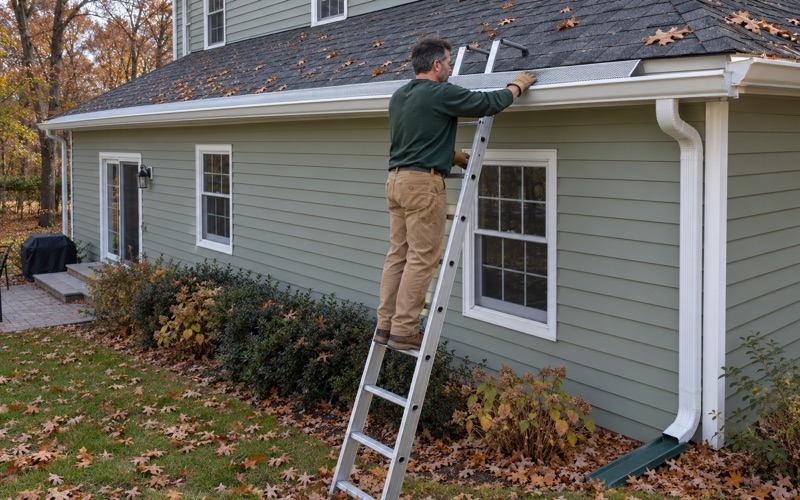
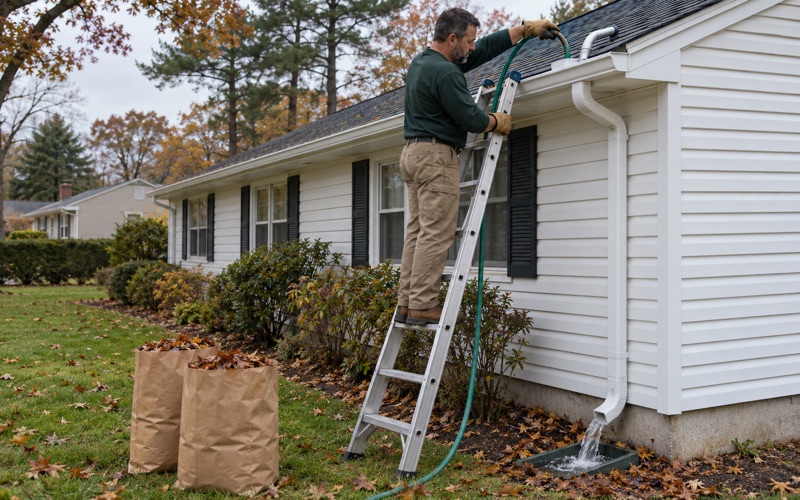
A clogged gutter that overflows sends a slurry of leaves and grit across the yard and onto the pavement, and a downspout flushed carelessly blasts that same debris into the street. On our cleaning visits we scoop and bag the debris first, then flush each downspout so whatever is left comes out where we can collect it rather than at the curb.
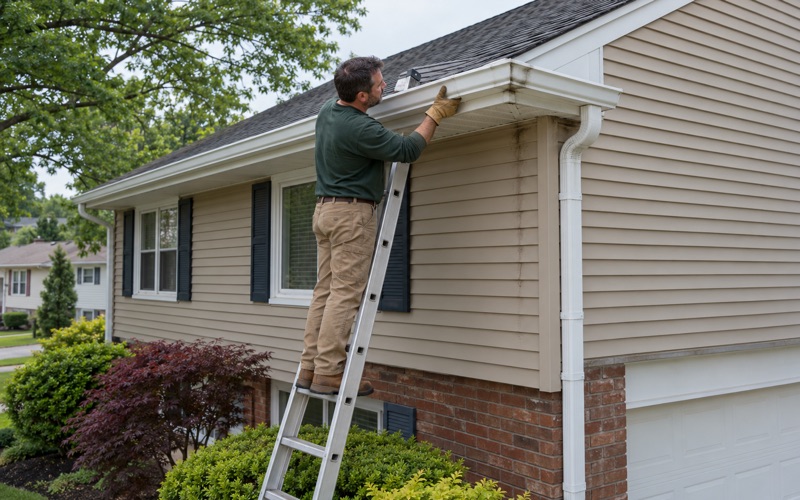
Nothing is left on the lawn or beside the storm drain when we leave. You receive before-and-after photos of every run, so you can see the troughs, outlets and elbows we cleared without climbing a ladder yourself. If a run keeps filling between visits, we note it in the photos and suggest what would slow it down.
Guards That Fit the Trees on the Lot
The less debris that reaches a gutter, the less can travel down a leader. We match guards to the trees that actually drop onto your roof, because oak leaves and pine needles call for different screens. Stainless steel micro-mesh guards stop fine needles and grit that would slip through a coarser cover, while still letting heavy rain through.
Riverfront Homes in the AE Flood Zone
What the Flood Map Shows
Most of Red Bank sits well above the river. A FEMA National Flood Hazard Layer reading at the borough’s center returns zone X, an area of minimal flood hazard. Down along the riverfront it is different: a reading near Marine Park returns zone AE, with a base flood elevation of 8 feet. The current effective flood map for the borough dates from June 15, 2022.
Homes below the bluff, close to the water, sit in that regulated floodplain, and their owners face different drainage questions than owners farther inland. If you are not sure which side of the line your house falls on, the flood map is the place to check before planning any work that involves buried lines or drywells.
What Changes About the Work Near the Water
On a riverfront lot, a drywell is often the wrong answer. New Jersey’s stormwater rule calls for dry wells to sit 2 feet above the seasonal high water table, and close to the river there may not be room for that. We look harder at surface options, such as splash blocks and emitters routed toward planted areas, before recommending anything buried.
Salt air also changes material choices. For houses near the water we choose gutters, hangers and fasteners with the manufacturer’s salt-air warranty terms in mind, and we favor hidden hangers screwed into solid fascia over spike and ferrule. Before new gutters go up we check that fascia for rot and show you any soft wood before it is replaced.
When the River Comes Up
Riverfront owners have seen what high water does. During Hurricane Sandy the Navesink overwhelmed the Marine Park bulkhead, covering walking paths and spreading through the parking lot, and it covered the shoreline at Maple Cove. After a storm like that, we look for bent downspouts, crushed elbows and outlets packed with silt before the next rain finds them.
Kickout flashing, gutter apron and drip edge are worth a look after a big storm too, since wind-driven rain finds any gap at the roof edge. We list repair work and new gutters on separate lines of the estimate, because New Jersey taxes a repair differently from new gutters installed as a capital improvement.
Leaders, Sidewalks and Winter Ice Downtown
The Sidewalk Rule
Red Bank’s Ordinance 2019-03 requires the owner, occupant, tenant or agent of property abutting a street to clear snow, slush and ice from the full paved sidewalk, or at least 42 inches of it, within 24 hours of daylight. Where ice cannot practicably be removed, it has to be covered with sand or salt.
The same ordinance makes it unlawful to deposit snow, slush or ice from private property onto a street or sidewalk. It says nothing about downspouts. But a leader that empties across a walk on a cold night leaves a sheet of ice by morning, and under the ordinance, clearing that walk falls to the people responsible for the property beside it.
Rerouting Leaders That Cross a Walk
Downtown buildings and houses set close to the sidewalk are where we see this most. A front leader that drops onto a stoop or runs across the walk can often be moved to a side corner, turned with A or B elbows, or carried under the walk in an underground line to an emitter in a planting bed.
When there is no room on the lot at all, we lay out the options plainly, including what each one means for ice on the sidewalk and for water reaching the street. The goal is a leader that keeps water away from the foundation without putting a frozen hazard in front of your door or your neighbor’s.
Freeze and Thaw on the Gutter Itself
Winter tests the gutters as well. Ice that builds in a clogged trough adds weight and can pull fasteners loose, and meltwater that cannot drain finds its way behind the gutter and into the fascia. A late-fall cleaning before the first hard freeze, with every downspout flushed, gives meltwater an open path down and away from the walk.
If you would like a cleaning scheduled before winter, a downspout moved off a sidewalk, or a new system sized for a riverfront roof, we can walk the property with you. We will show you where each leader sends its water today, and where it would go after the work is done.
- 20+ Years on Gutters
- Seamless, Formed On Site
- Before-and-After Photos