Middletown Quality Gutters has spent more than 20 years installing, repairing and cleaning gutters in South Amboy and the surrounding part of New Jersey, and our work here starts with a question many homeowners never get asked: where does your roof water go once it leaves the downspout? On a house close to the bay, that answer matters as much as the gutter itself.
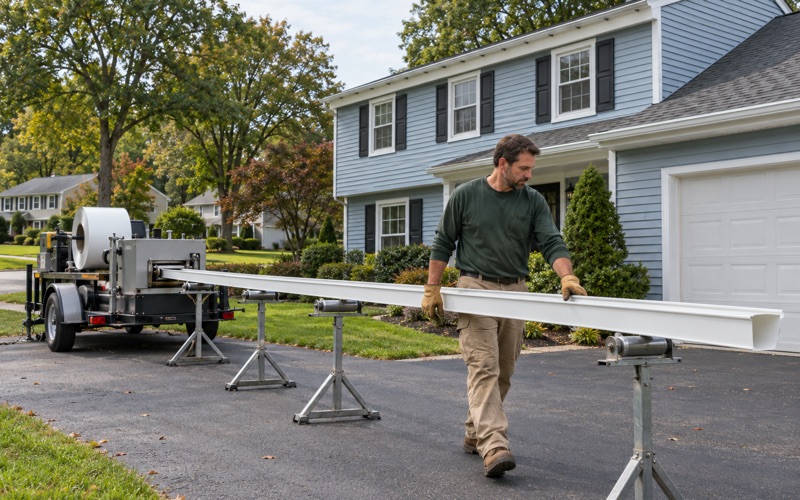
We size every gutter and downspout for the roof area that drains into it, form seamless runs on site from coil, and follow each leader to the spot where its water lands. When that spot is against a foundation wall, we propose an extension, a pop-up emitter or a drywell, and the estimate states plainly where each outlet will discharge.
This page explains how the local flood map changes that work from one block to the next. Some lots sit on higher ground well clear of the mapped hazard, while others along the water carry coastal flood zones with base flood elevations of 12 and 17 feet. The gutter job looks different on each side of that line, and we plan it accordingly.
How South Amboy’s Flood Map Divides the City
FEMA’s National Flood Hazard Layer places South Amboy on Middlesex County’s countywide flood map, panel 34023C0157F, effective July 6, 2010. We queried that layer at three points across the city, and the results were far from uniform. That split is the reason we ask where a house sits before we talk about gutter size, guard type or leader placement.
Zone X on the Higher Ground
At a point near the center of the city, the flood layer returns Zone X, which FEMA labels an area of minimal flood hazard. For a house on that higher ground, roof drainage is an ordinary grading question: get water off the roof, down the leader and far enough from the foundation that it soaks in or runs off somewhere harmless.
That does not make leader placement an afterthought. The 2021 New Jersey edition of the International Residential Code, section R401.3, calls for grade to fall 6 inches within the first 10 feet from the foundation, and a downspout dumping onto a flat or back-pitched patch defeats that slope. We check where each outlet lands before recommending anything new.
Zone AE on Henry Street
Down toward the water, the picture changes. A point on Henry Street in the Harbour Village neighborhood returns Zone AE with a static base flood elevation of 12 feet. Zone AE is FEMA’s designation for areas subject to the 1 percent annual chance flood with a base flood elevation determined, so these lots already sit within reach of Raritan Bay’s tides and storm surge.
On a lot like that, roof water is not landing on dry, well-drained soil far above the bay. It joins ground that may already be saturated after a high tide or a coastal storm. Pointing a leader toward a low corner of the yard, or toward the crawl-space vents, puts more water exactly where the house can least afford it.
Zone VE on Raritan Reach Road
A third point, on Raritan Reach Road in the same neighborhood, returns Zone VE with a static base flood elevation of 17 feet. VE is the coastal high-hazard zone, where FEMA expects wave action on top of surge. Three points do not draw the full boundary of any zone inside the city, so we treat the map as a starting point and check each address.
The query did not return the elevation datum with those figures, so we never quote a 12-foot or 17-foot number as a measured height above a particular yard. What the zones tell us is direction: the closer a house sits to the bay on that map, the more carefully its roof water has to be routed once it reaches the ground.
Looking for gutters closer to Asbury Park? See Gutters in Asbury Park.
Where Leaders Should Empty on a Bayfront Lot
Gutters do not keep floodwater out of a house, and nothing we install changes a flood zone. What a well-planned gutter system does on a bayfront lot is make sure rain from the roof is not added to the wettest part of the property. That planning happens at the bottom of each downspout, not at the top of the run.
Outlets, Extensions and Splash Blocks
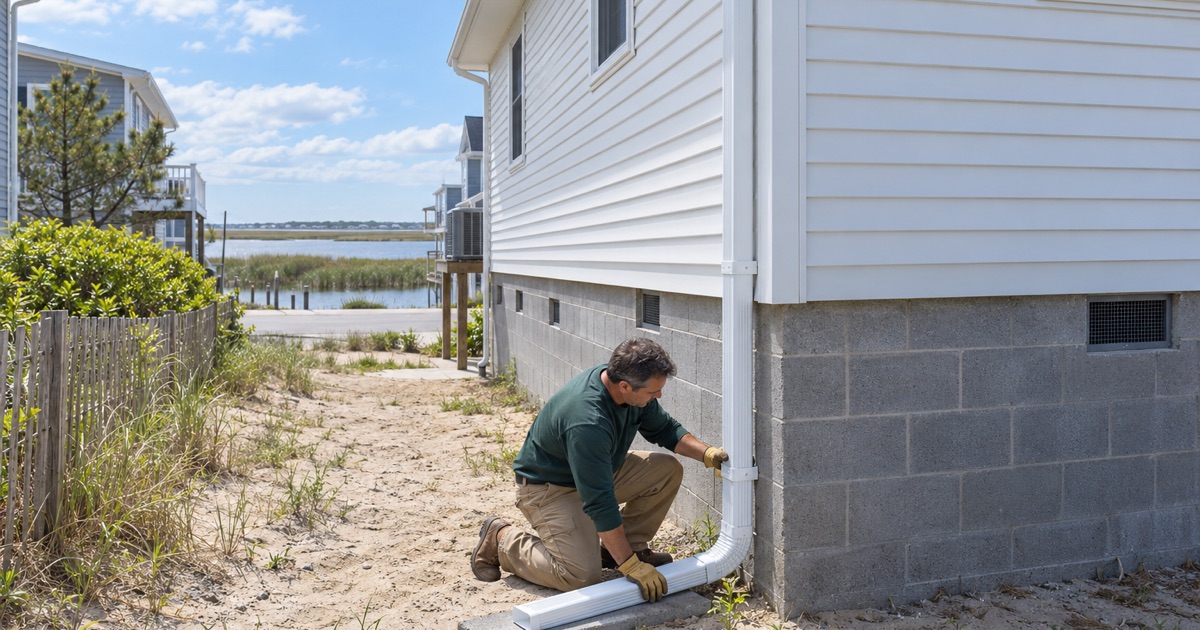
We start by walking the house and marking where every existing leader empties. On AE and VE lots, we place outlets so water moves away from foundation walls and crawl-space openings, then add extensions or splash blocks that carry it toward ground that drains, rather than toward the low spots where standing water already collects after a storm.
Wide-flange outlets and properly set A and B elbows keep the turn at the bottom of the leader from clogging or leaking at the joint. A cheap extension that pops loose during the first heavy rain sends water straight back against the wall, so we fasten each one securely and show the owner exactly where it ends.
Pop-Up Emitters and Drywells
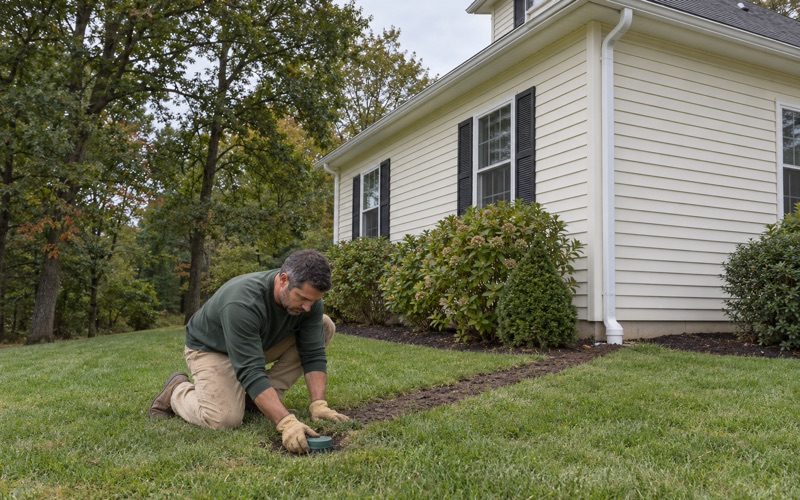
Where a yard needs water carried farther, an underground downspout line to a pop-up drainage emitter can move it across a lawn without an extension lying in the way. Drywells are a different matter near the bay. New Jersey’s stormwater rule calls for dry wells to sit 2 feet above the seasonal high water table, and low bayfront ground may not leave room for that.
So on a Harbour Village lot we do not assume a drywell is the answer. We look at the site first, and if a drywell would sit too close to groundwater, we recommend an emitter or a surface extension instead. Either way, the estimate names each discharge point before any gutter or leader work starts on the house.
Nothing Goes to the Sewer
Tying a leader into a sanitary sewer line is a shortcut some older houses still carry, and it sends storm water into a system built for wastewater. We never connect a downspout to the sanitary sewer, and if we find one already tied in, we point it out to the owner and show where that water could discharge on the lot instead.
Raised Houses, Longer Downspouts
Some bayfront houses have been raised or rebuilt to sit higher, which changes the gutter job in ways a standard estimate misses. A taller eave means a longer drop from gutter to grade, more roof water moving faster at the bottom, and more places along the run where a joint or strap can work loose over time.
Longer Leader Runs
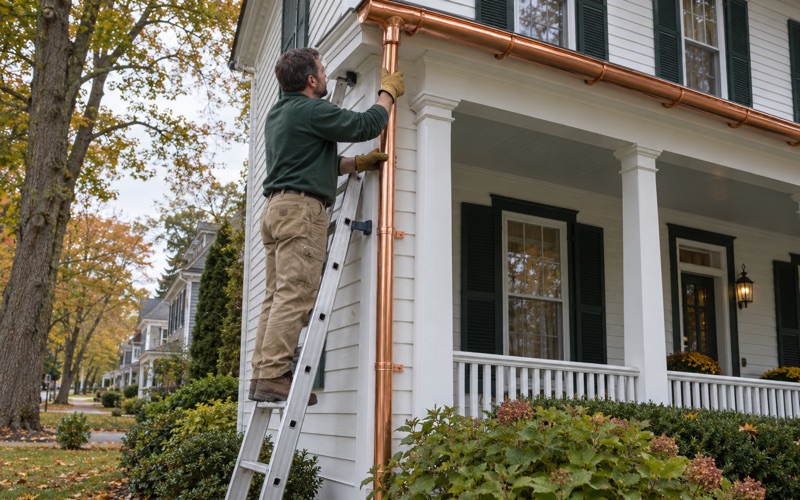
When a house is raised in a VE zone, the leader from the eave to the ground grows with it. We plan those runs with straps spaced to hold a long section steady in coastal wind, and we use 3x4 downspouts where the roof area calls for them, so a heavy rain does not back up at the elbows.
A long leader also needs a sensible landing. Water falling a full story or more hits the ground with more force, so the bottom elbow, the extension and the splash block matter more on a raised house than on a ranch. We match the discharge to the ground the house now stands over, not the ground it once did.
Sized to the Roof Above
We choose gutter and downspout sizes from the roof area that drains to each run. A raised house with a broad roof face may need 6-inch K-style gutters and an added downspout, while a small porch roof may not. Guessing from habit is how a gutter ends up overflowing at the same corner every storm.
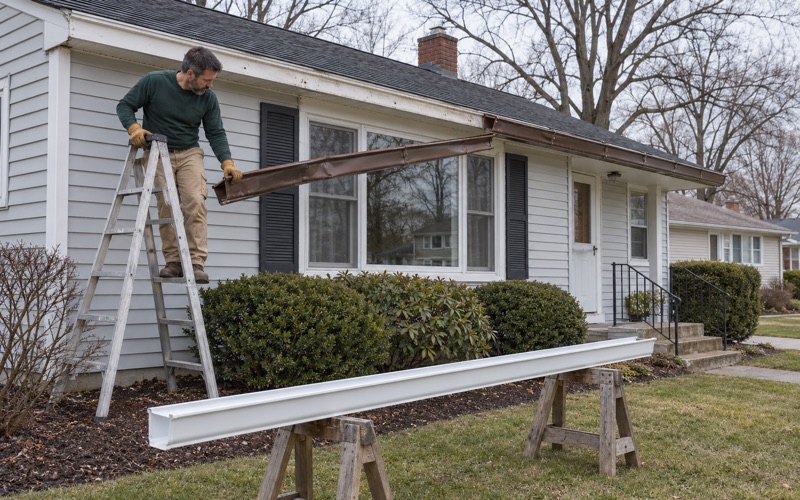
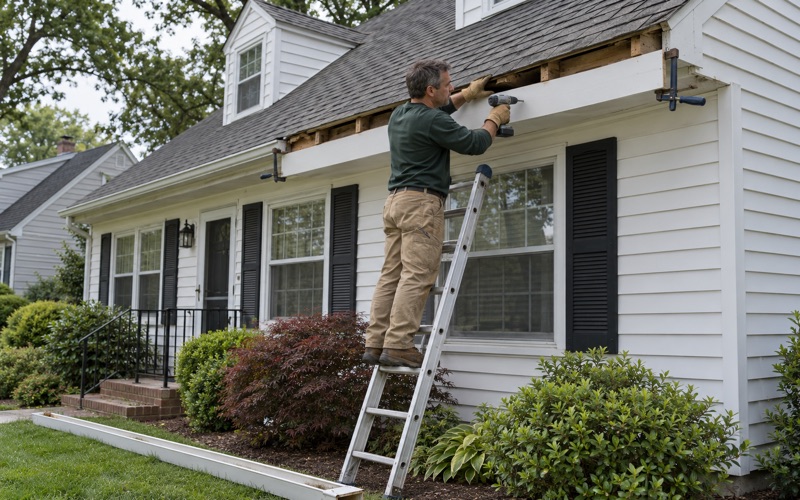
Each run is formed on site from .032 aluminum coil as a single seamless piece, so a long bayfront eave has no mid-run seams to open up. Hidden hangers hold the gutter to the fascia more securely than the old spike and ferrule method, which tends to loosen as the wood behind it moves with the seasons.
Materials Near Salt Water
Houses close to the bay live in salt air, and manufacturers write that exposure into their warranty terms. Before we choose gutter and fastener materials for a bayfront address, we read the manufacturer’s salt-air conditions so the owner knows what the warranty actually covers at that distance from the water, before anything is ordered.
Gutters Uptown, Off the Flood Map
Away from the bayfront, the point we checked at the center of the city sits in Zone X, and gutter work there follows a more familiar pattern. Water still has to leave the roof cleanly and land away from the house, but the questions shift toward debris, the condition of the wood behind the gutter and who is responsible for it.
Light Leaf Load, Matched Guards
South Amboy has thin tree cover. Curb Canopy, using American Forests data updated February 2026, puts the city’s canopy at 15.6 percent against a 45 percent goal. On most lots that points to a lighter leaf load than in heavily wooded towns, though a single oak or pine hanging over a roof can still fill a trough.
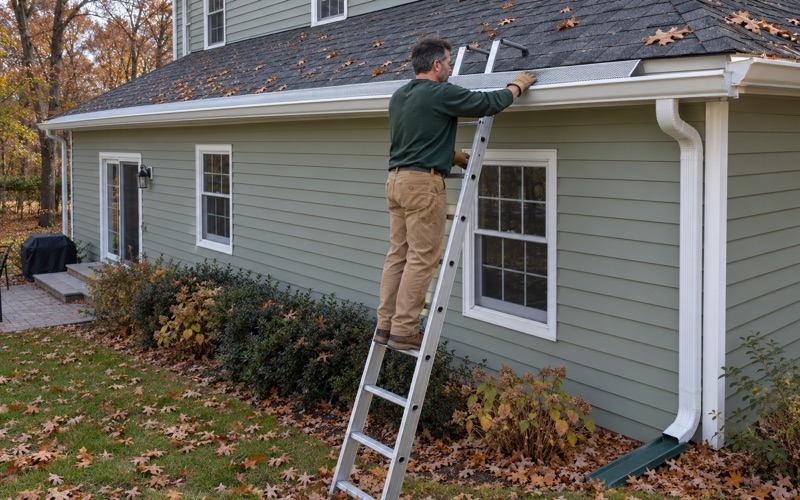
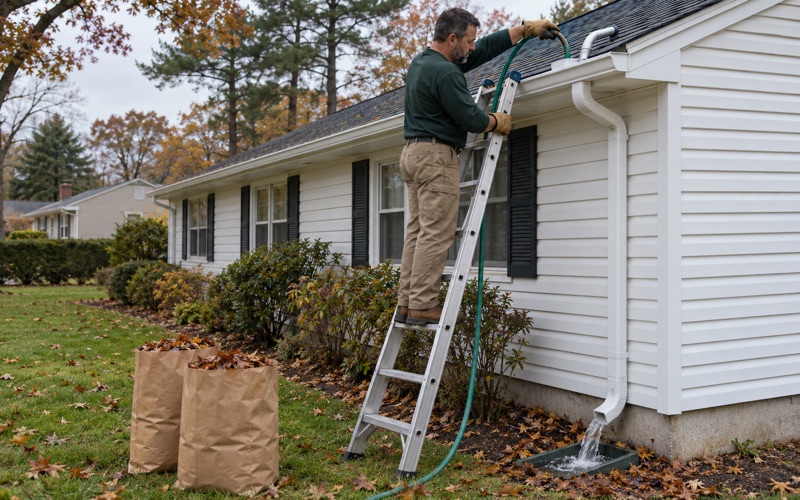
We match guards to the trees actually on the lot. Pine needles slip through screens that stop oak leaves, so a house under a pine may need stainless steel micro-mesh, while an open lot may need no guard at all. Our cleaning visits flush every downspout, bag the debris and come with before-and-after photos.
Checking the Wood and the Paperwork
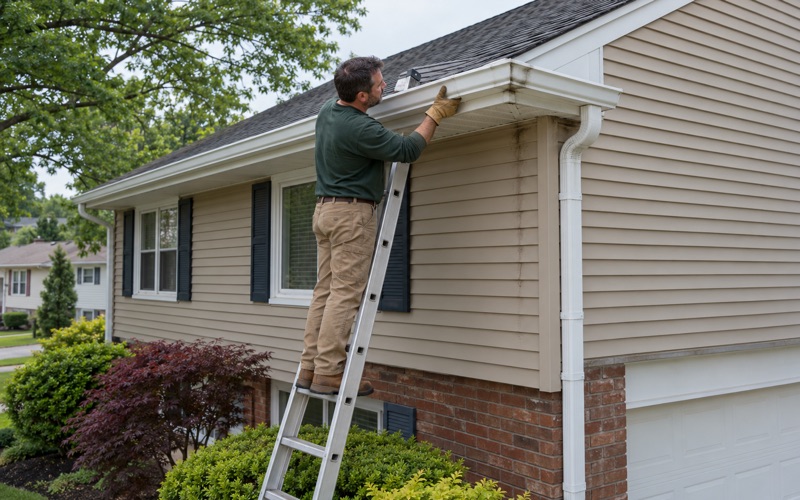
Before new gutters go up, we check the fascia board behind them for rot, and if the wood is soft, we show it to the owner before we replace anything. Many of the newer townhouses near the station and the bay belong to associations, so we check the master deed or management office first to confirm who is responsible for the gutters.
Our estimates list new gutters and repair work on separate lines, because New Jersey taxes them differently: new gutters are treated as a capital improvement, while repairs are taxable. For homes with character worth keeping, we can also match copper or half-round gutters to the age and style of the house rather than fitting a profile that looks out of place.
A Waterfront Still Being Planned For
South Amboy is one of seven municipalities in Resilient NJ: Raritan River and Bay Communities, an initiative led by the New Jersey Department of Environmental Protection in partnership with Middlesex County. The city announced its participation on April 7, 2021, as part of an effort to identify flood risk reduction strategies for the Raritan River and Bay region.
That planning is regional and long-term, and it is not a gutter rule. It sits alongside other waterfront work, including more than $2 million from FEMA’s Sandy aid to repair Raritan Bay Waterfront Park. We bring the same attention to the smaller scale of a single house: knowing where it sits on the map, and where every drop leaving its roof will go.
- 20+ Years on Gutters
- Seamless, Formed On Site
- Before-and-After Photos