Middletown Quality Gutters has spent more than 20 years installing, repairing and cleaning gutters, and our work on gutters in South Orange Village starts with a question most homeowners never have to ask: is this one of the few houses the village has designated historic? For nearly every address the answer is no, and a gutter job is simply a gutter job.
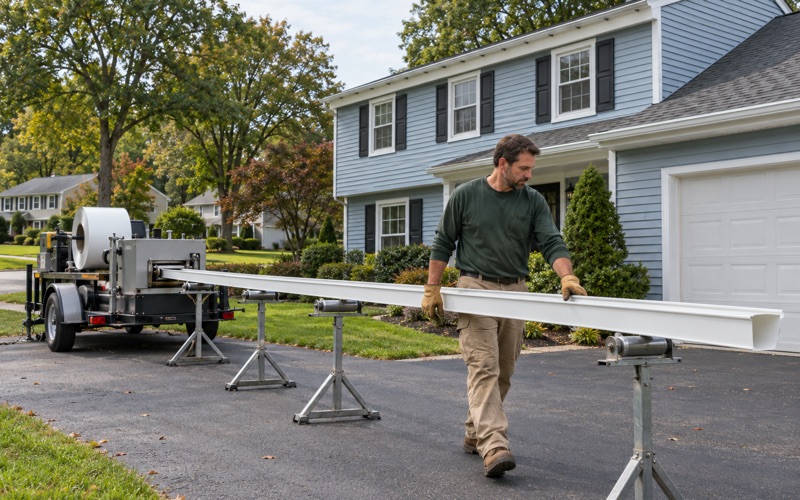
Whatever the house, we size each gutter and downspout for the roof area that actually drains into that run instead of reaching for a stock size. Seamless runs are formed on site from coil, one continuous piece per run, and we follow every downspout to where its water ends up. If it empties against the foundation, the estimate proposes an extension, pop-up emitter or drywell.
This page covers what changes on the handful of designated houses, why most owners never deal with that review at all, what older slate and tile roofs mean for the gutter beneath them, and how rental buildings fit in. Where the local ordinance is silent on gutters, we say so plainly rather than guessing how the commission would rule.
Gutters on a Designated Montrose Park House
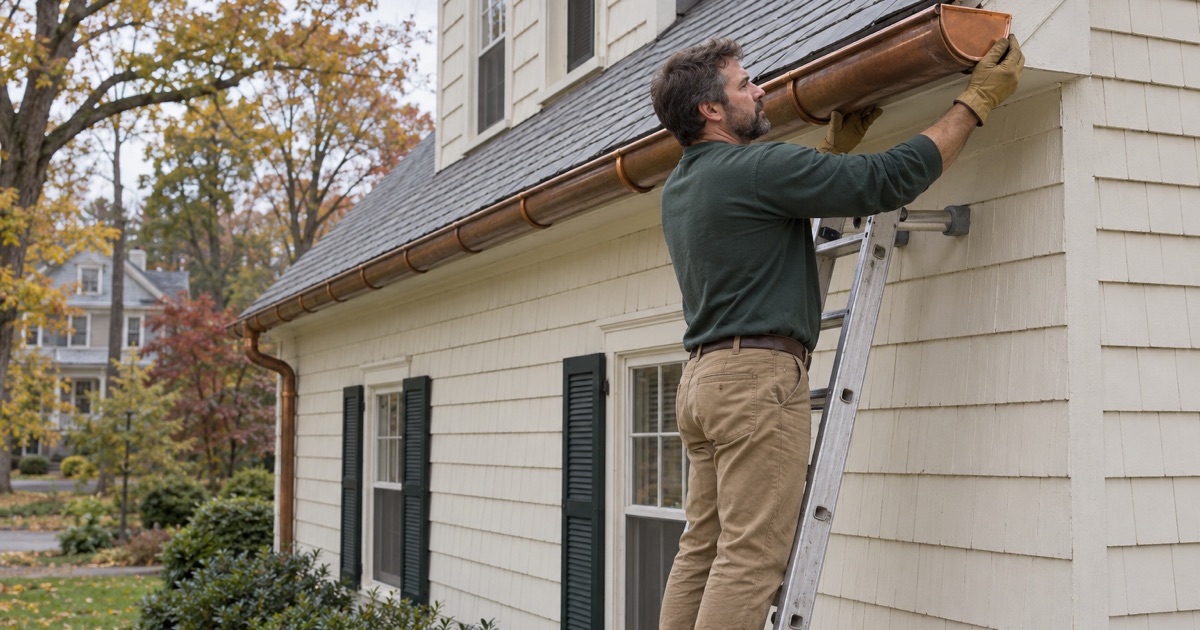
South Orange restated its preservation rules in Ordinance 2024-16, adopted September 9, 2024. According to the Historic Preservation Commission’s own 2024 FAQ, the only residential properties designated historic as of October 2024 are the 40 key contributing properties in the Montrose Park Historic District. Those are the houses where gutter work can run into the ordinance.
What the Minor Work List Leaves Out
The ordinance sorts exterior projects into Minor Work and Major Work. Minor Work is a closed list: replacing the roof with a compatible material, in-kind replacement of more than 25% of shingles, clapboards, siding, decorative elements, columns or porch posts, replacing windows and doors, and painting previously unpainted brick or stone. Gutters, leaders and downspouts do not appear on it.
Major Work is defined as additions, alterations or replacements, or any change to a publicly visible facade of a designated property, unless the job qualifies as Minor Work. Read together, those two definitions suggest that replacing a visible gutter with a different material or profile falls on the Major Work side. That is our reading of the text; we have not found a published commission position on gutters.
How the Screening Works
Every construction permit application in the village is screened by the Administrative Officer, which the ordinance defines as the Zoning Officer or Construction Official as appropriate. That screening is where a project on a designated house is sent toward Certificate of Appropriateness review, and the commission determines whether the work is exempt, Minor Work or Major Work.
Minor Work goes to a two-member subcommittee made up of the chair and one other member, which must decide within 15 days of receiving a completed application, and a failure to act counts as approval. Major Work goes before the full commission, which meets on the third Thursday of each month at 7:30 p.m. at the Baird Community Center on Mead Street.
Pricing a Designated House
When an owner tells us the house is one of the 40, we photograph the existing gutters and record the material and profile of each run before writing anything up. That record lets the owner see plainly which parts of the job keep the facade as it is and which parts would change it, before anything is ordered.
Our estimates also list new gutters and repair work on separate lines, because New Jersey taxes them differently. Under the Division of Taxation’s S&U-2 guidance, new gutters are an exempt capital improvement documented on Form ST-8, while repairing gutters is a taxable repair. Keeping the two apart makes the paperwork cleaner for every owner, designated or not.
Looking for gutters closer to Berkeley Heights? See Gutters Services in Berkeley Heights.
Repair in Kind vs Replacement: The 25% Line
The most useful line in the ordinance for gutter owners sits in its exemptions. Section 9-24F excludes from any certificate the repair and maintenance of less than 25% of existing siding, roofing materials, architectural trim and other building components, using the same style, materials and quality of workmanship. That clause decides how much paperwork most small jobs carry.
Patching With the Same Profile
Gutters are not named in that exemption, but patching a section of an existing gutter with matching material and profile reads as the kind of repair it describes. Resealing a leaking miter with tripolymer sealant, rehanging a sagging stretch or replacing a short dented length with identical stock all sit on that side of the line, in our reading.
Repainting existing painted surfaces is separately exempt under Section 9-24D, so refinishing a painted gutter or leader adds no review step either. When the fascia or trim behind a gutter carries paint on a house built before 1978, we follow the EPA Renovation, Repair and Painting rule as we disturb it, a federal requirement rather than a village one.
When a Change in Material Crosses Over
The picture changes once the work stops being in kind. Swapping half-round for K-style, or aluminum for a different metal, alters how the facade looks from the street, and that is the territory the Major Work definition covers. Replacing most of a gutter system at once, rather than a short section of it, raises the same question.
For owners who want to keep the original look, we match copper and half-round work to the age and style of the house, including double-bead half-round profiles where the existing gutter uses one. Matching what is there also gives the Administrative Officer the simplest project to screen, because the material and profile on the facade stay the same.
Emergency Repairs First
Section 9-24A allows temporary emergency repairs, with no further work until the commission’s approvals are in hand. If a storm tears a gutter off a designated house, we can secure or remove the loose section so it stops damaging the trim, then hold the permanent fix until the review path is clear.
Before-and-after photos come with every repair we make, so the owner has a dated record of what failed, what we removed and what was left in place. On a designated house that record does double duty, because it shows exactly what the permanent work is replacing when the application is screened.
Why Most South Orange Houses Skip HPC Review
Designation in South Orange is narrow, and that matters more than the rules themselves. The Montrose Park Historic District was listed on the National Register on August 29, 1997, covering about 406 acres in the northeast corner of the village, but National Register listing alone does not trigger review by the local commission.
The Rest of Montrose Park
The district’s nomination counted 708 primary buildings: 40 key, 511 contributing and 157 non-contributing. Only the key properties are designated under the local ordinance. Owners of other contributing houses may apply to be recognized as key contributing properties, but until one does, gutter work on that home carries no commission step.
That means two houses within the same district can sit on opposite sides of the line. Before we quote a Montrose Park house, we ask whether it is one of the designated key contributing properties, because that single answer decides whether the screening matters to the job at all.
Newstead, Tuxedo Park and Wyoming
Outside the 40 designated houses, including neighborhoods such as Newstead, Tuxedo Park and Wyoming, gutter work is planned around the house itself: the roof area feeding each run, where the downspouts sit, the trees on the lot and where the water goes once it reaches the ground.
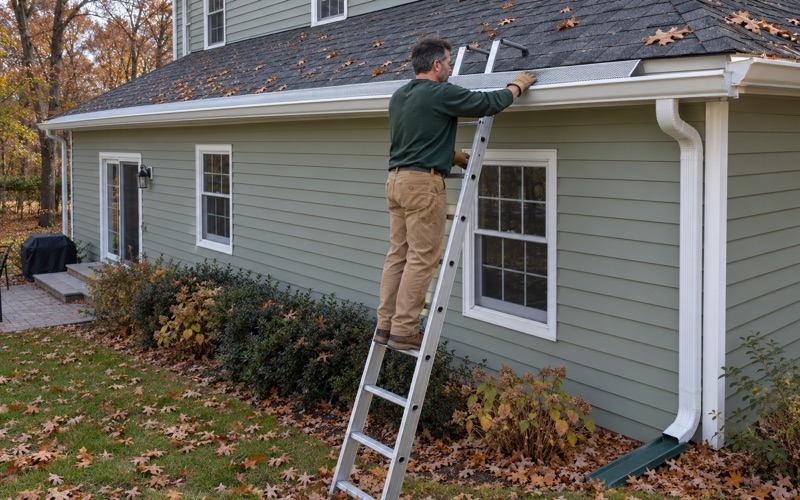
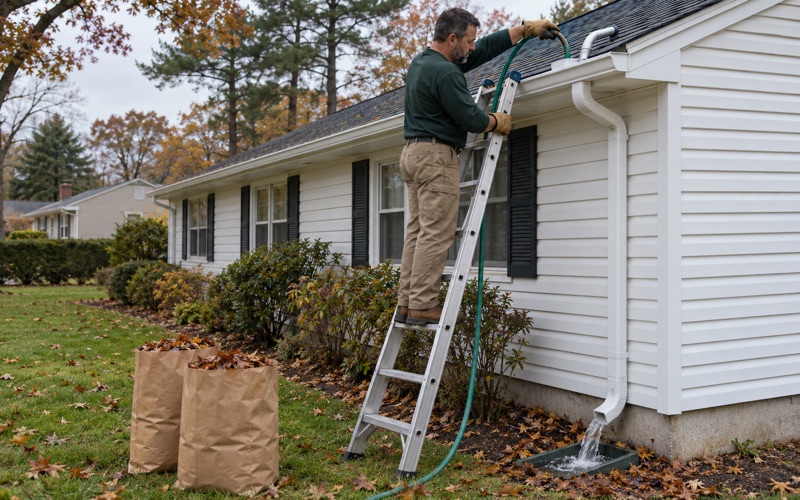
Guards are chosen for those trees, since pine needles and oak leaves call for different screens; stainless steel micro-mesh stops fine needles that slip through coarser guards. Our cleaning visits flush every downspout and bag the debris, so nothing is left on the lawn or at the curb once we pack up.
Where the Water Lands
Grade matters as much as the gutter. The IRC 2021 New Jersey edition, Section R401.3, calls for the ground to fall 6 inches within the first 10 feet from the foundation, and a downspout emptying onto a flat bed works against that. Each estimate names every discharge point, and we never tie a leader outlet into the sanitary sewer.
The East Branch of the Rahway River runs the length of the village and once flooded low-lying areas before Army Corps projects in the mid-1970s. South Orange is NFIP community 340194, and New Jersey’s stormwater rule keeps dry wells 2 feet above the seasonal high water table, so a drywell near the river needs a site check first.
Slate, Tile, Neglect and Rental Buildings
South Orange’s housing is old. The 2024 American Community Survey counts 2,701 of 6,208 housing units built during 1939 or earlier, and the Montrose Park nomination describes homes dating from the last quarter of the nineteenth century through the 1930s. Those ages shape what we find at the eaves.
Gutters Under Slate and Tile Roofs
The nomination’s inventory describes slate-clad hipped, gambrel and clipped-gable roofs on several Berkeley Avenue houses, along with a green pan tile roof elsewhere in the district. It describes roofs rather than what hangs at their edges, so the gutter on any particular house has to be seen in person.
Houses of this period with slate or tile roofs are commonly paired with copper or heavy-gauge gutters, and some carry built-in or box gutters set into the cornice. We plan the work so nobody walks the slate, and we check the drip edge and gutter apron where the roof edge meets the gutter before anything is rehung.
When a Failed Gutter Becomes Neglect
The ordinance defines demolition by neglect to include deterioration of roofs, chimneys and exterior wall elements on a designated building, to the extent it harms the character of the district or could reasonably lead to irreversible damage. Under Section 9-29, the commission may refer a suspected case to the Construction Official.
A gutter that has leaked into a cornice for years is how that kind of rot begins. On any older house, designated or not, we check the fascia for soft wood before new gutters go up and show the owner what we find, because fresh gutters hung on rotted backing only hide the problem for a season or two.
Rental Buildings and Gutters
About a third of occupied homes in South Orange are rented, 2,107 of 6,090, and 1,692 of those renter units sit in buildings with 10 or more units. Ordinance 09-18 requires every residential rental to be registered and licensed each year, at $50 for a single-family rental and $100 per multi-family property.
The village’s Landlords page notes that all rental units remain subject to Certificate of Habitability provisions; whether that inspection looks at gutters is something we have not confirmed. For condominium and association buildings, we check the master deed or management office first, so the owner knows who is responsible for the gutters before anything is priced.
- 20+ Years on Gutters
- Seamless, Formed On Site
- Before-and-After Photos