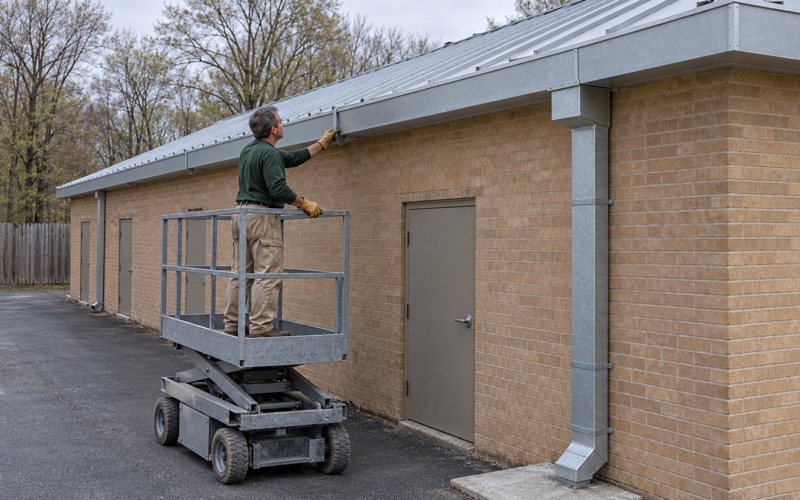
Middletown Quality Gutters has spent more than 20 years installing, repairing and cleaning gutters in South River, and on a lot shaded by mature trees our work starts with a plain question: which trees are staying? In this borough the answer is usually all of them, so we plan gutter sizes, guards and cleaning visits around the canopy the house already lives under.
That approach matters because a tree hanging over the roof is not something a homeowner can simply cut away here. A large tree on your own lot is regulated, and the practical path for most owners is to keep it, have the limbs over the eaves pruned by a tree professional, and give the gutters the right screen and schedule.
We do not take trees down and we do not offer tree work. Our part is the drainage system on the house: seamless runs formed on site from coil, downspouts traced to where their water lands, fascia checked before anything is hung, and guards chosen for the species dropping debris into them. The sections below explain the local rules and how we work within them.
What Chapter 319 Asks Before a Tree Comes Down
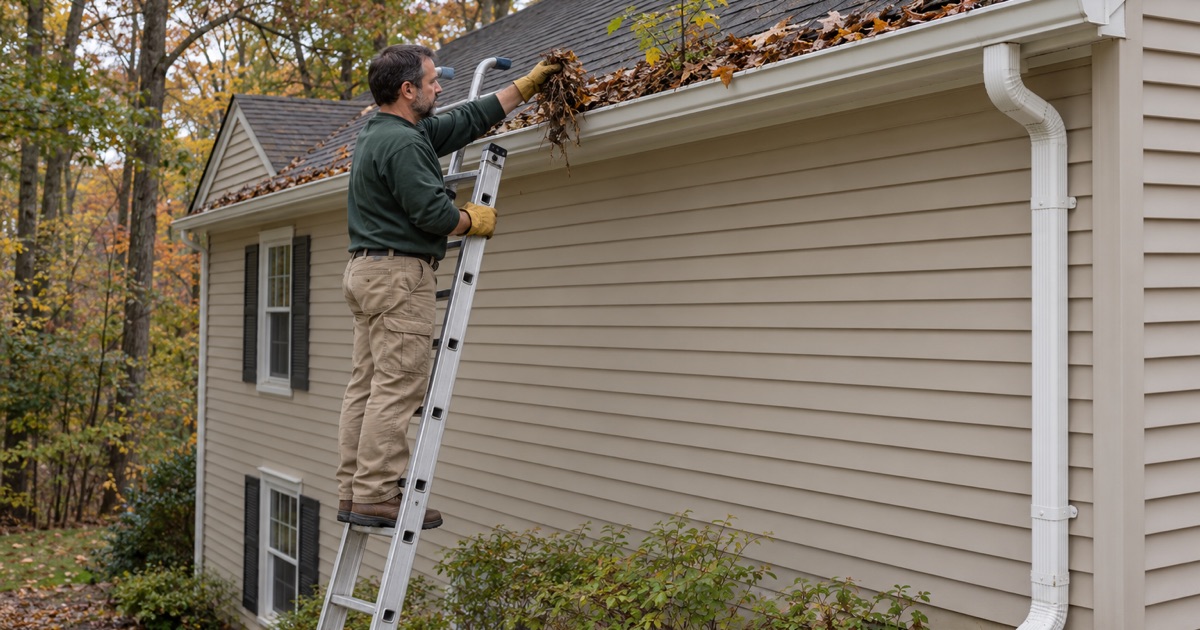
The Borough of South River rewrote Chapter 319 of its code, Tree Removal and Woodlands Management, through Ordinance 2024-21. The Mayor and Council adopted it on June 10, 2024, with six ayes, and it reaches trees in back yards as well as along the street. Homeowners frustrated by full gutters should know its terms before calling anyone with a saw.
The Size That Triggers an Application
Under Section 319-14A, anyone planning to remove a tree of 6 inches or more in diameter on their own property must first submit a Tree Removal Application to the Municipal Clerk or designee. For a street tree in the sidewalk, planting strip or public right-of-way, the threshold drops to 2.5 inches.
Diameter is measured at breast height, which the chapter defines as 4 1/2 feet above ground level. The ordinance is direct about timing: no tree shall be removed until municipal officials have reviewed and approved the removal. A mature oak or maple shading the eaves of a South River house will be well past that size.
Replacement Trees Scale With Size
Approved removals carry a replacement obligation. A tree up to 12.99 inches calls for one new tree of at least 1.5-inch caliper, a tree from 13 to 22.99 inches calls for two, 23 to 32.99 inches calls for three, and anything 33 inches or larger calls for four. Each category carries a $35 application fee.
Replacements must go in within 12 months, are monitored for two years and cannot be planted in containers. An owner without room can turn to the alternatives in Section 350-28, which allow off-site planting or a payment into a tree fund. Before adoption, the council struck the words other than a resident from the replacement section, so the rule reaches homeowners.
Why the Borough Wrote It
Section 319-1D says the chapter exists to reduce soil erosion and pollutant runoff and to promote infiltration of rainwater into the soil. In other words, the borough treats its trees as part of how stormwater is handled, and American Forests’ Curb Canopy data puts South River’s canopy cover at 24.7%.
Enforcement falls to the South River Police Department, the Public Works Supervisor and the Code Enforcement Officer, and a violation can bring a fine of up to $2,000 or a requirement to plant additional trees. That is a steep price for a problem that is better handled at the gutter.
Looking for gutters closer to Metuchen? See Gutters in Metuchen.
Pruning Over the Roof Is Not Removal
The most useful line in Chapter 319 for a gutter owner sits in its definitions. Tree removal, the chapter says, does not include responsible pruning and maintenance of a tree. Cutting back the limbs that hang over a roof is a different act from taking the tree down, and it is often the first step we suggest.
What Pruning Does for the Gutters
Limbs reaching over the eaves drop leaves, twigs and seed pods straight into the trough, and they rub shingles and gutter lips in wind. Shortening them reduces the load that lands in the gutter and keeps branches from resting on the hangers. It does not stop every leaf, since wind carries debris from well beyond the roofline.
Pruning is a job for a tree care professional, and it is the owner’s call to arrange. During an estimate we point out which limbs sit over which gutter runs, so the conversation with the tree crew is specific. After the pruning, we can return to clean and flush everything the work knocked loose.
Hazard Trees Are a Separate Category
Section 319-9G allows hazard trees to be removed with no fee or replacement requirement. The chapter defines them by specific conditions, such as an infectious disease or insect infestation, a dead or dying tree, a tree causing obvious damage to structures like foundations or sidewalks, or one a certified arborist or licensed tree expert judges a threat to public safety.
That judgment belongs to a certified arborist or licensed tree expert, not to a gutter contractor, and we do not offer an opinion on whether any tree qualifies. If a tree on your lot looks sick or unstable, call an arborist first. Our work resumes once the tree question is settled, whatever the answer turns out to be.
Questions We Leave to the Borough
Where a project might go beyond pruning, the Municipal Clerk’s office takes the application and can answer how the chapter applies to a particular lot. Asking before any cut is made is far cheaper than learning the rules from an enforcement notice, and it keeps the decision with the people who administer the ordinance.
The same goes for a street tree in the planting strip out front. We will tell you which gutter runs a street tree drops into and how much debris they collect, but any decision about the tree itself runs through the borough, not through us.
Gutter Guards and Cleaning Under Trees You Keep
Once the tree is staying, the gutter has to be built and maintained for it. That means a screen matched to the species overhead, gutters and downspouts big enough to pass what gets through, and a cleaning schedule set by the canopy rather than by the calendar alone.
Matching the Guard to the Tree
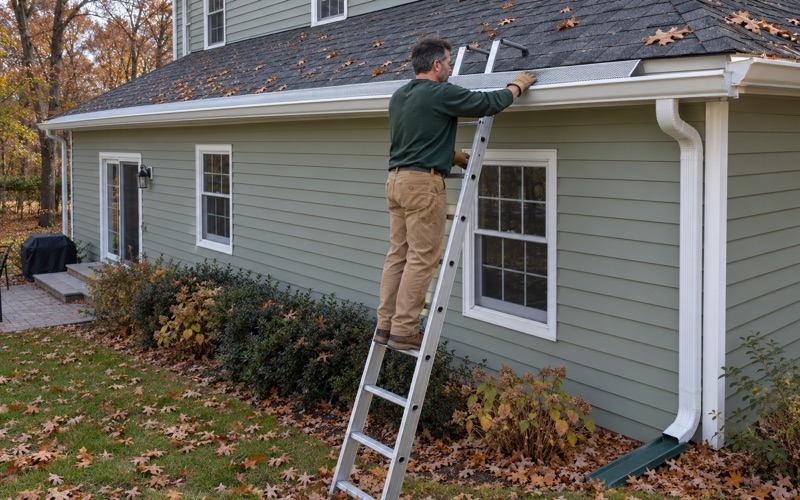
Pine needles and oak leaves behave very differently on a screen. Needles slip through coarse openings and lodge in downspouts, while broad oak and maple leaves mat on top and shed water over the edge. We look at what actually grows over each run before recommending a guard, and on needle-heavy runs that usually means stainless steel micro-mesh.
No guard is maintenance-free under a heavy canopy. Debris that sits on the mesh still needs brushing off, and seed pods and pollen can coat fine screens in spring. We tell owners plainly how often their particular trees will need attention, so a guard is bought for what it can do rather than what a brochure promises.
Sizing for the Load
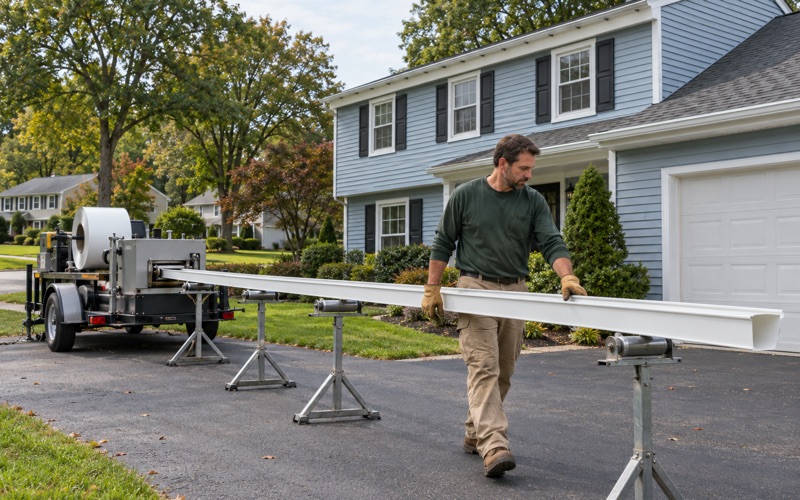
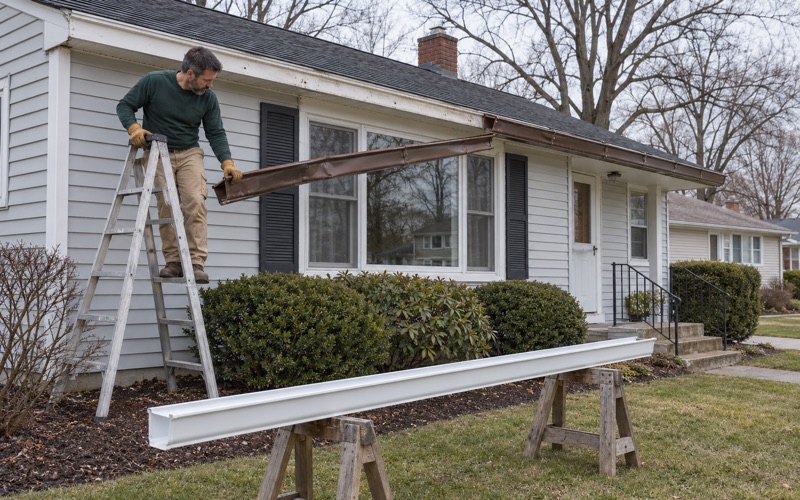
Trees add to what a gutter has to carry, so we size gutters and downspouts by the roof area draining to each run instead of defaulting to one size for the whole house. On shaded houses a 6-inch K-style gutter with 3x4 downspouts gives debris more room to pass. Every run is seamless, formed on site from .032 aluminum coil in one piece.
Wide-flange outlets at the downspout openings help keep leaves from bridging the hole. Hidden hangers hold the gutter more firmly than spike and ferrule when wet debris adds weight, which matters on runs under heavy limbs that drop material all season.
Cleaning Visits and the Leaf Program
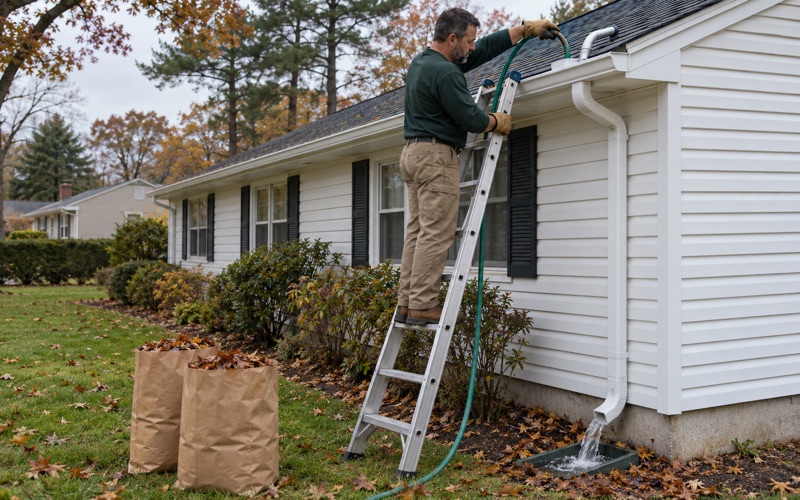
Our cleaning visits flush every downspout, bag all of the debris and leave nothing on the lawn or at the curb. Owners get before-and-after photos of each run, which makes it easy to see whether the trees overhead call for a second visit later in the fall.
Homeowners who handle their own leaves should know the borough’s rules. The Department of Public Works runs a Curbside Leaf Program beginning October 19 and continuing into mid-December. Leaves go out in biodegradable paper bags or open containers, never plastic bags, no closer than 10 feet to a storm drain inlet, and loose leaves only during the seven days before the scheduled collection.
Fascia, Older Houses and Storm Limbs
Shade and wet debris are hard on the wood behind a gutter, and much of South River’s housing is old enough for that wood to need care. Census figures show 4,324 of the borough’s 5,754 housing units were built before 1980.
Checking Fascia Before New Gutters Go Up
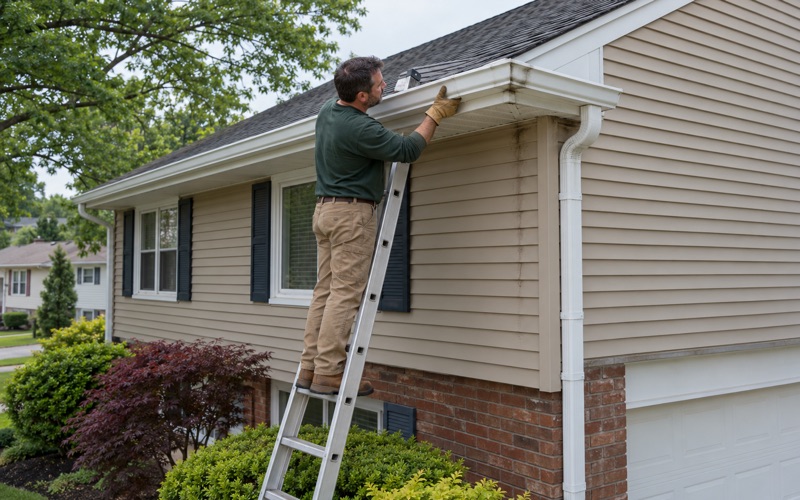
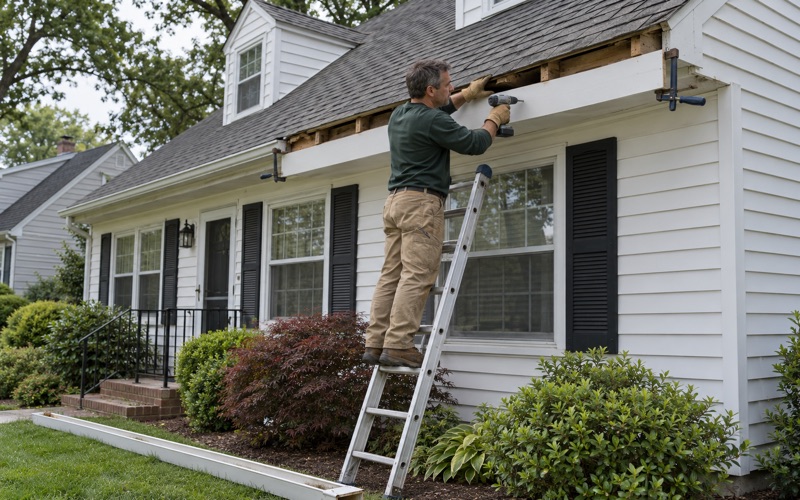
Gutters that stay packed with wet leaves hold water against the fascia board, and shaded eaves dry slowly. Before we hang anything, we probe the fascia along every run for rot. Soft wood is shown to the owner before it is replaced, so the repair line on the estimate matches something you have seen.
We also check the gutter apron and drip edge, which keep roof runoff behind the gutter instead of letting it run down the board. Where a lower roof meets a wall, kickout flashing steers water into the gutter rather than behind the siding.
Painted Trim on Pre-1978 Houses
On a house built before 1978, painted fascia and trim may carry lead paint. The EPA’s Renovation, Repair and Painting rule, 40 CFR 745, treats exterior work that disturbs more than 20 square feet of painted surface as more than minor repair, so we plan fascia replacement on older South River houses with that rule in mind.
When fascia under a shaded run has to come off, we tell the owner up front how the rule affects the job. A house built after 1978 does not carry that obligation, and the estimate says which case applies to yours.
When a Storm Brings Limbs Down
A limb that drops onto the eaves in a storm can crush a gutter, pull hangers out of the fascia or bend a downspout off the wall. We replace damaged sections with seamless runs matched to the rest of the system and confirm that each downspout still discharges where it should.
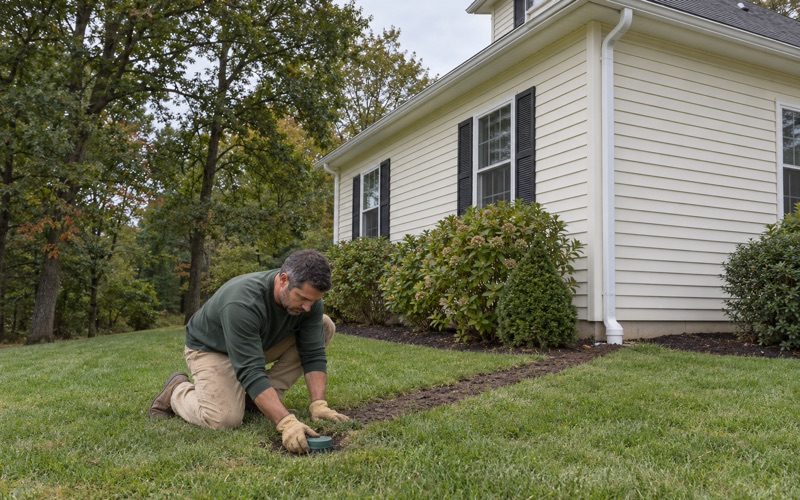
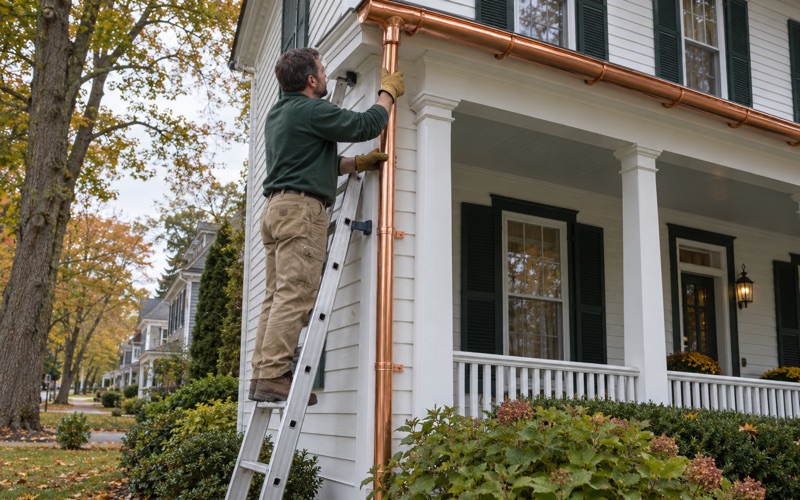
Every downspout is followed to where its water lands, and if it lands against the foundation we propose an extension, pop-up emitter or drywell. Leader outlets are never tied into the sanitary sewer. Estimates list new gutters and repairs on separate lines, because New Jersey taxes a capital improvement and a repair differently.
- 20+ Years on Gutters
- Seamless, Formed On Site
- Before-and-After Photos