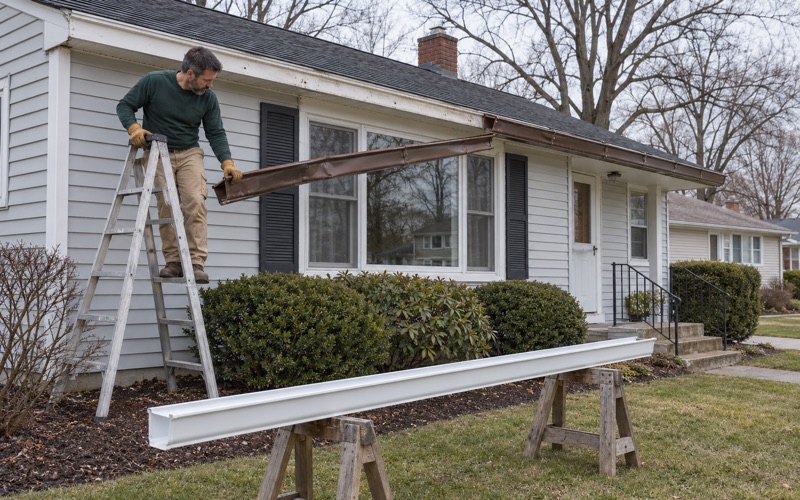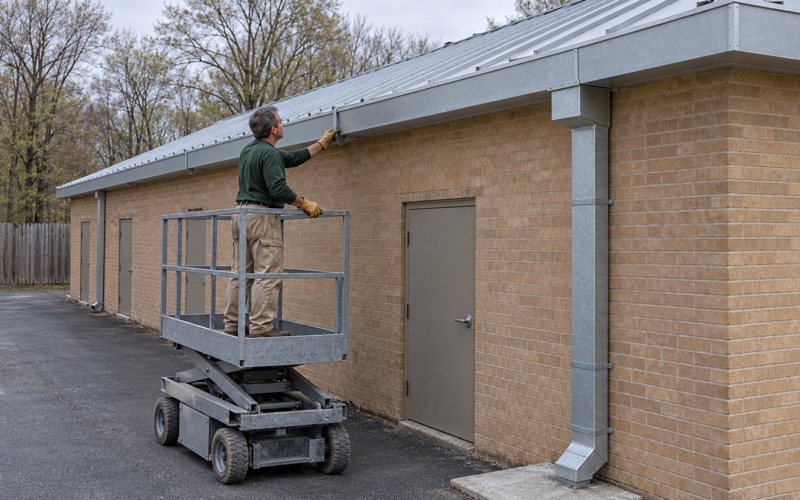
Middletown Quality Gutters has spent more than 20 years installing, cleaning and repairing gutters in Springfield Township, and the first question we ask about any house is where the water goes once it leaves the roof. A gutter is only half of the system. The downspout, the elbow at its foot and the ground it empties onto decide whether a storm ends up out in the yard or pressed against the foundation.
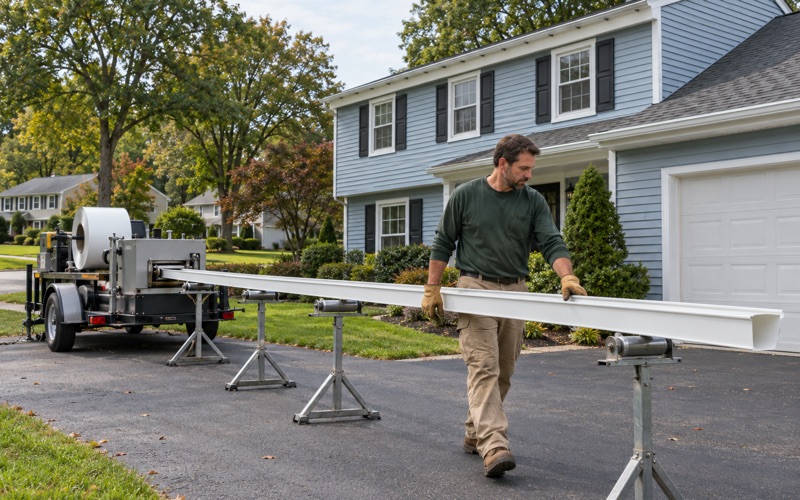
Our seamless gutters are formed on site from .032 aluminum coil, one continuous piece for each run, so there are no joints along the front to open up over the years. Sizes come from the roof area that feeds each run rather than from habit, which is why the long back slope of a house may get 6-inch K-style gutters and 3x4 downspouts while a short porch run stays smaller.
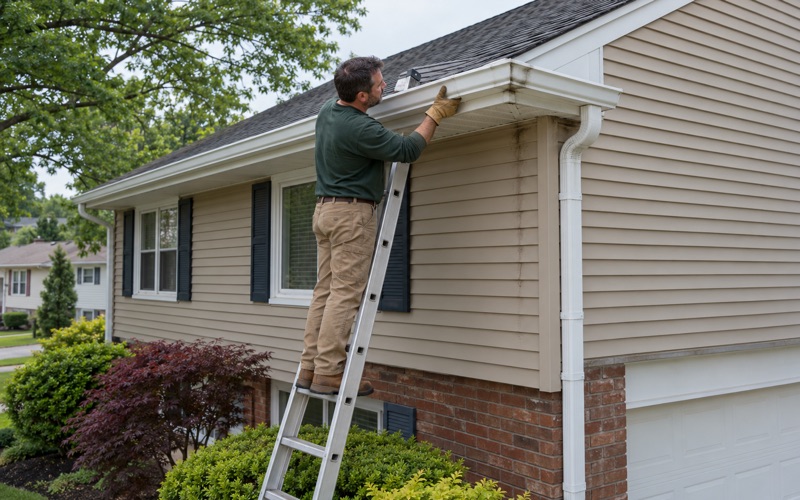
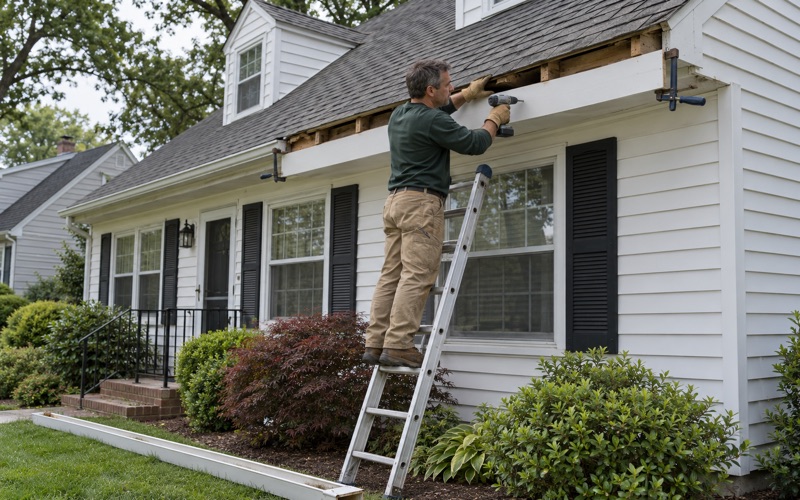
Before anything new is hung, we check the fascia board behind the old gutter for rot, and any soft wood is shown to the owner before we replace it. Every estimate also lists new gutters and repairs on separate lines, because New Jersey taxes them differently: new gutters are an exempt capital improvement documented on Form ST-8, while repairing existing gutters is a taxable repair.
Rain, the Rahway River and What a Gutter Can Do
The Streets That Flooded During Hurricane Irene
Springfield’s serious flooding comes from the Rahway River. When Hurricane Irene came through in August 2011, Union County named Cranford, Springfield and Rahway as the places with its most severe flooding, all of it driven by a river that had crested in many areas. County police in boats rescued 36 residents at Albin Drive in Springfield.
That October, Patch reported that floodwaters took only 45 minutes to cover Alvin Terrace and Marion and Warner Avenues, and that those streets were hit far harder by Irene than by Hurricane Floyd in 1999. The township engineer said the water level was a lot higher than a 100 year storm. As recently as January 2024, Marion Avenue homeowners were asking the state for help with river flooding.
A Gutter Is Not a Flood Defense
We say this plainly to owners on those streets: when the Rahway River is in the yard, no gutter keeps the basement dry, and no guard or downspout changes how high the water climbs. A gutter handles the rain that lands on the roof. River water arrives from the other direction, across the ground, and it calls for different answers than anything we install.
What gutters do decide is whether ordinary rain, the storms of every month rather than the storm of the decade, lands at the foundation. A house whose soil is already soaked from years of overflowing gutters goes into a flood wetter than it needs to be. Keeping roof water off the foundation through the dry weeks and the normal storms is the part of the problem a gutter contractor can actually own.
Overflow, Kickouts and Pitch
On these houses we look first for the everyday failures that put water against the wall: a run pitched the wrong way, a missing kickout flashing where a roof edge meets a sidewall, an elbow knocked loose by a mower, or a gap behind the gutter where a drip edge or gutter apron belongs. Each one sends water straight down beside the foundation, storm after storm.
Fasteners matter on older homes too. We replace spike and ferrule fastening with hidden hangers, so a gutter full of water and leaves holds its pitch instead of sagging in the middle and spilling over the front. End caps and box, strip and bay miters are sealed with tripolymer gutter sealant, which stays flexible through the swings between summer heat and winter cold.
Looking for gutters closer to Weehawken? See Gutters Services in Weehawken.
Where Downspout Water Goes on a Flood-Prone Lot
Discharge at the Surface, Away From the House
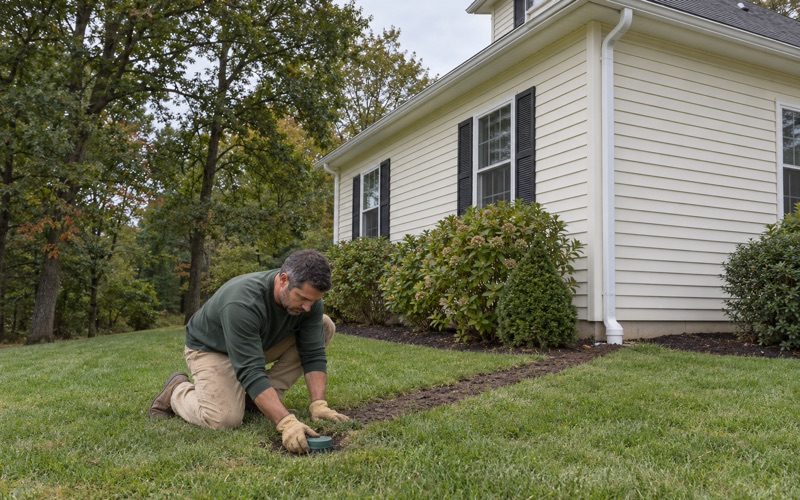
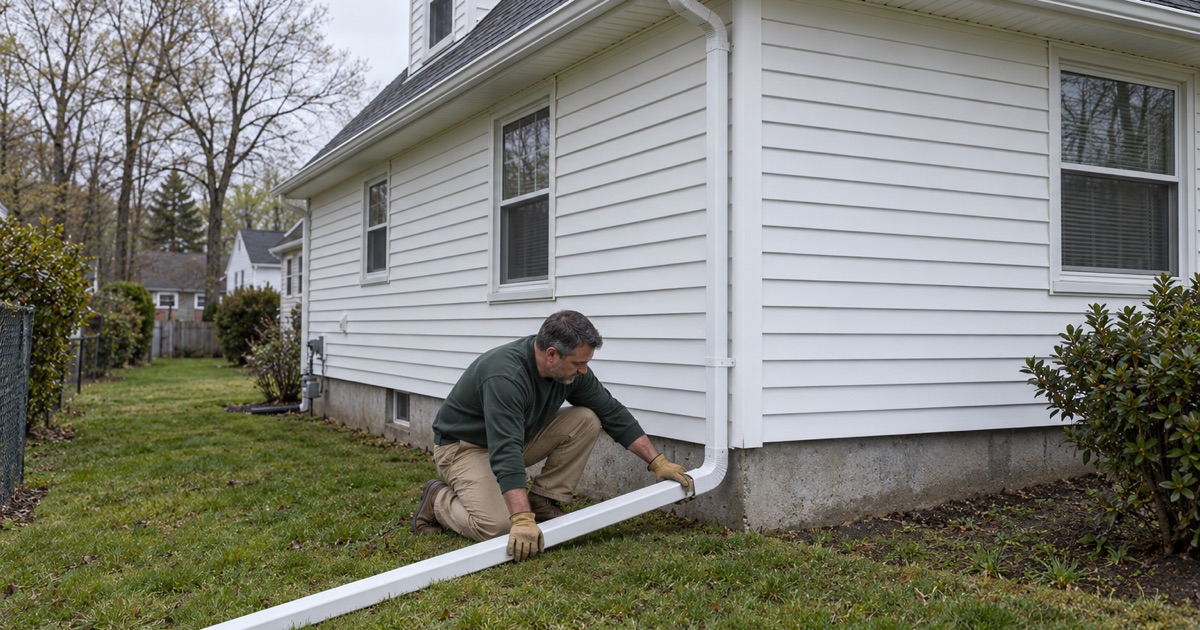
On a lot that floods, our preference is to discharge each downspout at the surface, well away from the house, rather than into a buried pipe. Underground lines look tidy, but when the river is up, water can back up through a pipe that runs toward low ground. An extension or a pop-up emitter set out in the lawn keeps the outlet visible and the route short.
The ground near the house matters as much as the outlet. The 2021 New Jersey edition of the International Residential Code, section R401.3, calls for grade to fall 6 inches within the first 10 feet from the foundation. Where a yard has settled back toward the wall, we point it out, because a downspout emptying onto soil that slopes inward simply returns the water to the house.
Drywells Need Dry Ground
Drywells have a place, but not on every lot. New Jersey’s stormwater rule keeps dry wells 2 feet above the seasonal high water table, and a yard close to the river may not offer that margin. Where the soil cannot take the water, we say so and propose a surface route instead of burying a drywell that would sit in groundwater for half the year.
Never Into the Sewer
Whatever the route, we never tie a leader outlet into the sanitary sewer, and the estimate states where each downspout will discharge. After a heavy rain we would rather an owner walk the yard and see every outlet doing what the paper said than wonder where a pipe disappears to under the lawn.
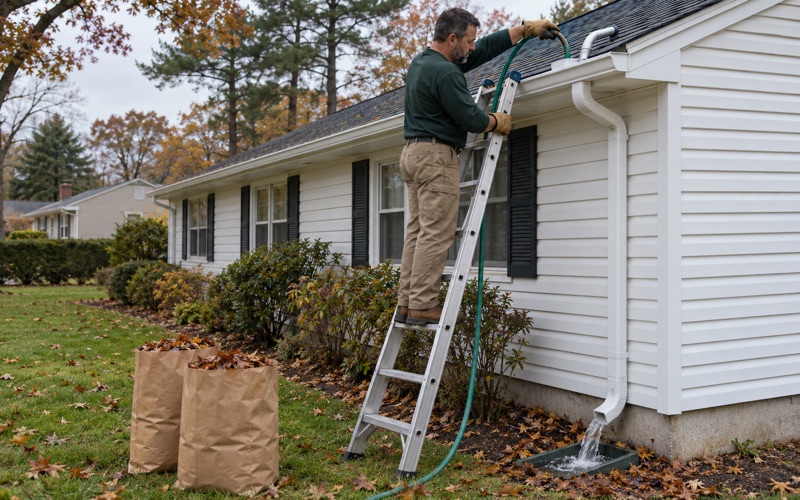
Cleaning visits on these lots include a flush of every downspout from top to bottom, with the debris bagged and hauled away rather than left on the lawn or at the curb. Before-and-after photos come with each cleaning and repair, which also leaves an owner with a dated record of what the gutters looked like before the next storm arrives.
After a Flood, and Who Owns the Gutters
Gutters Count Toward Substantial Damage
After a flood, gutter work is not a side note. FEMA’s substantial improvement and substantial damage guidance, P-758, counts roofing, gutters, and downspouts among the costs included when a damaged house is measured against the federal 50% test. On a house near that line, the price of new gutters and leaders belongs in the same tally as the rest of the repair.
Springfield is National Flood Insurance Program community 345321. Its first flood insurance rate map dates from 10/01/71, the current effective map from 09/20/06, and the township holds no Community Rating System class. Whether a particular house sits in a Special Flood Hazard Area is something to confirm on that map before we price post-flood work, and we ask owners to check it.
Separate Lines Make the Tally Easier
Because we already split new gutters and repair work onto separate lines, an estimate written after a flood shows exactly which parts are replacement and which are repair. That separation lets an owner, an adjuster or anyone reviewing the damage total see the gutter and downspout share of the job without untangling a single lump sum.
We also note the condition of the fascia on the same estimate. If floodwater or years of overflow have softened the board behind the gutter, the owner sees it in our photos first, and the cost of that wood appears as its own line instead of being folded into the gutter price.
Springfield Park Place and Association Gutters
Not every Springfield owner hires a gutter contractor directly. Springfield Park Place, a condominium of 312 townhouse units in 53 buildings under a 1988 master deed, assigns repair of the townhouse buildings’ roofs and main walls to the association, and its 2026 budget carries a gutter maintenance line of $4,500, down from $10,000 the year before.
State statute 46:8B-18 bars a unit owner from contracting for common-element repair except through the association. So when a Park Place owner calls about a clogged gutter, we read the master deed and send them to the management office first, because that request is an association work order rather than a private job, and the owner should know that before anyone climbs a ladder.
Street Trees, Older Houses and Fall Cleanouts
What Falls Into Springfield Gutters
Springfield’s street trees are the other half of gutter care here. The township’s Community Forestry Management Plan lists London plane, pin oak, Norway maple, red oak and ash as typical street trees, and notes a canopy significantly reduced by Winter Storm Quinn, the Halloween snowstorm of 2011 and Hurricane Sandy in 2012.
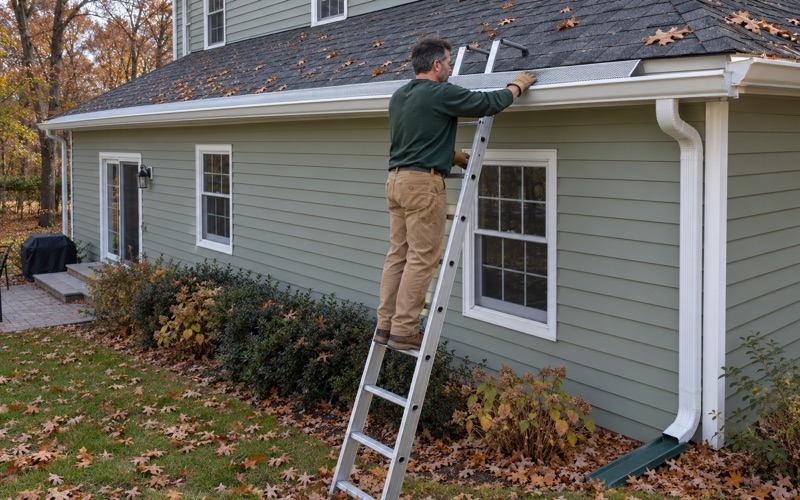
Oak and maple leaves come down in volume each fall and settle into gutters and outlets. We match guards to the trees over each roof, because broad leaves and pine needles call for different screens, and stainless steel micro-mesh gutter guards suit lots where leaves and finer debris mix. Fall cleanouts are timed to the main leaf drop rather than a fixed date on the calendar.
Taking Down a Tree Needs a Permit
Owners sometimes ask whether to remove the tree that keeps filling their gutters. Since September 22, 2020, removing any tree with a diameter greater than 4 inches, measured 4 1/2 feet above the ground, needs a Tree Removal Permit from the Springfield Zoning Office, at $75 for up to two trees and valid for 90 days. We usually start with guards and scheduled cleanings and leave the tree decision to the owner.
Older Houses, Painted Trim and Copper
Much of Springfield’s housing is older. The Census Bureau’s 2024 five-year survey puts 45.1% of the township’s units as built before 1960, and counts 4,511 detached houses. When our work disturbs painted fascia or trim on a house built before 1978, we follow the EPA Renovation, Repair and Painting rule for that work.
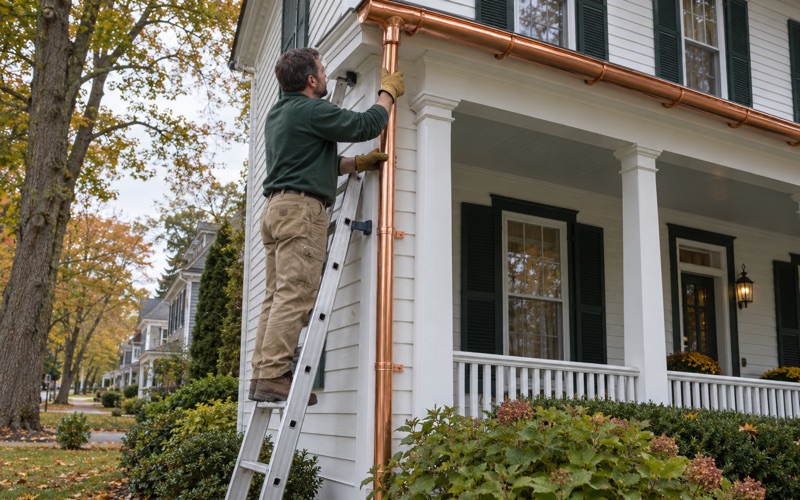
Where an older house calls for it, copper and half-round work is matched to its age and style, from half-round gutters with a double-bead profile to 16-ounce copper gutters that weather to a patina. On most houses, though, seamless aluminum in a color that suits the trim is the practical choice, joined at the corners with clean miters and finished with wide-flange outlets and A and B elbows that send each downspout where it belongs.
- 20+ Years on Gutters
- Seamless, Formed On Site
- Before-and-After Photos