Middletown Quality Gutters has handled gutters in Warren for homeowners who need more than a quick patch, and our 20+ years in the trade have taught us that the big houses here ask for a different kind of plan. Long rooflines, many corners and generous yards change how a gutter system should be sized, hung and drained.
Most calls we take in this township start the same way: a gutter that has begun to sag, leak at a seam or spill over in a heavy rain. Before we quote anything, we walk the whole house, measure each run, look at the fascia behind it and follow every downspout to the spot where its water actually lands.
What follows covers the work as it plays out on Warren’s houses: why gutters from one building era are due for attention now, how we size runs on large roofs, where roof water can go on a big lot, and how trees and newer townhomes change the job. It is written for owners weighing a repair against a full replacement.
Gutters on Warren’s 1980s and 1990s Houses
A Building Wave Reaching Its Third and Fourth Decade
Census estimates for Warren count 2,073 of the township’s 5,560 homes, about 37.3 percent, as built between 1980 and 1999. Those houses are now 27 to 46 years old. Where the original gutters were never replaced, they are at or past the service life usually quoted for aluminum, though no township record tracks which houses have already had the work done.
That age shows up in predictable ways. Spike-and-ferrule hangers back out of the fascia, sealant at the corners dries and cracks, and long sections develop low spots that hold standing water. A gutter that holds water also holds weight, which pulls harder on the fasteners and speeds the next failure along the same run.
Nine or More Rooms Means a Lot of Gutter
More than half of Warren’s homes, 2,900 or 52.2 percent, have nine or more rooms. A house that size usually carries a long eave line, several roof planes and a number of inside corners, which adds up to many feet of gutter and several downspouts. No survey of roof forms exists for the township, so we confirm each house’s layout by measuring it ourselves.
Most of those homes are detached, about 87.4 percent of the township’s housing, so each one carries its own full perimeter of gutter rather than sharing walls with a neighbor. That is why our estimates here tend to list many separate runs, each with its own outlet count, rather than a single figure for the whole house.
The Fascia Behind an Older Gutter
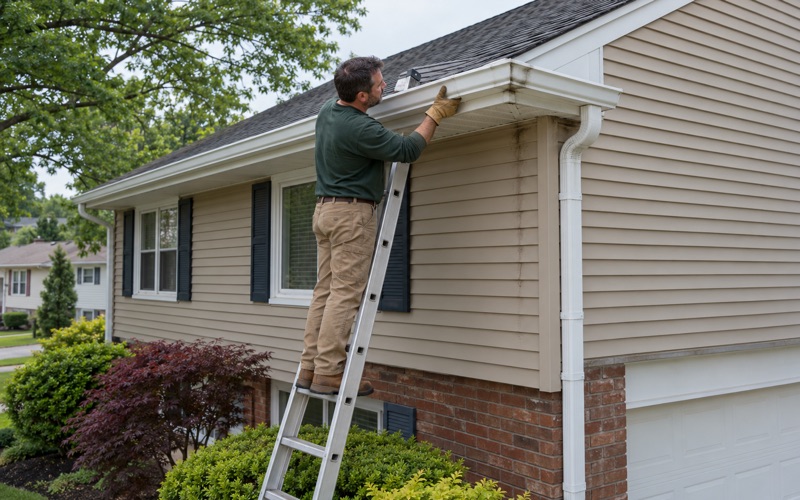
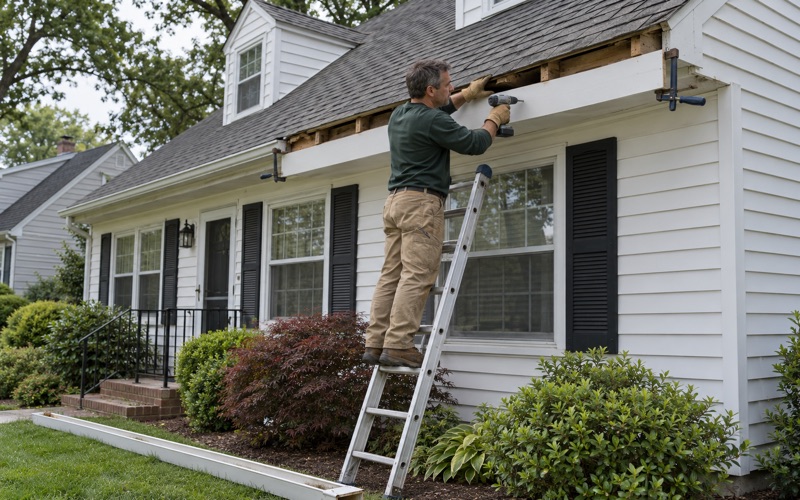
Gutters that have overflowed for years often leave the board behind them soft. Before any new gutter goes up, we probe the fascia along each run, and when we find rot we show the owner the damaged section before replacing it. Hanging a new gutter on soft wood only moves the failure a few years down the road.
On houses with painted fascia and trim built before 1978, the federal Renovation, Repair and Painting rule applies whenever that paint is disturbed. Most of Warren’s 1980s and 1990s stock falls after that line, but the township also has plenty of older homes, so we check the build date before any trim work starts.
Looking for gutters closer to East Rutherford? See Gutters in East Rutherford.
Long Runs and Many Downspouts on Big Roofs
Sizing Each Run to the Roof Above It
We size gutters and downspouts to the area of roof that drains into each run instead of reaching for the same size on every house. On a large Warren roof, one run might take water from a single small plane while another collects from two big slopes meeting at a valley, and those two runs need different capacity.
For the big catchments, 6-inch K-style seamless gutters paired with 3x4 downspouts are a common fit, because a larger trough and outlet move more water before it climbs over the front lip. We add downspouts where a run is long enough that water would otherwise travel too far to reach a single outlet.
Seamless Runs Formed in the Driveway
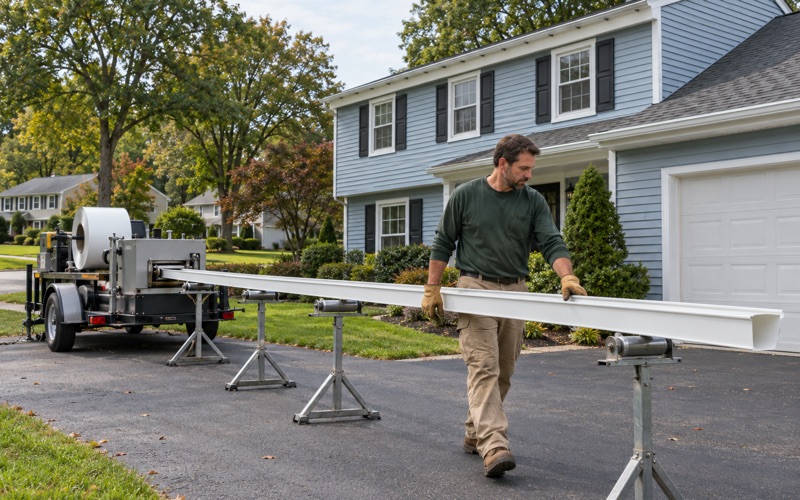
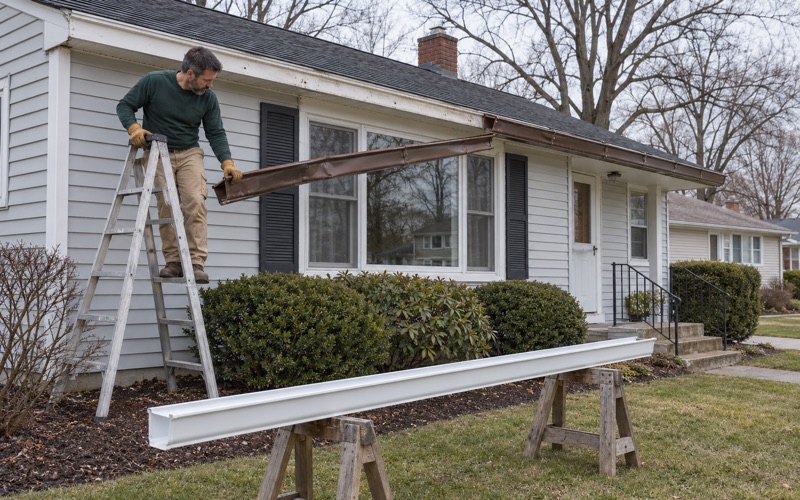
Our seamless gutters are formed on site from .032 aluminum coil, cut as one piece for each run of the house. A long eave line on a large Warren house is exactly where seams cause trouble, since every joint in a sectional gutter is a place for sealant to fail and water to drip behind the trough.
Corners still need joints, and big houses have plenty of them. We fit box, strip or bay miters to suit each corner, seal them with tripolymer sealant and hang the runs on hidden hangers, which hold the trough from inside and resist the slow pull-out that older spike-and-ferrule installations show after a few decades.
Copper and Half-Round Where the House Calls for It
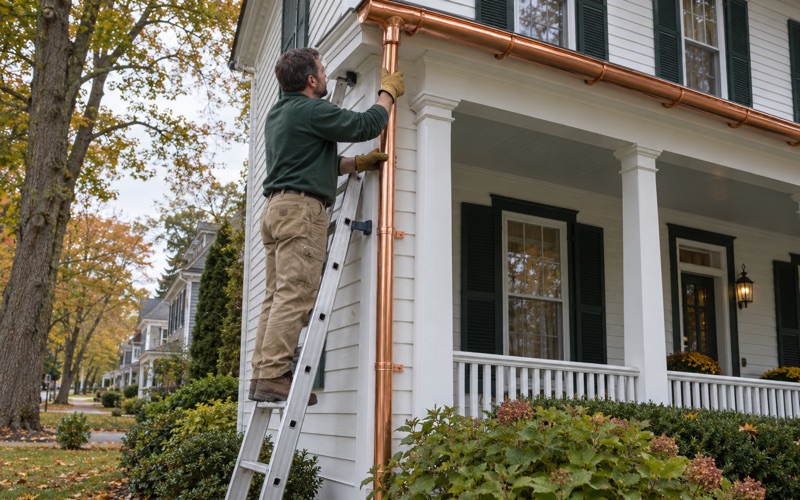
Some owners want the gutters to match the character of the house rather than disappear into it. We match copper and half-round work to the age and style of each home, using half-round gutters with a double-bead profile and 16-ounce copper where the design suits it, and we explain how copper weathers into a patina over time.
Half-round and copper are not the right answer for every house, and we say so. On most of Warren’s late-20th-century homes, a well-sized aluminum K-style system does the job, and the money is better spent on correct downspout placement and drainage at grade than on a more expensive trough.
Moving Water Across an Acre and a Half
What R-65 Lots Make Possible
Warren’s zoning describes the R-65 district as covering the majority of the township’s existing acre-and-a-half single-family neighborhoods, with lots of 65,340 square feet. That much ground usually leaves room to carry downspout water well away from the foundation and release it on the lawn rather than toward the street.
We treat that room as the main advantage of working here. We have not found a township rule that dictates where a downspout discharges, so the decision rests on the lot itself: where the grade falls, where the beds and walks are, and how far the water needs to travel before it no longer runs back toward the house.
Following Every Downspout to Its Outlet
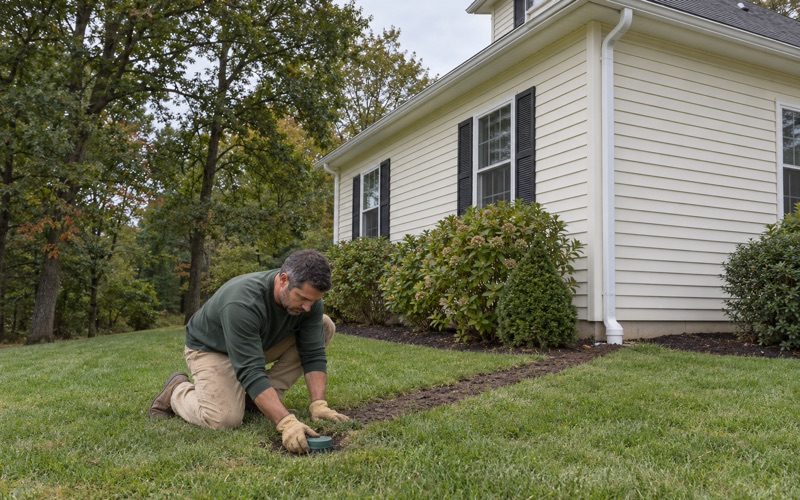
We follow each downspout to where its water lands. When it empties against the foundation, the estimate proposes an extension, a pop-up emitter at the end of an underground line, or a drywell, and names the discharge point for each outlet. The building code’s grading standard, IRC R401.3, calls for the ground to fall 6 inches within the first 10 feet from the foundation.
Where we propose a drywell, we set it so its bottom sits at least 2 feet above the seasonal high water table, the separation New Jersey’s stormwater rule uses. On many large lots a simple extension or emitter line out to open lawn does the same job for less, and we will say when that is the case.
Second Watchung Slopes and Which Way a Lot Falls
The Second Watchung Mountain runs east to west through the township. North of the ridge, land slopes toward the Passaic and Dead rivers; south of it lies the Washington Valley. A lot on the ridge’s flank can fall steeply one way, so where downspout water ends up depends on the slope of that particular yard.
On a sloped lot we look at what sits downhill before choosing an outlet. Water released at the top of a yard can cross a driveway or reach a neighbor’s property, so we place emitters where the lawn can absorb the flow, and we keep the outlets short of walks and beds that would channel it elsewhere.
When Hurricane Ida struck in September 2021, the township reported extensive flash flooding and long-term damage to roads, including Blazier Road just west of Dock Watch Hollow, Ferguson Road and part of Stiles Road. Storms on that scale are when an undersized run, or a downspout emptying at the foundation, shows its limits first.
Keeping Roof Water Out of the Sewer
Warren’s sewer system was built for a spread-out township. The former Sewerage Authority, created in 1972, oversaw construction of 3 sewer plants, 20 pump stations and nearly 130 miles of sewer line before the township moved the work into a Sewer Department in 2022. Residential bills are tied to water use, a $344 minimum plus $3.06 per 1,000 gallons.
New Jersey’s sewer systems are sanitary-only, and rain belongs outside them. Our leader outlets never tie into the sanitary line, because water sent there costs the system to pump and treat without ever showing on a meter. Every outlet we install discharges on the property, at a point written into the estimate.
Trees, Townhomes and Other Warren Details
A Permit for Trees, Dead or Alive
Trees over the gutters are a permit question here. The township’s own notice quotes Chapter 17, saying trees ‘shall not be cut (except for reasonable pruning), damaged, injured, or removed, until a permit is obtained,’ and asks residents to get a permit before cutting any trees, dead or alive. The township FAQ allows 1 tree per quarter acre a year, up to 4 per acre, for $25.
A 2014 amendment removed the old exception for dead, dying, diseased or hazardous trees, so a failing tree over the roof still needs that paperwork. Reasonable pruning of limbs over a roof edge stays outside the permit, and keeping branches trimmed back is one of the simplest ways to cut down how much debris reaches the gutters.
Guards Matched to the Trees on the Lot
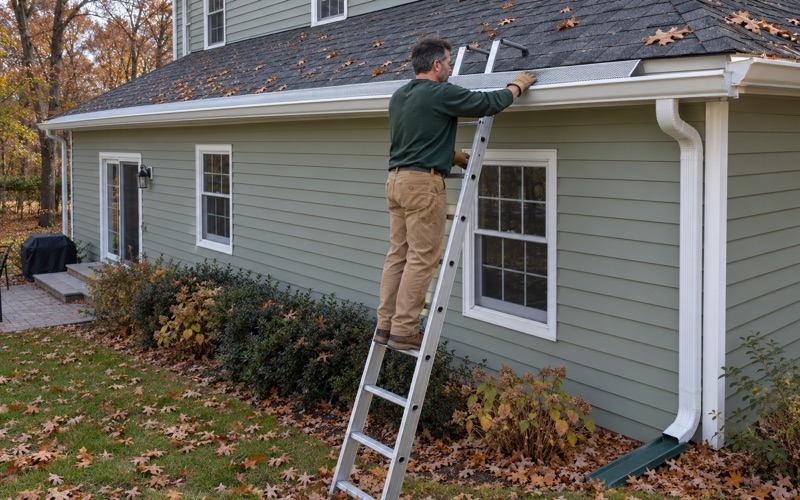
Because removal is regulated, most Warren owners live with the trees they have, and guards do much of the work. We choose guards by what falls on the roof: pine needles slip through screens that stop oak leaves, so a lot with conifers usually needs stainless steel micro-mesh, while a broadleaf canopy can take a coarser screen.
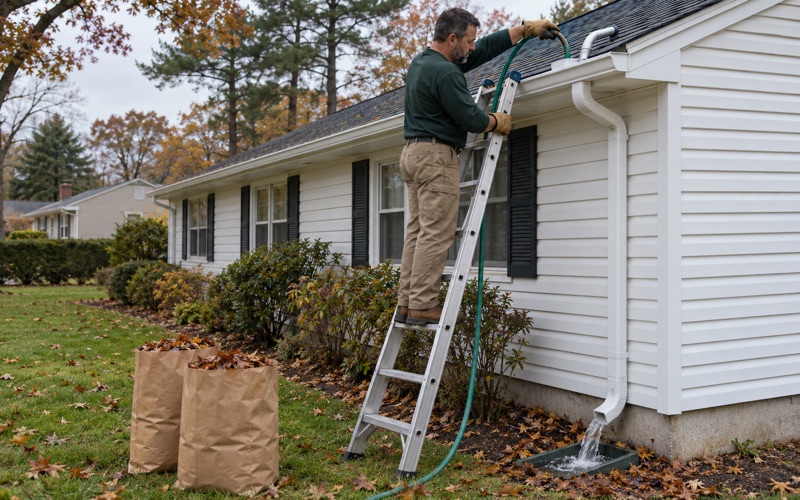
Guards reduce cleanings rather than end them. On our cleaning visits we flush every downspout, bag the debris and haul it away instead of leaving piles on the lawn or at the curb, and we send before-and-after photos so an owner who travels or works long hours can see what was done.
Townhome Gutters at Fairview at Warren
Not every Warren home sits on a big lot. Fairview at Warren has 115 townhomes in 22 buildings, and the builder’s brochure lists association duties such as common-area insurance, landscaping, snow removal, trash pickup, and pump station and basin maintenance. Roofs and home exteriors are not on that list.
Who maintains a unit’s gutters there depends on the community’s declaration, which we read or ask the management office about before any work begins. That way an owner knows whether a sagging run is their bill or the association’s before we quote it, and the estimate shows new gutters and repairs on separate lines because New Jersey taxes them differently.
- 20+ Years on Gutters
- Seamless, Formed On Site
- Before-and-After Photos