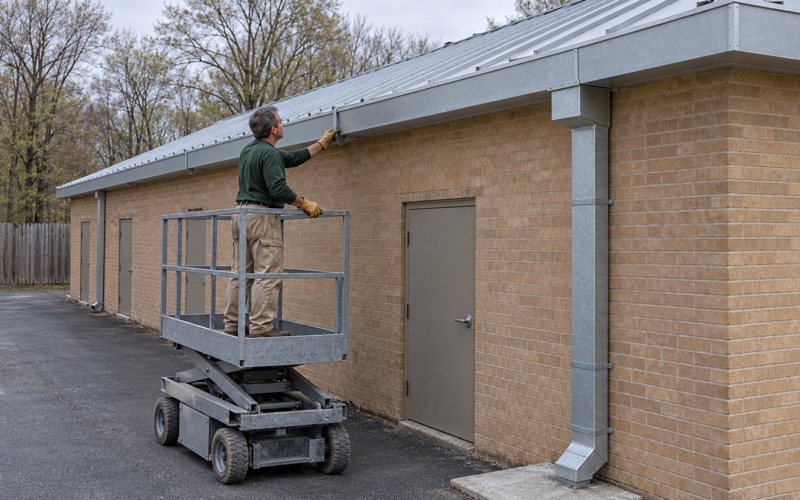
Middletown Quality Gutters brings more than 20 years of work to gutters in Weehawken, and the first question we ask on a job here is not about color, profile or price. It is about where the roof’s water goes once it leaves the downspout. In this township, that answer can decide whether a hard storm ends quietly or ends with water on a basement floor.
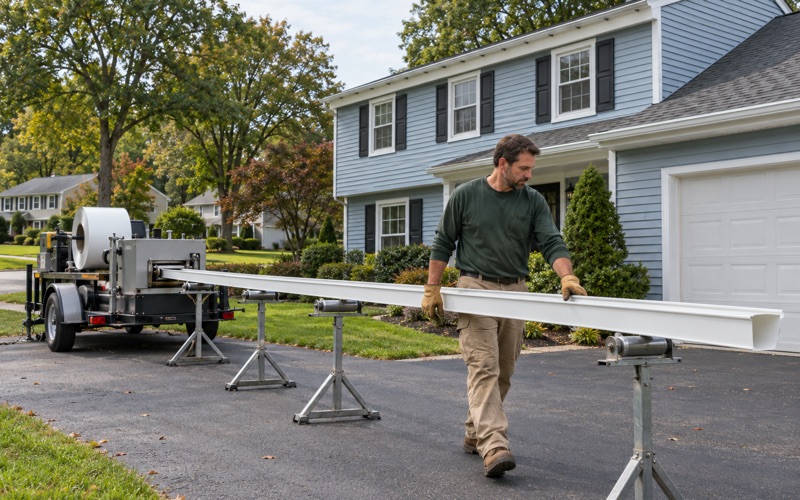
So we start every visit at the outlets. We size each gutter and downspout to the roof area that actually drains into it, form seamless runs on site from coil so each side of the house gets one piece, and follow every leader to the spot where its water lands before we price anything. The estimate then names where each outlet will discharge.
That outlet-first habit matters more here than in most places we work. The sections below explain how the local sewer handles rain, what the current sewer project on Boulevard East is meant to fix, and how all of it shapes the way we handle leaders, cleaning and repairs on the buildings you own, live in or rent out.
Gutters and Leaders in a Combined Sewer Town
One Pipe for Rain and Sewage
Weehawken drains to a combined sewer run by the North Hudson Sewerage Authority, an agency the township helped create in 1988 as the Tri-City Sewerage Authority. NHSA’s own explanation is plain: a combined system collects rainwater runoff, domestic sewage and industrial wastewater into one pipe. Its public diagram even draws a building downspout feeding that same pipe.
The authority operates 107 miles of combined sewers, 16 overflow regulators and 10 overflow outfalls with solids and floatables treatment. In ordinary weather the flow is carried to a treatment plant such as the River Road facility. When heavy rain exceeds what the pipes can hold, NHSA says untreated stormwater and wastewater discharge directly to nearby rivers and other waterbodies.
Why Every Leader Outlet Gets Traced
Some older buildings have leaders that disappear into the ground or into a wall, while others shed roof water onto a sidewalk, an areaway or a rear yard. Nobody can tell which from the street, and many owners have never checked, so we trace each one on the first visit. Knowing the outlet is the start of every recommendation we make.
We never tie a new leader outlet into the sewer lateral, and our written estimate says where each downspout will discharge. Where an existing leader already runs underground, we tell you what we found and leave the connection decision with you and the township, rather than guessing at a rule nobody has shown us. New gutters and repair work appear on separate lines, because New Jersey taxes them differently.
What Gutters Change and What They Do Not
Gutters do not create sewer overflows by themselves, and no published figure ties Weehawken’s roofs to overflow volume. What a gutter system does control is timing and placement: whether roof water reaches its outlet steadily, spills over a clogged run onto the front steps, or lands where it can soak toward a foundation wall.
That is why sizing comes before style. A run that overflows in every downpour dumps its water at the wall line, the last place an old foundation needs it. Matching gutter width and downspout count to the roof area behind each run keeps the water inside the system until it reaches an outlet chosen on purpose rather than one chosen by gravity and a clog.
Looking for gutters closer to Middlesex? See Middlesex Gutters.
Basement Flooding and Where Your Downspouts Go
Streets and Basements in Heavy Rain
NHSA describes the township’s problem in its own words: frequent flooding of streets and basements in Weehawken. On a block whose combined sewer backs up in heavy rain, every downspout tied into that sewer adds to the load at the moment the pipe has the least room to spare. That is a sewer problem first, but roof water is part of what fills the pipe.
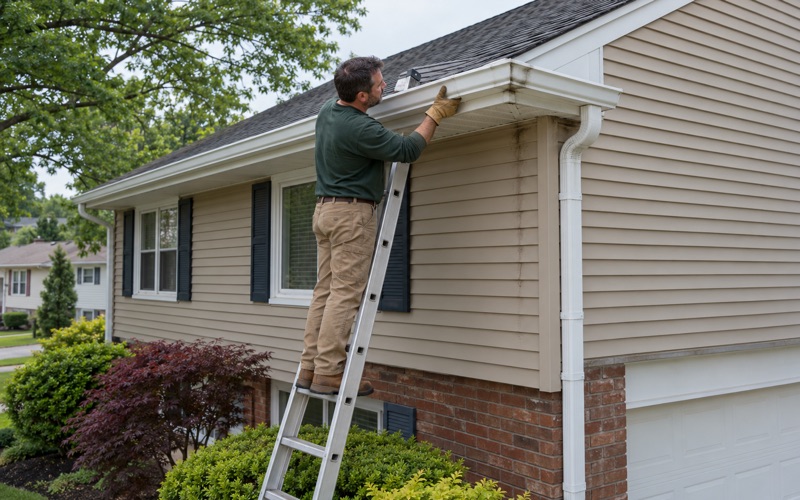
We cannot fix a street sewer from a ladder. What we can do is make sure your gutters are not adding avoidable trouble on top of it: runs that sag and hold water, seams that leak behind the fascia, or outlets that empty against the wall directly above a basement window. Each of those is visible on a walk-around, and each has a direct fix.
Areaways, Stairwells and Basement Windows
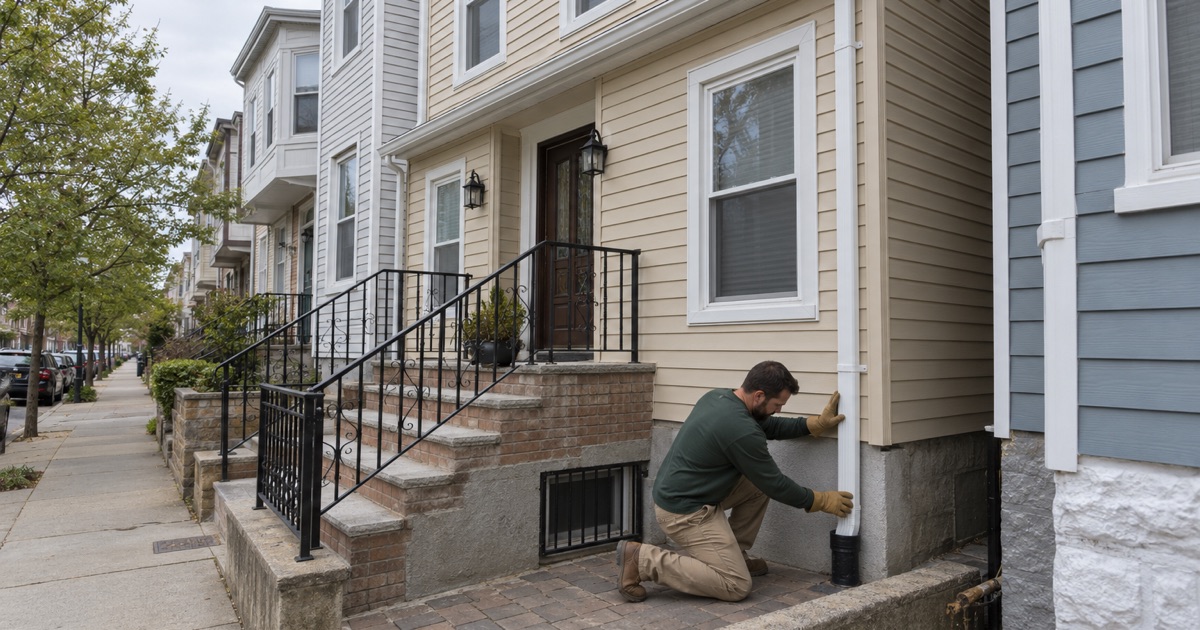
On buildings that shed roof water to grade, the downspout outlet decides where that water goes next. A leader ending at the top of an areaway or beside an exterior basement stair sends a storm’s worth of roof water straight down to the lowest point on the property. We look for that pattern at the front and rear of every building we quote.
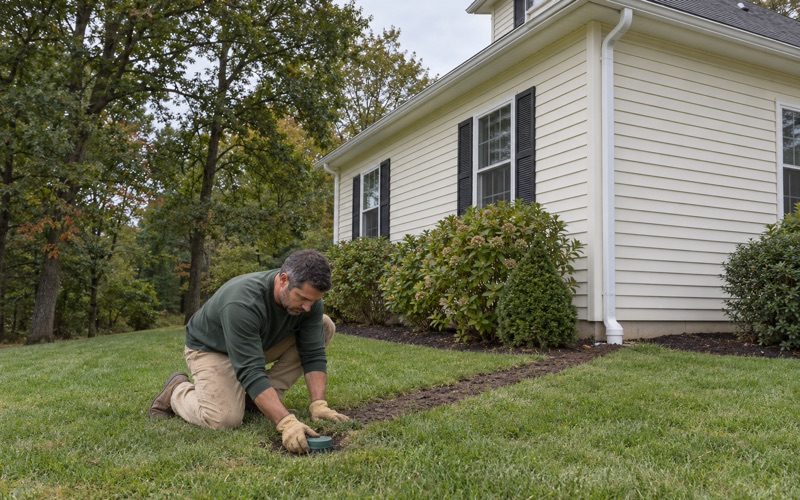
Where there is room, we propose an extension, a pop-up drainage emitter or a drywell to move the water off the wall. Our target is the grade standard in the 2021 New Jersey edition of the residential code, a fall of 6 inches within the first 10 feet from the foundation. On a tight, paved lot, the fix may be moving an outlet or splitting a long run so less water reaches one corner.
Fascia Rot and Leaking Joints
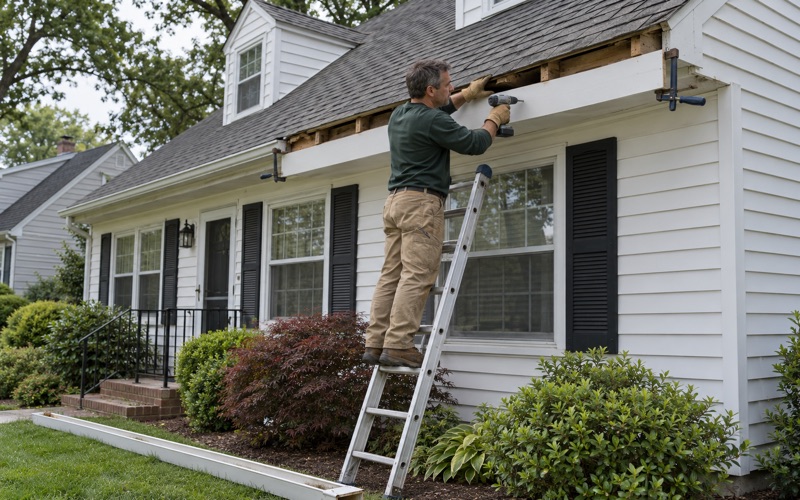
Water that never reaches the downspout is the other path toward a basement. A seam that drips behind the gutter wets the fascia and the wall below it, and on a prewar wall that water follows the building down. Before new gutters go up, we check the fascia for rot and show you any soft wood before we replace it.
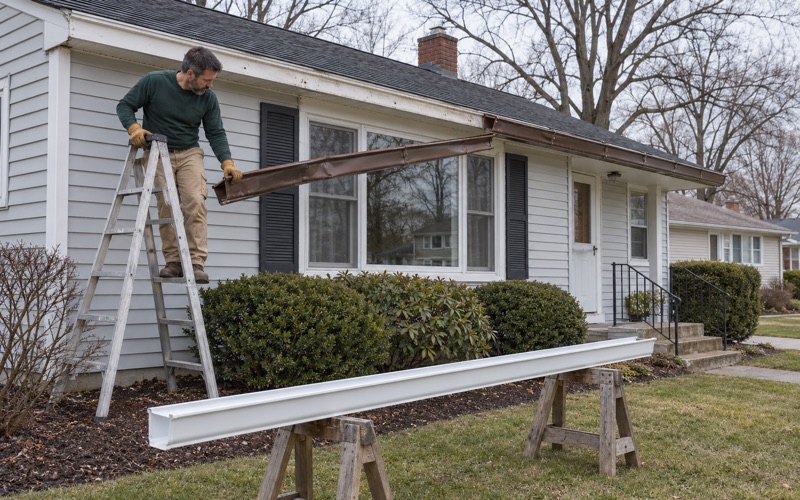
Our seamless runs are formed in one piece per run, so the only joints left are the corners and the outlets. Corners are cut as box, strip or bay miters to fit the building, sealed with tripolymer gutter sealant, and the outlets are wide-flange so a heavy flow drops into the leader instead of backing up along the trough and over the front lip.
The Boulevard East and Hamilton Avenue Sewer Work
What NHSA Is Rebuilding
NHSA’s Weehawken Infrastructure Project, part of its long-term control plan for combined sewer overflows, has one stated main objective: to tackle flooding problems in Weehawken. The work upgrades portions of the combined sewer on Boulevard East, Highwood Avenue, Hudson Place and Hamilton Avenue, and it adds a new underground pump station at a site on Highwood Avenue.
A December 2023 township update reported the 48-inch combined sewer on Boulevard East finished and the Hamilton Avenue phase making slow progress because of bedrock. We have not seen a completion date confirmed since early 2024, so we do not treat the flooding question as settled for any block, and we plan every outlet as though the street sewer can still back up.
An Old System Beyond One Project
The age of the system shows elsewhere too. In late 2021 NHSA closed a $499,946 loan with the New Jersey Water Bank to repair the W1234 overflow outfall, a 72-inch brick pipe running from Weehawken to the Hudson River, after an internal inspection found a high level of deterioration at its crown. The repair used cured-in-place and geopolymer lining.
NHSA calls combined sewers normal in older urban areas like Hudson County, where sewer infrastructure can date from the Civil War. Roof drainage on many local buildings sits on a similar timeline, which is why we treat an old leader run as something to inspect rather than something to assume. A cracked underground leader can hide for decades.
What the Sewer Work Means for Your Gutters
While sewer work continues on nearby streets, the practical move for an owner is to control what is on the building. Keep gutters clear so water reaches the downspouts, keep outlets aimed away from stairwells and windows, and learn which of your leaders, if any, run into the ground. Those three steps cost little and remove the most common surprises.
If you are planning a full replacement, we can lay out the new runs and the outlet plan together, so each downspout’s discharge point is decided before the coil is formed. We photograph every outlet before and after the work, which leaves you a record of where your roof water now goes, useful for a tenant question or a future sale.
Two- and Three-Family Houses Below and Above the Cliff
An Old, Small-Multifamily Housing Stock
Weehawken sits on the Hudson Palisades and the waterfront below them, and its housing is old. Census estimates count 3,628 of the township’s 9,563 housing units as built 1939 or earlier, and 2,609 units sit in buildings of two to four units. Prewar two- and three-family houses are the buildings where leader outlets most often go unchecked.
Roughly seven of every ten households rent, so the gutter decision on a two-family or three-family house usually falls to an owner-landlord who may not live under that roof edge. Our before-and-after photos with every cleaning and repair let an owner see the work without climbing. In condominium buildings, we check the master deed or management office first so you know who is responsible.
Copper, Half-Round and Matching the Building
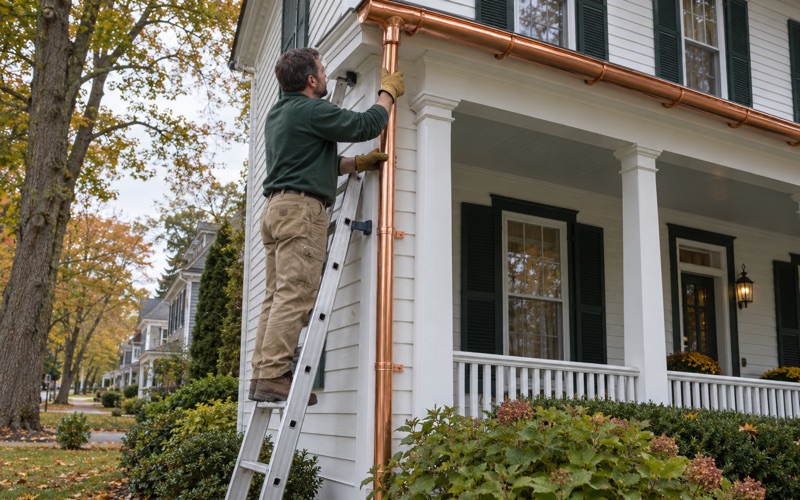
A prewar facade does not always suit standard K-style. We match copper and half-round work to the age and style of the house, using half-round gutters with a double-bead profile or 16-ounce copper gutters where the building calls for it, and 6-inch K-style seamless gutters with 3x4 downspouts where capacity matters most on a deep roof.
More than half of the township’s units were built before 1970, so painted fascia and trim often fall under the EPA Renovation, Repair and Painting rule for pre-1978 housing, and we plan the work around it. Hidden hangers, rather than spike and ferrule, hold each run tight to the board without splitting old wood or loosening over a few winters.
Gutter Cleaning Before Heavy Rain
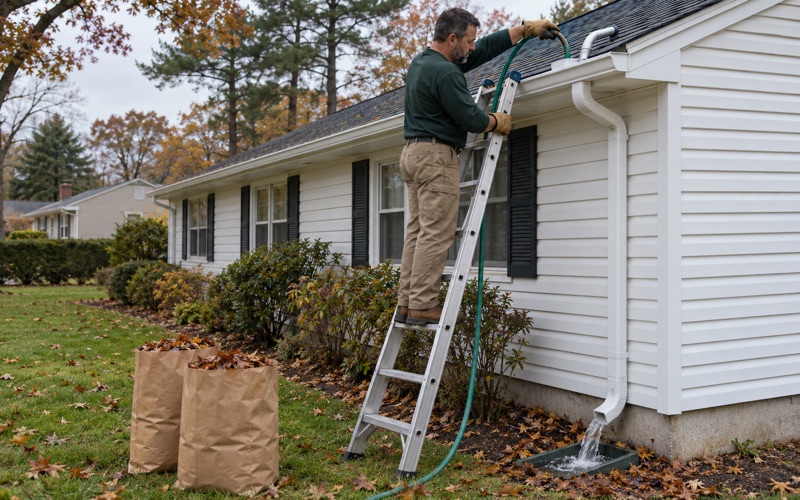
A clogged gutter on a combined sewer street does two kinds of harm: it spills roof water at the wall line during the storm, and it lets leaves and grit ride down the leader when it finally clears. Our cleaning visits flush every downspout, bag the debris and carry it away, so nothing is left on the stoop, the lawn or the curb.
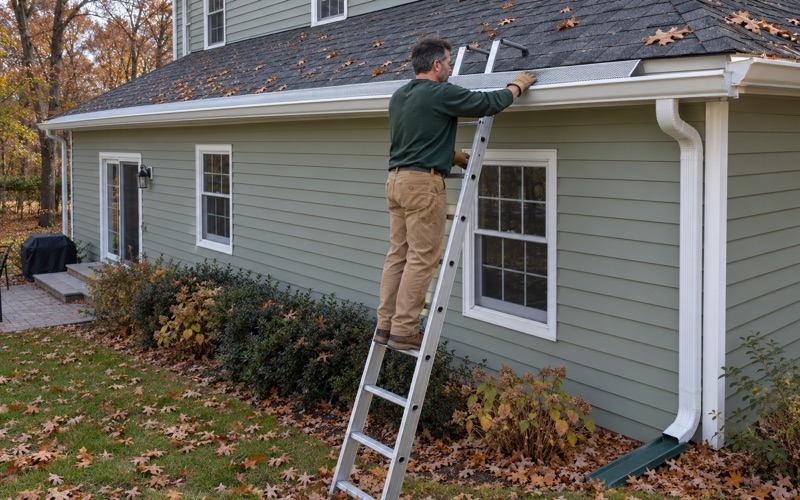
Guards are matched to the trees over the lot, because pine needles and oak leaves call for different screens, and stainless steel micro-mesh suits the finest debris. For most owners, though, a cleaning booked ahead of a stretch of forecast heavy rain is the cheapest protection available, and it keeps each leader carrying water where we agreed it should go.
- 20+ Years on Gutters
- Seamless, Formed On Site
- Before-and-After Photos